

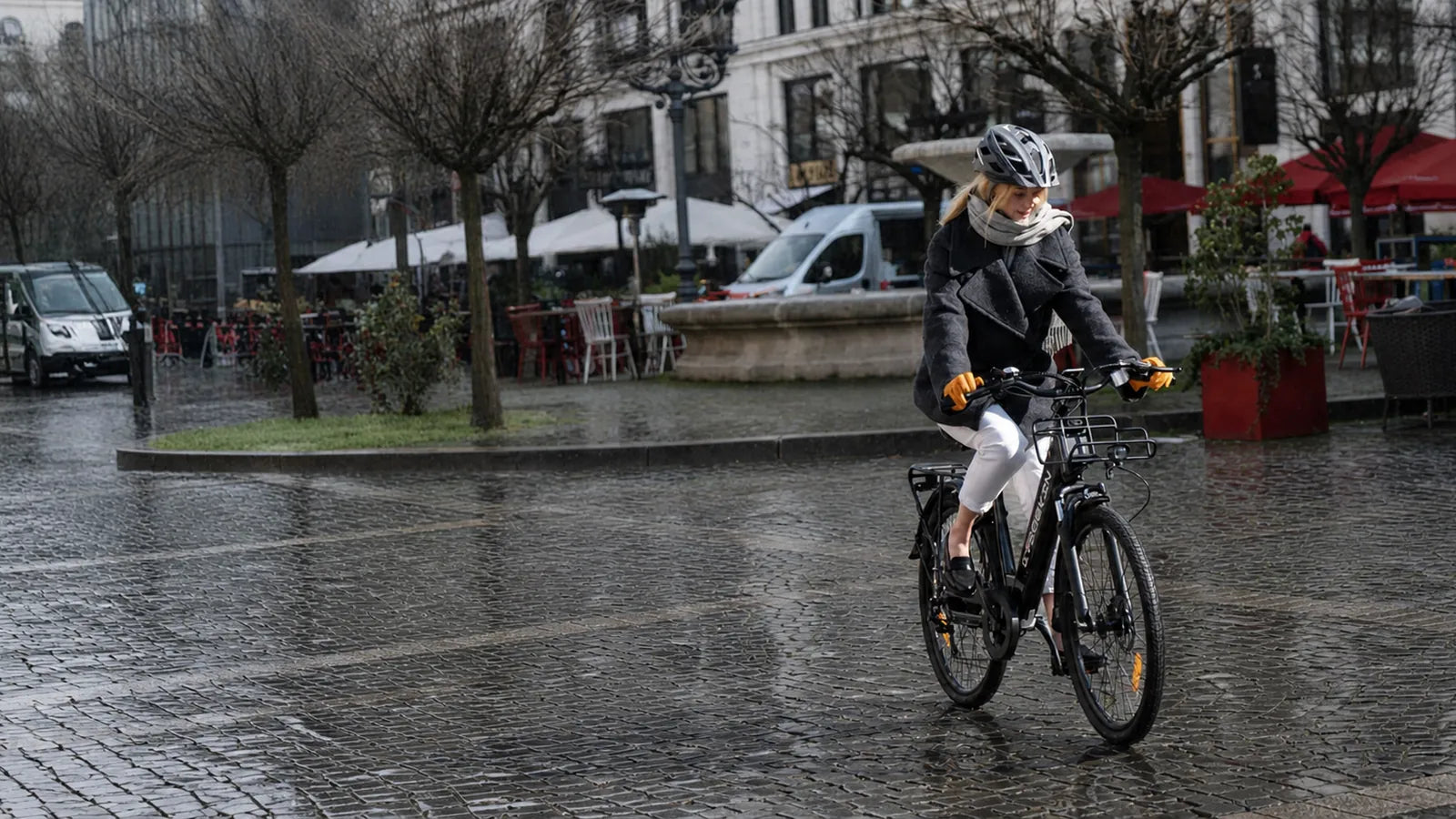
A calm riding style, greater braking distance, and a dry check after the ride are important. “Water-resistant” and “waterproof” are not the same: Without a published IP rating, an e-bike should neither be left in the rain for extended periods nor cleaned with a strong water jet.
The short answer for the road
Before the ride
Check the lights, tires, brakes, and visible connectors. The manufacturer’s instructions remain authoritative.
On wet roads
Reduce your speed, increase your following distance, brake smoothly, and avoid puddles of unknown depth.
After the ride
Switch off the bike, wipe the surfaces dry, remove splashed water and dirt, and only charge it once dry.
Water-resistant does not automatically mean waterproof
An e-bike combines mechanical parts, electrical contacts, and a lithium-ion battery. Many components are designed for normal everyday use and splashing water, but this does not constitute blanket approval for heavy rain, standing water, or high-pressure cleaning.
The Cyseekin product pages currently reviewed for C10 and S10 do not specify an IP rating. Therefore, no specific level of water resistance is promised here. For your own model, follow the supplied manual and the support team’s instructions.
| Situation | Appropriate response | What should be avoided |
|---|---|---|
| Light rain during the ride | Continue riding if you can remain in control of the brakes, visibility, and road surface. | Continue riding as you would on a dry road. |
| Heavy rain or thunderstorms | Head for a sheltered place and reassess the weather conditions. | Ride through deep water or ignore visibility problems. |
| Bike wet after the ride | Switch it off, dry it, and store it in a ventilated, protected place. | Do not pack it while wet, charge it immediately, or dry it with hot air. |
| Suspected water in the battery or connector | Do not charge or switch it on; use the manual and contact support. | Do not open the housing or test its condition by switching it on repeatedly. |
Before riding in the rain: five calm checks
- Check the brakes while stationary. Both levers must respond clearly. After a longer period of storage, carry out a short test at low speed.
- Inspect the tires. Tread, visible damage, and the pressure specified for the particular model are more important on wet roads than achieving the highest possible pressure.
- Switch on the lights. Rain often reduces contrast and visibility even during the day. The headlight and rear light must not be covered by luggage or clothing.
- Check the battery and display. The battery must be properly locked in place; covers and plugs must not be loose, damaged, or already damp.
- Choose clothing without loose ends. A rain jacket and reflective details help, but loose straps must not get caught in the wheel, chain, or brake.

How wet conditions change riding
Braking distance and corners
Wet roads, leaves, road markings, and metal surfaces can reduce traction. Anticipatory riding creates time: brake earlier, apply both brakes in a controlled manner, and reduce your lean angle when cornering. Even a good tire cannot turn slippery road markings into dry asphalt.
Puddles and curbs
If the surface is not visible, its depth is unknown as well. Riding around it slowly is usually the better choice. Water can conceal a pothole; moreover, neither the motor nor the battery is approved for submersion unless the manufacturer has expressly confirmed this.
Display and controls
Improvised plastic covers must not obstruct brake levers, switches, visibility, or steering. Weather protection accessories must be compatible with the respective display and must not block any operating function. If the display is fogged up or has failed, end the ride if important information or safe operation is unavailable.
The ten-minute routine after your ride
- Switch off the e-bike and park it in a protected place. A ventilated, dry location is better than an airtight cover over a wet bike.
- Wipe off water with a soft cloth. Wipe the display, battery surface, frame, and light housings only from the outside.
- Remove dirt without pressure. A damp cloth or soft brush is often sufficient. Bosch expressly warns against steam cleaners and high-pressure cleaners for its systems; for Cyseekin, follow the relevant user manual.
- Inspect the drivetrain. Gently remove sand and road dirt. Apply lubricant sparingly to the designated chain only—never to brake discs or pads.
- Allow it to dry completely before charging. The charging port, charger, and surrounding area must be dry and undamaged.
What does this mean for the C10 and S10?
When C10 and S10 According to the current product pages, the batteries are removable and lockable. This does not mean they must be removed after every ride in the rain. What matters is whether the manual calls for removal, whether the bike and contacts are dry on the outside, and whether the battery is then stored safely.
The relevant model manuals are compiled on the User Manuals & Assembly Videos page. Before your first ride in bad weather, check there which care and usage instructions apply to your specific model.
Model-specific guidance instead of blanket promises
Product data and manuals may change. Before riding, therefore, check the current model page against the relevant user manual.
FAQ: E-Bikes in the Rain
Can I ride the e-bike in the rain?
This is possible if the manual for the specific model does not rule it out and the brakes, tires, lights, and electrical components are undamaged. Speed and following distance must be adjusted to visibility and road conditions. Heavy rain, flooding, and deep water are not a normal splash-water situation.
Can I charge the e-bike battery immediately after riding in the rain?
Only if the battery, charging port, charger, and surrounding area are completely dry and undamaged. If there is moisture in the connection, an unusual smell, heat, or visible damage, do not charge the battery and contact Support.
Should the battery be removed after every wet ride?
Not as a general rule. It depends on the model, the manual, and where it is stored. If the battery is removed, its external surfaces and contacts must be dry, and the battery must not be dropped or stored in a hot or damp place.
Can I clean an e-bike with a garden hose?
Avoid strong water jets and steam or pressure washers. Water can be forced into bearings, connections, and electrical components. For the specific bike, follow the cleaning instructions in the manufacturer’s manual.
What should I do if the battery was left out in the rain overnight?
Do not charge, open, or test by switching it on if water ingress is possible. Leave the battery in a safe place away from flammable materials and contact the manufacturer’s Support team or a qualified specialist, providing the model designation and photos.
Is the Cyseekin C10 or S10 waterproof?
The public product pages reviewed on August 20, 2026 do not specify an IP rating for the complete C10 or S10. Therefore, no general assumption of water resistance should be made. The current user manual and written information from Support are authoritative.
Sources and test basis
- Cyseekin C10 product page and Cyseekin S10 product page – battery and equipment specifications; no published IP rating on the pages reviewed, accessed on August 20, 2026.
- Cyseekin User Manuals & Assembly Videos – model-specific instructions, accessed on August 20, 2026.
- Bosch eBike Systems: Caring for your eBike – warning against steam and pressure washers. This statement applies to Bosch systems and is mentioned here only as an example from a manufacturer, accessed on August 20, 2026.
- ADFC Munich: Cycling in wet conditions – distance, braking distance, and slippery surfaces, accessed on August 20, 2026.
- Reddit discussion from July 29, 2026 and discussion from July 10, 2026 – for identifying frequently asked user questions only, not as technical sources.
Share:
Carry an E-Bike Up the Stairs: How to Assess Weight, Grip, and Route
Taking an E-Bike on the Train: Planning Your Ticket, Battery, and Folding Bike Properly