

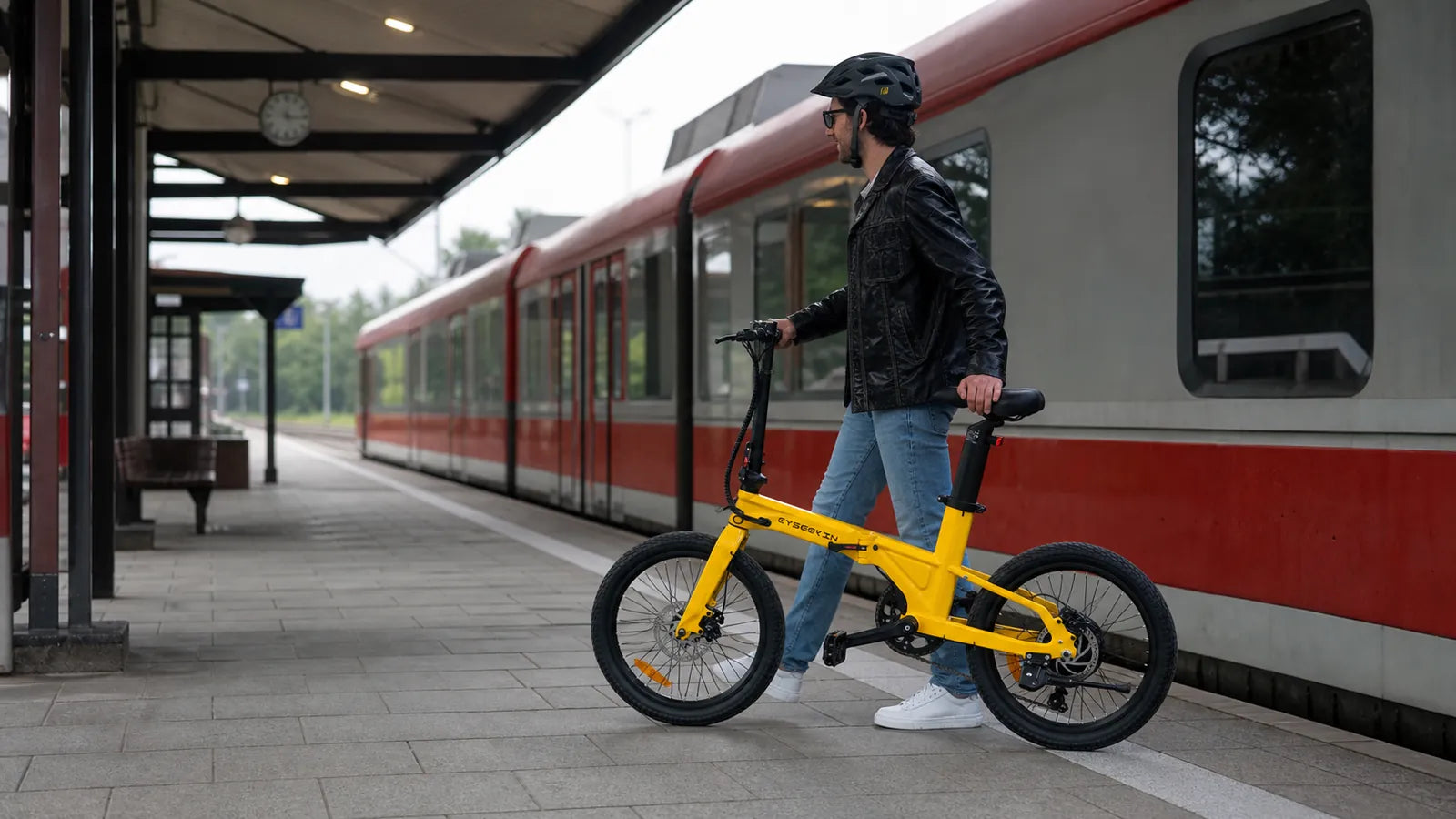
Tickets, reservations, and battery requirements depend on the train type, transport association, and connection. That is why the decision should not be made only at the platform: the connection, space reservation, folded dimensions, elevators, and transfer time should all be included in the same check before the journey.
The decision in three steps
1. Folded or roadworthy?
This determines whether the bike is treated as luggage or as a bicycle.
2. Which train?
Long-distance services, regional trains, and transport associations may require different tickets and reservations.
3. Is the route suitable?
Weight, folded dimensions, stairs, elevators, and short transfers determine practical feasibility.
Standard e-bike or folded folding bike?
| Option | With Deutsche Bahn | Check before departure |
|---|---|---|
| Roadworthy pedelec up to 25 km/h | Generally permitted as a bicycle if it fits in the designated holder. | Bicycle ticket, space reservation, tire width, train type, and capacity. |
| Folded bicycle | DB describes a fully folded bicycle as free hand luggage, provided it is safely stowed like luggage. | Actual packed dimensions, weight, bag or strap, and sufficient luggage space. |
| Partially folded e-bike | It cannot safely be assumed to count as luggage; it may still be treated as a bicycle. | Fully close the folding mechanism and check the operator’s rules in writing. |
| International connection | Additional operator- and country-specific rules may apply. | Check every participating operator, the dimensions, and the reservation separately. |
Understanding tickets and reservations correctly
Long-distance transport
For a roadworthy bicycle on DB long-distance services, a bicycle ticket and a reserved space are generally required. The number of spaces is limited. Having a ticket is therefore worth more than hoping to find a place spontaneously.
Regional transport
In regional transport, times, prices, and bicycle transport rules vary depending on the federal state and transport association. Some offers allow bicycles to be taken along at certain times, while others require an additional bicycle ticket. The timetable information and the conditions of the responsible transport association should be checked together.
Folded bike as luggage
DB states that no bicycle ticket or space reservation is required for fully folded bikes. However, the bike must be stored like luggage. Doors, aisles, escape routes, fire extinguishers, and wheelchair spaces must remain clear; a bike must not shift or endanger other passengers.

The battery requires a separate rules check
For a road-ready e-bike on DB long-distance services, the railway currently states that the battery must remain firmly mounted throughout the journey. This should not be interpreted as a blanket rule for every folding e-bike, regional train, or foreign operator.
A battery is not removed spontaneously on the platform just because doing so makes the bike lighter. The operator’s rules and the user manual are decisive. Charging on the train should not be assumed either: power outlets are not an approved charging location for every e-bike system.
What does this mean for the Cyseekin C10?
According to the product page, the current Cyseekin C10 weighs 18.6 kg including the battery and measures 815 × 400 × 690 mm when folded. It has folding pedals and a removable, lockable battery. These figures help with planning but do not guarantee that the bike can be carried on board.
The 18.6 kg must be manageable when being carried over stairs, platform gaps, and possibly longer distances. An elevator may be too small or out of service. On a connection with only a few minutes to change trains, a compact bike does not automatically become light luggage.
For DB–ÖBB cooperation trains, DB gives dimensions such as 90 × 60 × 40 cm for folded bikes and scooters in international traffic. The C10 measures 81.5 × 40 × 69 cm when folded and therefore exceeds one of the stated dimensions. For such connections, you should not assume that luggage transport is permitted without explicit confirmation.
The checklist for the day of travel
- Open the connection again. Check the train number, operator, carriage formation, cancellations, and reserved bicycle space.
- Check access to the station. Plan for elevators, stairs, construction work, and sufficient transfer time.
- Remove or secure loose parts. Bags, bottles, and accessories must not fall off while being carried or stowed.
- Fully close the folding mechanism. Lock the joint, pedals, and steering column according to the instructions; a bag protects other pieces of luggage and passengers.
- Stand by the correct carriage early. Boarding with an e-bike requires more space and time than boarding with a suitcase.
- Follow staff instructions on the train. Secure the bike or luggage so that doors, aisles, and safety equipment remain clear.
When the train journey is poorly planned
A journey with several tight connections, no reservable bicycle space, and unknown elevators is risky despite having a folding bike. The same applies if the bike cannot be lifted independently or stowed securely. In that case, an earlier connection, a direct connection, or a different travel day is often the better solution.
Compare the folded dimensions and model before booking
The current product page provides the dimensions and weight; the transport rules always come from the operator of the specific connection.
FAQ about taking an e-bike on the train
Does an e-bike always require a bicycle ticket on the train?
A road-ready pedelec is generally treated as a bicycle; the required ticket and reservation depend on the train and fare. At DB, a fully folded folding bike may qualify as free hand luggage if it is safely stowed like luggage. Other operators may have different rules.
Can I remove the battery before boarding?
Not as a general rule. For road-ready e-bikes on DB long-distance services, Deutsche Bahn currently specifies that the battery must remain permanently mounted during the journey. For a folded e-bike or other operators, check the specific transport rules and the manufacturer’s instructions.
Can I charge my e-bike on the train?
An available power outlet does not automatically mean charging is permitted. Without the operator’s explicit permission and a suitable, safe charging location, the battery must not be charged on the train. Damaged or damp batteries and chargers must never be connected.
Does a reserved bicycle space guarantee that the bike can be taken if the train changes?
If the timetable changes, a different train type may have fewer bicycle spaces or spaces arranged differently. The reservation and connection should be checked again shortly before departure. In the event of changes, Deutsche Bahn or the respective operator can help clarify the situation.
Does the Cyseekin C10 fit as luggage on every train?
No. The folded dimensions of 81.5 × 40 × 69 cm and the weight of 18.6 kg must be checked against the operator’s rules and the available luggage space. Some international connections have fixed maximum dimensions that the C10 does not meet on every side.
What happens if the train is very crowded?
Safety and keeping passageways clear come first. Without usable bicycle or luggage space, taking the bike may be restricted despite prior planning. Booking early, travelling outside peak times and choosing a connection with sufficient transfer time reduce this risk.
Sources and review status
- Deutsche Bahn: Taking folding bikes on trains – folded as hand luggage, secure storage, accessed on 20 August 2026.
- Deutsche Bahn: Which bicycles can I take with me? – pedelecs up to 25 km/h, folding bikes and rack widths, accessed on 20 August 2026.
- Deutsche Bahn: Taking bicycles on trains and bicycle tickets – long-distance and regional services, accessed on 20 August 2026.
- Deutsche Bahn: Bicycles on long-distance services – FAQ – bicycle space and battery requirements, accessed on 20 August 2026.
- Deutsche Bahn: Luggage on trains – folding bikes and example dimensions for DB-ÖBB cooperation trains, accessed on 20 August 2026.
- Cyseekin C10 product page – weight, folded dimensions, battery and folding function, accessed on 20 August 2026.
- Reddit discussion dated 10 March 2026 and discussion dated 27 July 2026 – for identifying common user problems only, not as a source of transport information.
Share:
Riding an E-Bike in the Rain: Protection for the Battery, Display, and Brakes
Charging the e-bike battery: What is the correct sequence for the C10?