

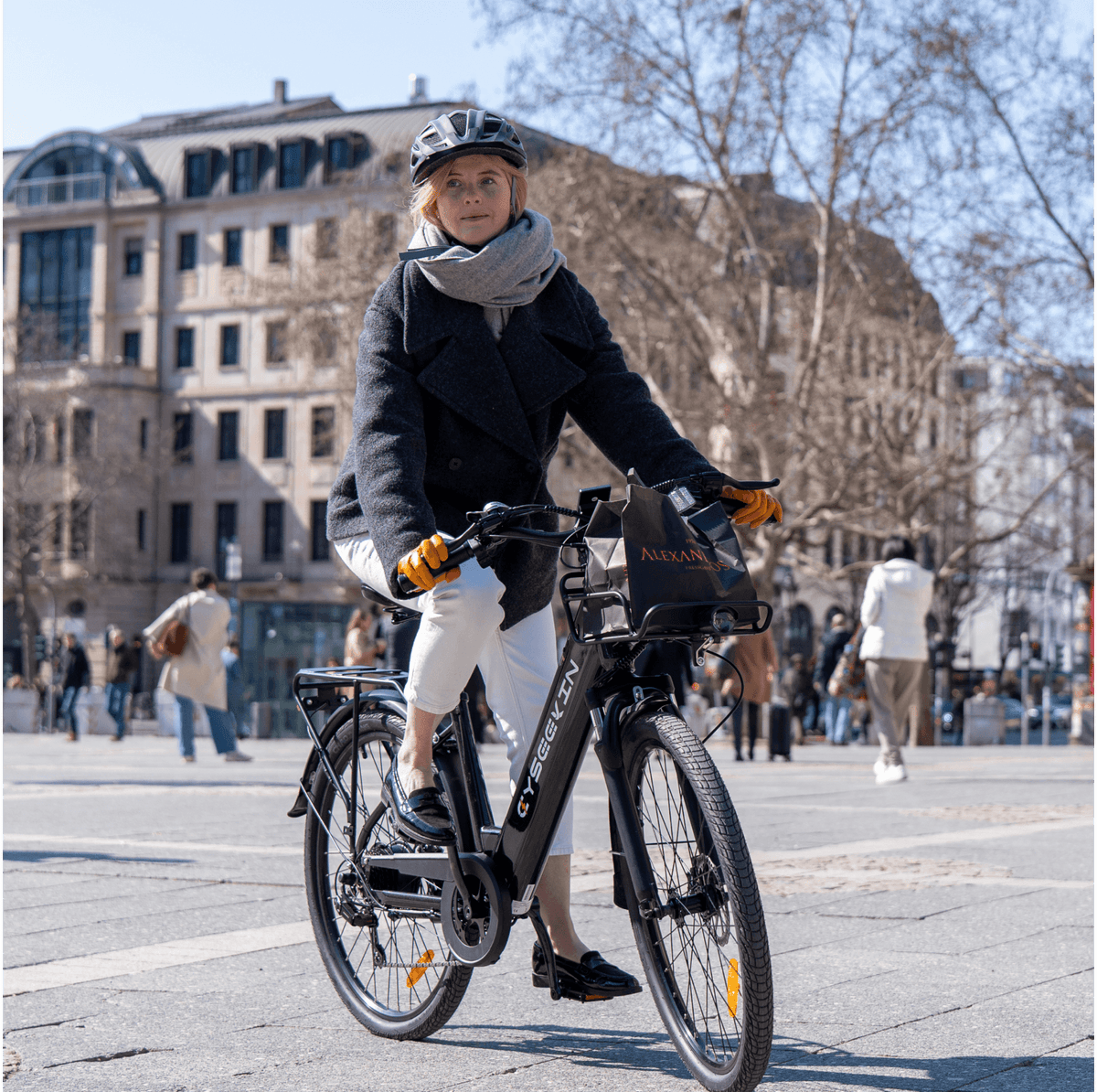
An e-bike for shopping needs to do more than carry a basket. A practical luggage rack, suitable load capacity, controllable handling, and a storage location where you can safely manoeuvre and park the loaded bike are all essential. The Cyseekin S10 already comes with a front basket and luggage rack. Compared with other city e-bikes, however, it is not the number of add-on components that matters, but whether the entire bike suits your usual shopping, routes, and storage conditions.
What does an e-bike need to handle shopping?
Start with your actual shopping routine rather than with the longest possible equipment list. If you ride a few kilometres to the supermarket several times a week, you need different reserves than for a large weekend shop over hilly terrain. Note the distance, surface, inclines, typical bags, and where the bike is stored at home.
Then check three limits separately: the permitted load of the entire bike, the load capacity of the individual luggage components, and the available space. A high total figure does not automatically mean that the front basket or luggage rack can be loaded as heavily as desired. For the S10, the product page states a maximum load capacity of 150 kg, including the rider and luggage. Separate load limits for the front basket and luggage rack are not specified there and must be clarified with the manufacturer before carrying a heavy load.
Front basket or luggage rack: What goes where?
A front basket is practical for lightweight items that you want to access quickly. However, a heavy or tall load around the handlebar area can noticeably affect steering and restrict your view of the front wheel. Bags must not protrude or get caught in cables or the wheel. Therefore, use the basket only within its confirmed load limit and secure the contents so that nothing shifts.
Depending on the approved system, the rear luggage rack is suitable for a basket or compatible panniers. Panniers can carry weight lower down and can often be removed after shopping. When doing so, check heel clearance, attachment, and the permitted load of the specific rack. The ADFC describes lighting, luggage racks, and mudguards as typical components of a practical city bike; nevertheless, whether a particular bag or basket fits must be checked on the individual bike.
S10 and other city e-bikes compared for shopping
| Criterion | Cyseekin S10 | Check other city e-bikes |
|---|---|---|
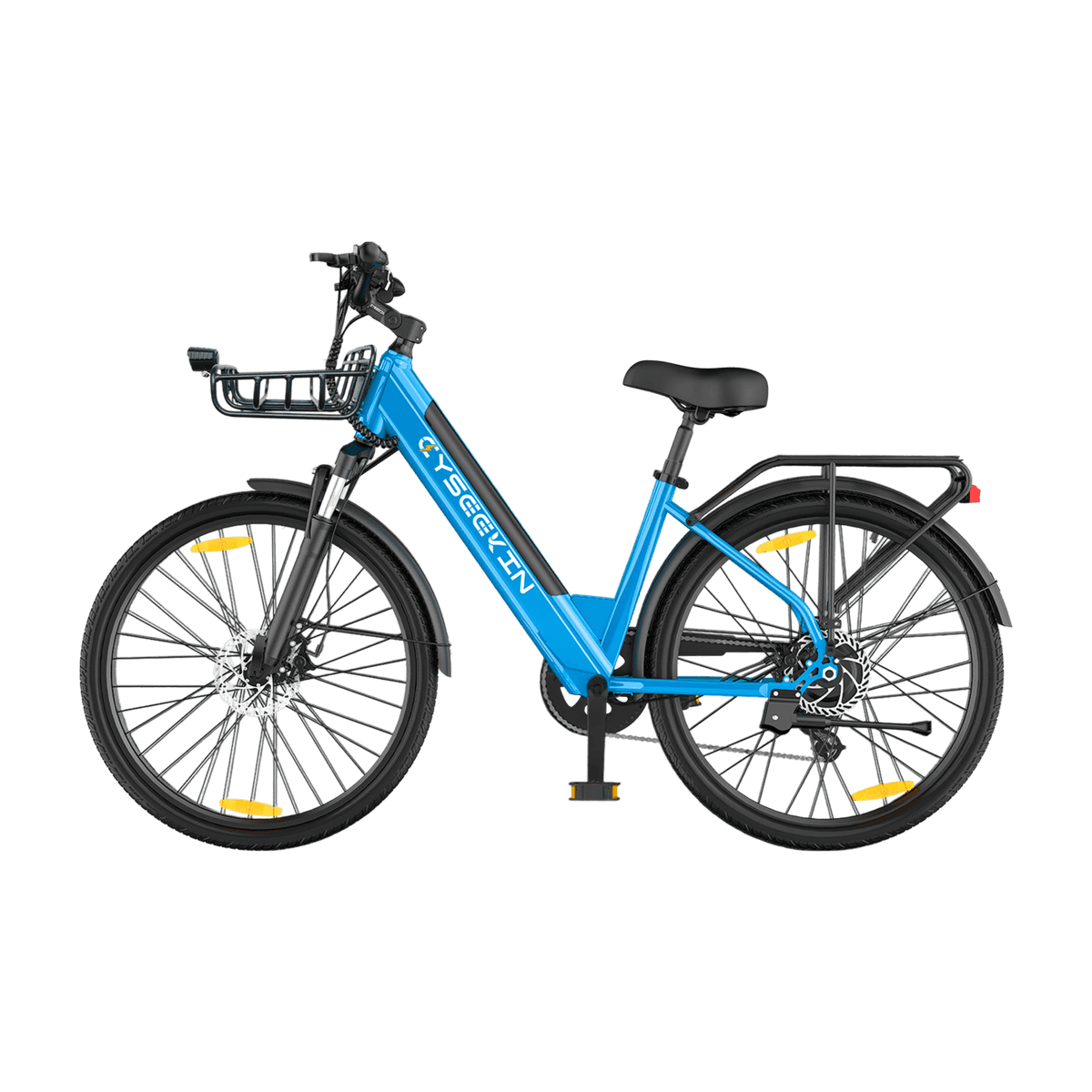
| Transport equipment | Front basket and luggage rack are listed as standard equipment. | Are racks, a basket, or bag holders included, available as retrofits, and approved for the intended load? |
| Load capacity | Maximum 150 kg combined for rider and luggage. | Is a total or system limit specified, and what individual limits apply to the racks? |
| Entry | Approximately 45 cm low step-through for frequent mounting and dismounting. | Does the frame design remain suitable when loaded for mobility, inseam length, and safe stopping? |
| Bike weight | 27.9 kg; this is relevant when carrying and maneuvering the bike. | Is a lighter bike more important because stairs, trains, or narrow basement doors are part of everyday life? |
| Drive system and battery | 250 W rear-wheel motor, up to 55 Nm, and 499.2 Wh. | How do the motor, gears, and battery perform with your actual load and route? |
| Everyday equipment | LED lighting, mudguards, kickstand, suspension fork, and Shimano 7-speed according to the product page. | Which parts are included, and what additional costs arise to achieve the desired fully equipped configuration? |
How much load capacity remains for shopping?
For the S10, the 150 kg refers to the combined weight of the rider and luggage. This value is not a luggage-only allowance. Therefore, do not weigh only your shopping; also include clothing, the lock, and permanently mounted accessories, insofar as the manufacturer counts them toward the relevant load. If the classification is unclear, ask support before buying.
The load limit is also not a target value for every ride. The more weight you carry, the more noticeably starting off, cornering, braking distance, and maneuvering can change. The ADFC electric bicycle buying guide recommends assessing weight distribution, permitted total weight, brakes, lowest gear, and assistance during a test ride. For a shopping bike, a test ride with a realistic, securely fastened load is more informative than a ride with an empty basket.
What changes when riding with luggage?
Load the bike as evenly as possible and keep heavy items low and securely fastened. After loading, start slowly and test steering and braking in a suitable, low-traffic area. If you find that the front wheel is difficult to steer, the rear sways, or bags touch your feet, the arrangement is not suitable for continuing the journey.
Even a powerful motor does not eliminate these limitations. The S10 combines a 48 V system with 499.2 Wh and up to 55 Nm of torque. These figures can help with your choice, but they do not replace a load and route test. Range and assistance depend, among other things, on weight, inclines, wind, temperature, tire pressure, and assistance level. The manufacturer's stated range of up to 100 km is therefore not a promise for a loaded shopping trip.
When is the S10 suitable for shopping?
The S10 is a plausible choice if you are looking for a fully equipped city e-bike, frequently get on and off, and want to use the basket and luggage rack without separate base retrofitting. The low step-through frame, 26-inch tires, and upright riding position are designed for comfortable everyday trips. Nevertheless, before buying, you should check your height and inseam, the actual bag attachment, and the limits of both racks.
The S10 is less suitable if you have to carry the bike up and down several flights of stairs every day. At 27.9 kg, it is not lightweight. A lighter urban e-bike may be more practical in this case, even if the basket and luggage rack need to be retrofitted.
For regularly transporting very large, heavy, or bulky loads, a cargo bike approved for this purpose may be more suitable. The ADFC points out that cargo bikes have dedicated loading areas, different designs, and altered cornering behavior. The S10 should not be treated like a cargo bike.
What points should you check before buying?
- How heavy and bulky is your typical shopping load?
- What load limits apply to the bike, front basket, and luggage rack individually?
- Do your bags fit securely with sufficient clearance from your feet, spokes, and brakes?
- Can you maneuver the bike at your storage location, or will you have to carry it?
- How does the model ride and brake with a realistic test load?
- Which parts are included as standard, and which would you need to purchase additionally?
Cyseekin S10 promotion notice
As of September 24, 2026. The “Back to Everyday Life” promotion offers the code ALLTAG100 for an additional €100 discount on one eligible individual e-bike. The promotion is valid only during the promotional period and for eligible products. Check the current price, eligibility, and successful application of the code in your cart before ordering.
Conclusion: Evaluate equipment and actual load together
The Cyseekin S10 provides a practical starting point for everyday trips and shopping, with a front basket, luggage rack, low step-through frame, and a maximum load capacity of 150 kg. However, its weight of 27.9 kg and the separately unpublished load limits of the two racks should also factor into your decision. Note your typical shopping load, clarify the component limits, and then compare a test ride with a lighter city e-bike or - if you need to transport larger loads - a suitable cargo bike.
Share:
E-bike with a low step-through frame and 26-inch wheels: Is the S10 a good fit?
E-bike: 36 V or 48 V? The S10 in a city e-bike comparison