

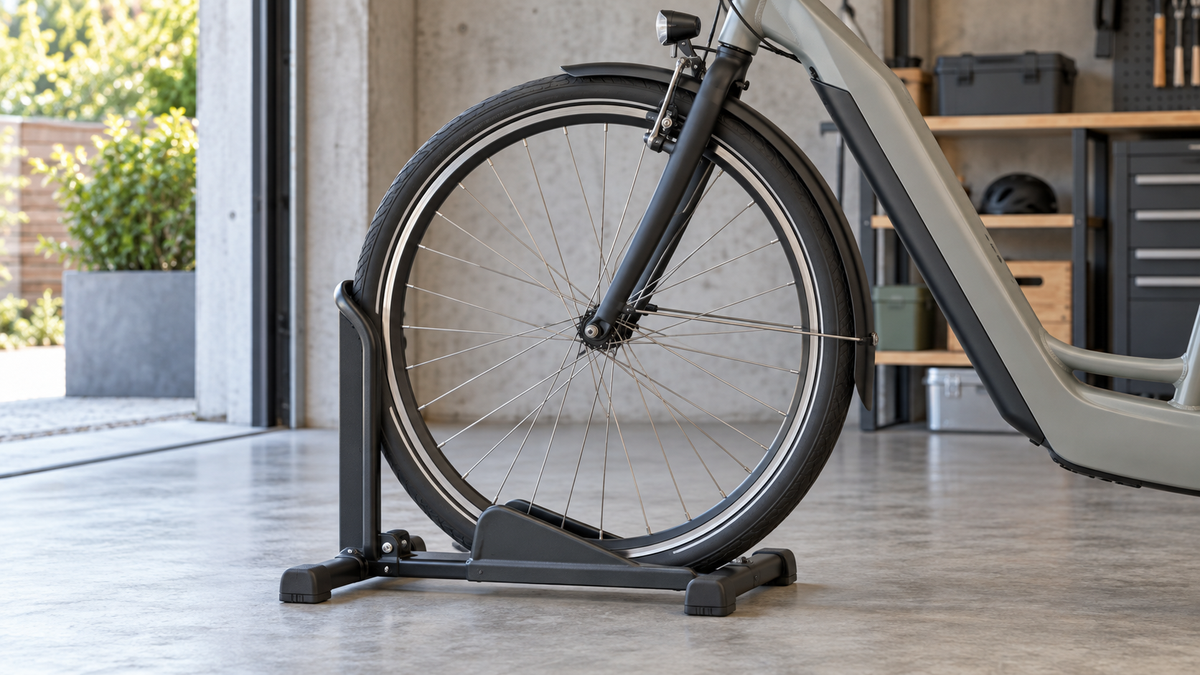
When choosing a bicycle floor stand, specifications such as “for 29 inches” or “suitable for e-bikes” are not enough. The key factors are the actual tire width, approved wheel sizes, permitted load, contact with fenders or brake components, and the floor at the storage location. An unsuitable stand may hold the bike at an angle, touch components, or tip over with a slight movement. Use this guide to check compatibility before buying and test that the bike is stable after setting it up.
Here, this means a freestanding floor stand for a home, basement, or garage, into which the front or rear wheel is placed. This article does not cover a kickstand mounted on the bicycle or a repair stand, and it does not replace the manufacturer’s instructions.
What is meant by a bicycle floor stand?
A floor stand stands on the ground independently of the bicycle and usually stabilizes one wheel. Depending on the design, the wheel is pushed into a channel, held by a bracket, or supported by a movable arm. Other models have wheels, fold up, or can be connected to multiple units.
These designs look similar but serve different purposes. A simple stand is only meant to hold a bicycle upright. A wheeled board moves it sideways in a cramped garage. A repair stand lifts the bike for maintenance. So first check which function you need; a floor stand must not automatically be used for repairs, as an anti-theft device, or to support a person sitting on the bike.
What tire size must fit in the floor stand?
Check the ETRTO marking on the tire sidewall. In a marking such as 37-622, the first number indicates the nominal tire width in millimeters and the second indicates the tire’s inner diameter. These two values are more useful for choosing a stand than the inch designation alone. According to Schwalbe, 28- and 29-inch tires can have the same inner diameter of 622 millimeters, even though their width and outer diameter differ.
Compare these three values with the stand manufacturer’s specifications: supported wheel size, minimum and maximum permitted tire width, and any available special adapters. If the manufacturer only specifies “20 to 29 inches” but gives no tire width, compatibility with a wide city, trekking, or e-bike tire has not been adequately established.
Why does tire width matter more than “28 or 29 inches”?
The actual width of an installed tire may differ from its nominal specification. Continental notes that the inner rim width, among other factors, affects the actual tire width. If tolerances are tight, measure the widest point of the inflated tire and account for tread knobs.
Specific products also show how much the limits can vary. According to the manufacturer, the Topeak LineUp Stand is designed for 20 to 29 inches, tires up to 57 millimeters wide and a maximum weight of 20 kilograms. The EX version specifies up to 2.4 inches or 700 × 60C, but retains the 20-kilogram weight limit. Feedback Sports, by contrast, specifies 20 to 29 inches, tire widths from 23 millimeters to 4.5 inches and 75 lb, or around 34 kilograms, for the RAKK 2.0. These examples explain which specifications to check; they are not a general buying recommendation or a comparative test.
What load capacity does a floor stand for an e-bike need?
Determine the bike's weight in the condition it is normally stored in. This includes the battery, lock, permanently attached parts and, where applicable, loaded bags. Compare this figure with the stand's explicitly stated maximum load. The label “for e-bikes” is no substitute for a number.
Do not exceed the weight limit. If the bike's everyday weight is exactly at the limit or the manufacturer's specifications are unclear, don't guess. Check with the supplier or use a stand that is confirmed to be suitable. There is no reliable, general percentage that can be considered a safety margin for every model.
Front or rear wheel: Which side is easier to position?
The answer depends on the specific system. Feedback Sports recommends inserting the front wheel first with the RAKK 2.0 because, according to support, this reduces movement of the handlebar and front wheel. The instructions for the ROSE Bike Board One, however, specify the rear wheel. So you should not infer a general rule from a single design.
Test both possible directions only if the instructions allow it. Check whether the handlebar tips to the side, a rear rack touches the wall, or rolling the bike in and out requires too much force. For a particularly heavy bike, make sure there is a clear path so you can guide it in a controlled way without lifting it sideways.
What should I watch out for with mudguards, brake discs and gears?
The stand should support the bike at the contact points specified in the instructions. Check whether the arms or rollers press against a mudguard, touch or load parts they are not intended to, or come close to the brake disc, derailleur or cables. A system designed for the tire must not be adjusted so tightly that other parts unintentionally bear the load.
Depending on the model, wide tires, long fenders, and small wheels may require specific approval or an adapter. Suitability for fat bikes must not be inferred from a standard version. For example, the RAKK XL specifies its own range of 2.3 to 5.0 inches and requires the spacers to be installed to suit the width. This requirement applies to this model and not automatically to other products.
How do you check that the bike is stable on your floor?
Place the floor stand on a hard, level, clean surface as instructed. Align it in the specified direction. Feedback Sports support warns against positioning the RAKK 2.0 at an angle to the bike, as this can cause the bike to fall over. Behavior may vary on carpet, slopes, or loose surfaces; use a stand there only if the manufacturer allows it.
Guide the bike slowly into the stand and hold it at first. Check that both support feet are fully in contact with the floor, that the tire is centered, and that the bike remains stable without the handlebars being turned. Do not test the bike by shaking it forcefully. A careful check is enough to identify obvious play, slipping, or contact with components.
For rolling models, operate any existing brakes as instructed. For example, the ROSE Bike Board One instructions require a smooth, level indoor surface and locking at least two of the four wheels. This is not a rule for all mobile stands; read the instructions for the model you choose.
Folding, rolling, or fixed: Which design suits your parking space?
| Design | Suitable when | Check before buying |
|---|---|---|
| Fixed bike stand | the bike stays in the same spot every day | tire range, load, footprint, and component contact |
| Folding model | the space is needed for another purpose after parking | locking, setup and takedown, and folded dimensions |
| Rolling board | the bike needs to be moved sideways in a garage | floor requirements, wheel brakes, load, and required wheel orientation |
| Wide-tire version | Plus or fat bike tires need to be held securely | exact width range, adapter, and installation instructions |
Measure the entire parking area, not just the stand. Handlebar width, pedal position, the access door, and the route for rolling the bike out determine whether the solution works in everyday use. Plan the location so the parked bike does not narrow a frequently used passage or obstruct safe access.
Checklist: Choosing a bike floor stand before you buy
- Tire ETRTO marking: note the width and inner diameter.
- Measure the tire at its widest point while inflated.
- Weigh the bike with its battery, lock, and usual accessories.
- Compare the stand’s wheel size, tire width, and load limit separately.
- Check the intended wheel orientation and any compatible adapters in the instructions.
- Check the clearance from the fender, brake disc, spokes, and gears.
- Check for a level surface, non-slip feet, or lockable wheels.
- Measure the space required, including room for the handlebars and safe access.
- Plan for indoor or outdoor use only with the manufacturer’s explicit approval.
- Do not use a floor stand as a repair stand or an anti-theft device.
Frequently asked questions about bike floor stands
Does every 29-inch bike fit in a 29-inch stand?
No. Tire width, actual outside diameter, and stand design can vary. Compare the ETRTO marking, actual width, and the manufacturer’s full limits.
Does an e-bike need a special floor stand?
It needs a stand whose load limit and geometry suit the specific bike. Some standard models meet these requirements, others do not. The figures and instructions matter, not just the product name.
Should the front or rear wheel go in the stand?
Follow the model’s instructions. Some systems allow either orientation or recommend the front wheel, while others require the rear wheel. Also check for contact with the fender and drivetrain.
Can a floor stand be left outdoors?
Only if the manufacturer explicitly approves the materials and design for outdoor use. Do not assume a model described as an indoor product is weatherproof based on its appearance.
Can I service my bike in a floor stand?
Only for tasks permitted by the manufacturer and the instructions. A parking stand is not a repair stand; it does not automatically hold the bike securely against the forces involved in tightening screws or turning the crank.
Conclusion: ETRTO and weight first, then design
To choose a bike floor stand safely, first check the ETRTO marking, measure the actual tire width, and determine the bike’s everyday weight. Then compare the wheel size, width range, load limit, and permitted wheel orientation with the instructions. Check the fenders and brake components, as well as the level parking surface. Only once these points match should you choose between a fixed, folding, rolling, or wide-tire model. This way, your purchase is based on verifiable measurements rather than a generic inch or e-bike designation.


Share:
Planning a Group Cycling Tour: Coordinate Pace, Meeting Points, and Responsibilities
Choosing a bike multitool: Which bits you really need