

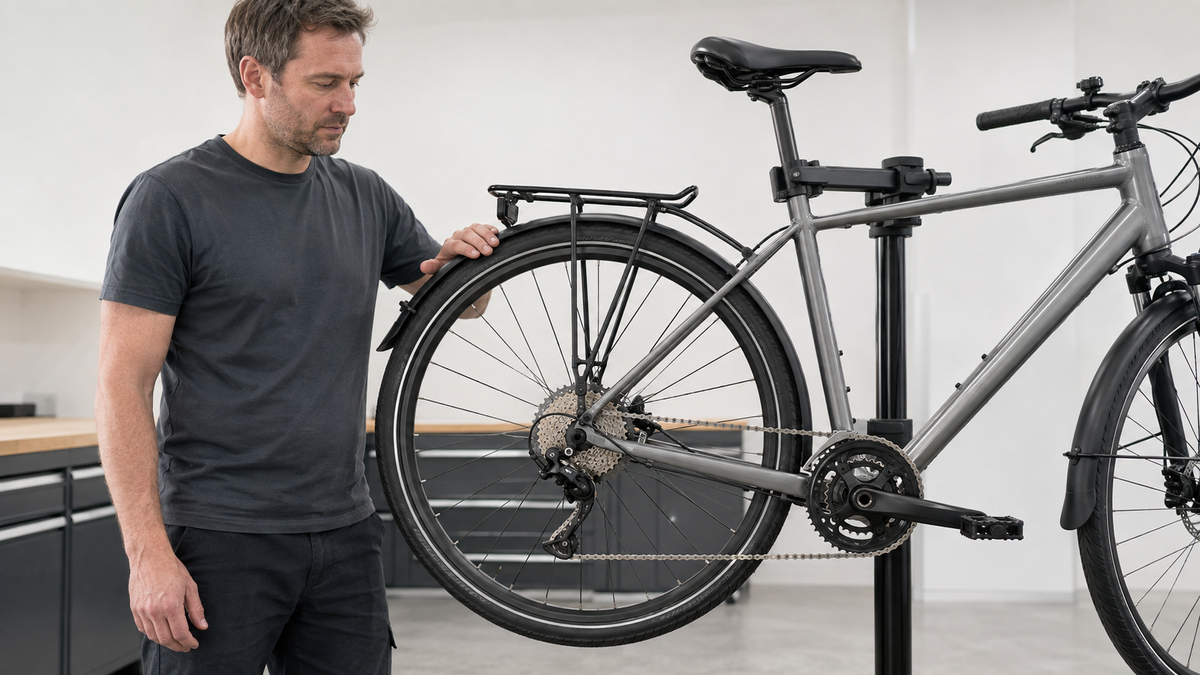
If the bicycle freehub sticks, the rear wheel may behave unusually when pushing the bike, the chain is pulled forward while coasting or the crank turns along with it. The problem is not automatically in the freehub body: the chain, derailleur, cassette, brake or hub bearing can create a similar sensation. Therefore, first check from the outside and while the bike is safely stationary. Do not flood a sticking freehub with spray oil or dismantle it without the appropriate retailer documentation.
When not to continue riding
The ride is over if the chain is pushed strongly forward while coasting, becomes jammed between the cassette and frame, the rear wheel locks up, the crank turns uncontrollably or loud impacts come from the hub. The same applies if the rear wheel is loose, the axle is damaged, the hub has noticeable play or spokes are damaged. A drive that suddenly locks up can cause a fall.
Get off and move the bicycle out of traffic. On an e-bike, switch off the system. Lift the rear wheel only with a secure repair stand or a second person; do not place a heavy e-bike unstably on the handlebars and saddle. Keep hands, clothing and hair away from the chain, sprockets, brake disc and spokes.
What a freehub normally does
When pedaling forward, the freehub transfers torque to the rear wheel. When you stop pedaling and continue rolling, the wheel should be able to turn without necessarily driving the crank along with it. Depending on the hub, a distinct clicking sound, a quiet whirring or hardly any noise may be normal. The sound alone therefore says little about the condition.
The term freehub body commonly refers to the assembly on a cassette hub onto which the cassette is mounted. Other hubs, screw-on freewheels, internally geared hubs and some e-bike drives have a different design. Before ordering replacement parts, the hub model, axle type and sprocket system must be clearly identified.
Clearly distinguish the symptoms from one another
| Observation | Possible area | Safe next step |
|---|---|---|
| Crank turns when pushing the bike forward | Freehub is stiff, but the chain or derailleur may also be the cause | Observe while stationary and without load |
| Chain sags at the top or bunches up while coasting | Freehub does not disengage properly | Do not continue riding; workshop |
| Rear wheel is hard to turn even without the chain | Brake, bearing, axle seat or tire contact | Check other components separately |
| Pedals sometimes spin freely | Freewheel may not engage reliably | No load test; service |
| Lateral play at the rim or cassette | Hub bearings, cassette, or mounting | Do not continue using the wheel |
“Sticking” can therefore describe two opposite faults: the freewheel does not disengage freely while coasting, or it does not engage reliably when pedaling. Both are safety-relevant. Tell the workshop what behavior you observed rather than simply assuming “freewheel broken.”
External inspection with the rear wheel installed
- Check whether the rear wheel is correctly secured and shows no visible misalignment.
- Check whether the tire, mudguard, or brake is touching the wheel.
- Raise the bicycle securely and slowly turn the rear wheel forward.
- Observe the chain, derailleur, and crank without touching them.
- Listen for rubbing, regular clicking, hard impacts, and changing resistance.
- Stop immediately if the chain bunches up, the wheel locks, or parts shift.
Slight crank rotation on an unloaded repair stand may be caused by friction and alone does not prove a defect. What matters is whether the crank is driven strongly, the drivetrain builds up tension, or the behavior recurs under normal conditions. Do not perform a quick hand rotation near sprockets or the brake disc for this purpose.
Rule out the brake, chain, and gears
A rubbing brake disc or rim brake set too tightly can make the rear wheel hard to turn without the freewheel sticking. Check clearance only externally. If the brake is affected after a fall, wheel removal, or transport, do not loosen the brake caliper without a specific reason. Brake function and correct wheel seating take priority.

A twisted, stiff, or incorrectly routed chain can jerk. A damaged derailleur can also pull the chain under the cassette. The article Sagging bicycle chain covers tension systems separately. A sticking freewheel concerns the disengagement between the cassette and the rolling rear wheel, not general gear adjustment.
Inspect the cassette and hub externally
With the bike stationary, check whether the cassette lockring is visibly missing, the sprockets are wobbling significantly, or a foreign object is caught between the cassette and the spokes. Do not pull on sharp-edged sprockets or use tools if you are unfamiliar with the system and its securing method. A loose sprocket cluster can cause noise and must be installed using the appropriate tools and the manufacturer's specifications.
Check the hub for lateral play by carefully applying sideways pressure to the rim with the wheel securely attached. Movement may come from the wheel or hub bearing area and is not automatically a freehub problem. The existing article Play in the bicycle hub explains bearing and mounting issues in more detail.
Why spray oil can mask the wrong diagnosis
Do not spray penetrating oil through gaps into the hub. It can dilute the specified special grease, impair seals, introduce dirt, and get onto the brake or tire. Even if the noise temporarily disappears, the cause has not been identified. The lubricant, quantity, and access points vary depending on the freehub system.
Shimano explicitly states in its dealer service manuals that certain freehub bodies should not be disassembled or lubricated by users, as this can cause malfunctions. Other designs are intended to be serviced professionally. This does not constitute a universal replacement rule, but it does establish a clear boundary: Without identifying the model and consulting the appropriate technical documentation, leave the internals closed.
After rain, cleaning, or a long period of storage
If the sticking began after heavy rain, washing, or winter storage, note this connection. Water or dirt that has entered may play a role, but flushing with solvent is not a safe user test. Dry the outside of the bike at room temperature and avoid hot air and direct heat.
After freezing temperatures, the internals may become stiff or damp. Wait until the bike is dry and at a suitable temperature, and have a recurring problem inspected. Riding to “warm it up” puts strain on a potentially faulty engagement mechanism.
Information for the workshop
Note the hub and wheel model, cassette type, axle system, and when the issue first occurred. Describe whether the fault occurs while coasting, when pedaling, or in both situations. A short video made with the bike secured in a safe repair stand can show whether the crank and chain are being pulled along. Send serial numbers privately only.
Also helpful are details such as recent work on the rear wheel, recent cleaning, riding in heavy rain, a long period of storage, or a fall or impact. The workshop can inspect the brake, chain drive, bearings, cassette seat, and freewheel separately. Only then can it be determined whether cleaning according to the service instructions, replacing the freewheel body, or another repair is required.
Do not attempt these things
- Open or drill into the freewheel body without the appropriate dealer documentation.
- Spray penetrating oil, chain oil, or degreaser into the hub and seals.
- Take a test ride with a jammed chain or pedals that intermittently spin freely.
- Remove the cassette with unsuitable tools or “hammer it tight” by hand.
- Spin the rear wheel quickly while your hands or clothing are near the drivetrain.
- Place an e-bike for testing in an unstable position on the display, handlebars, or saddle.
Frequently asked questions about a sticking bicycle freewheel
Is it normal for the crank to turn slightly when I push the bicycle?
Slight rotation without a load can be caused by friction. Strong pulling, chain jamming, locking, or repeated occurrences while riding, however, are reasons for an inspection.
Can I loosen the freewheel with WD-40?
No, not as a general repair. An unsuitable product can affect the lubrication and seals. The specific system determines the maintenance product and procedure.
Why do the pedals sometimes fail to engage?
The freewheel engagement may be impaired, but other drivetrain components may also be involved. Do not put further strain on the system; suddenly pedaling without resistance can lead to loss of control.
Does the entire freewheel body always need to be replaced?
No. That depends on the hub model, the diagnosis, and the replacement-parts concept. Some manufacturers specify replacement rather than disassembly, while others define a service procedure. A decision can only be made after clear identification.
Conclusion: narrow it down externally; keep the inside closed
If the bicycle freewheel is sticking, observe from a safe stationary position whether the crank and chain are being pulled along while the bike rolls, or whether the drivetrain fails to engage when you start pedaling. Rule out the brake, chain, wheel seating, and hub play externally. Do not use spray oil or disassemble anything without model-specific documentation. If the chain jams, the wheel locks, the pedals suddenly spin freely, there is play, or there are harsh noises, do not ride the bicycle until it has been professionally diagnosed.
As of: September 6, 2026. Assembly, lubrication, disassembly, and replacement-part decisions are based on the current documentation for the specific hub and sprocket system installed.
Share:
Maintain the suspension fork: clean the stanchions and schedule servicing
E-bike assistance cuts out: identify the cause with confidence