

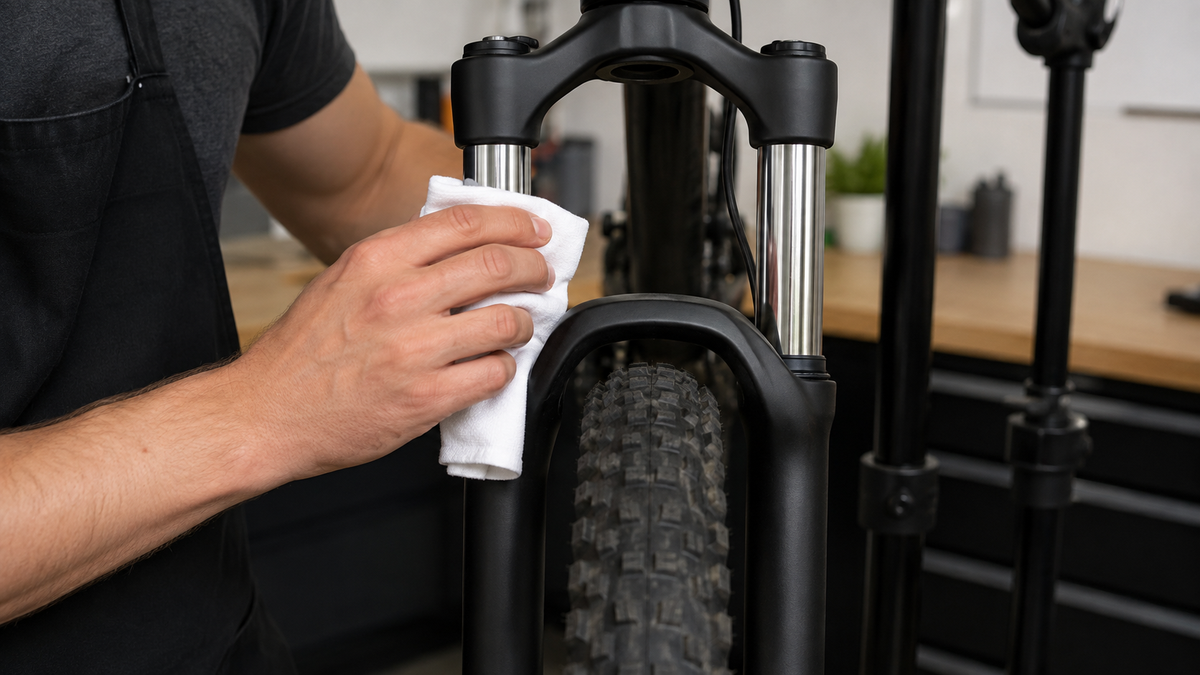
Regular care of a bicycle suspension fork starts on the outside: remove dirt from the stanchions and wipers, identify damage, and plan maintenance for the specific model. It does not mean opening the fork after every ride or spraying arbitrary oil under the seals. Anyone familiar with the model, its use, and the manufacturer’s maintenance schedule can keep dirt away from the sealing system and recognize early when professional servicing is needed.
Check for warning signs before cleaning
Do not continue using the suspension fork if the stanchions show deep scratches, dents, or cracks, if oil is clearly leaking, if the fork is stuck, has excessive play, or appears crooked after a crash. A loose steerer tube, damaged crown, or visibly damaged brake caliper mount is also not a maintenance issue. Keep the bicycle out of use until a specialist workshop has inspected the load-bearing parts.
A light ring of dirt on the wiper is different from a wet trail that repeatedly moves up the stanchion or reaches the brake or tire. Wipe the area clean, photograph it, and observe it only while the bike is unloaded and stationary. Oil on the brake disc or pad ends the ride; contaminated brake components must be treated or replaced according to the manufacturer’s instructions.
Distinguishing between the stanchion, slider, and wiper
The smooth tubes that slide into the lower fork legs as the fork compresses are generally called stanchions. Wipers or dust seals are located at the transition. They are intended to keep dirt on the outside. The lower fork legs, often called sliders, hold the axle and brake mounts. Terminology may vary depending on the manufacturer’s documentation; for replacement parts, the exact model drawing is what matters.
Daily exterior care primarily concerns smooth surfaces and the seal edge. A lower-leg service, oil change, or damper service, on the other hand, is specialist work involving model-specific oils, quantities, tools, and bleeding procedures. RockShox explicitly distinguishes between regular external cleaning and specified service work in its documentation.
Gentle cleaning after the ride
- Park the bicycle securely and switch off an e-bike.
- Remove coarse, dry dirt with a soft brush without pushing it over the seal.
- Wipe the stanchions with a clean, soft, lint-free cloth.
- Carefully clean the visible seal edge from the outside.
- Dry the fork and inspect both sides in good light.
- Check the axle seat, brake-hose routing and mudguard mounting only externally.
- Document new scratches, wet marks or unusual noises.
In current maintenance documents, RockShox specifies cleaning dirt from the stanchions and wiper seals after every ride. This is a manufacturer's instruction for the products described there, but the principle is understandable: dried dirt should not reach the seal during the next movement. For your model, its owner's manual remains authoritative.
What applies to water and cleaning products
Do not use a high-pressure jet on seals, adjusters or bleed ports. Water can force dirt into gaps and wash out lubricant. A damp cloth is usually sufficient for regular care. If the manufacturer permits a cleaning product, apply it sparingly to the cloth rather than directly to the fork, and keep it away from the brake disc and pads.

Solvents, brake cleaner and aggressive degreasers can damage seals, coatings and stickers. The fact that a product cleans metal does not automatically make it suitable for a suspension fork. After a muddy ride, clean it promptly, but without a hard brush, metal edge or compressed air around the seal.
No universal oil on the dust wiper
The internet often recommends applying oil to the stanchion and compressing the fork several times. Without explicit approval for the model, seal and lubricant, this is not a good standard method. Unapproved oil can attract dirt, be incompatible with internal lubricants or get onto braking surfaces. Silicone spray, chain oil and household oil are not universal suspension-fork care products.
If the owner's manual specifies an external care step, follow the instructions exactly regarding the product, amount and removal of excess residue. Do not lift the sealing lips with a screwdriver or cable tie. What lies beneath the wiper belongs to the prescribed service procedure, not to quick cleaning.
Service intervals depend on the model and how it is used
| Influence | Why it matters | What you document |
|---|---|---|
| Manufacturer and model year | Design, oil and service interval vary | Keep the model code and serial number private |
| Hours of riding instead of kilometres | Slow off-road riding can mean few kilometres but high strain | Approximate hours of use |
| Dust, mud and wet conditions | Seals and lubrication are subjected to greater stress | Typical conditions |
| Jumps, high loads, and bike parks | Mechanical stress increases | Type of use and special events |
| Long periods of inactivity | Aging does not end when the mileage is recorded | Date of the last service |
Do not adopt a blanket number of hours from a manual for a different model year. On the RockShox model pages, you can search for documents by product or serial number; these include the owner's manual, service manual, and, where applicable, a service interval plan. Other manufacturers also provide model-specific tables. If in doubt, an authorized service center can confirm the correct document version.
Air pressure and sag are settings, not cleaning
An air-sprung fork can lose pressure or sit too low if set incorrectly. Check the pressure and sag only according to the instructions for the specific model and with a suitable shock pump. Tire pumps, compressors, and values transferred from other sources are unsuitable. Remove a valve cap only from the correct valve and keep dirt away.
If the fork repeatedly loses air, remains deeply compressed, or its pressure changes significantly, repeatedly adding air is not a long-term maintenance solution. The service technician must inspect the seals, valve, and air spring. A coil-spring fork does not have this air valve; for this reason too, general instructions without identifying the model are risky.
Keep adjusters clean and record the initial settings
Compression damping, rebound damping, and lockout may be present depending on the fork. Wipe their exterior clean, but do not turn the adjusters randomly for cleaning. Photograph the initial settings and change only what the operating instructions specify as user-adjustable. Do not use pliers to force a lever that cannot be moved.
If a lockout no longer works or the fork returns unusually slowly after an adjustment, restore the safe baseline settings according to the manual and have it inspected. A locked-out fork must not continue to be used as a rigid fork if there is a defect.
After a crash, transport, or a long period of inactivity
After a crash, also look for paint cracks around the crown and steerer tube, twisted components, damage to the axle mount, and contact marks. A fork that appears straight on the outside may still be affected. After transporting it in a car, check that the levers and adjusters were not subjected to stress and that the wheel is properly secured.
Before your first ride of the season, check the date of the last service, not just the cleanliness. With the front brake applied, carefully compress the fork a few times while stationary, provided the manual allows this. It should operate smoothly, but it must not be considered technically approved based on a single compression test.
These tasks should be left to a specialist service.
- Opening lower legs, the air spring, or the damping unit.
- Changing oil, bleeding, or replacing internal seals.
- Repairing scratches or coatings on stanchions.
- Straightening the steerer tube, crown, or axle mount.
- Diagnosing play, internal knocking, oil loss, or recurring air loss.
- Work without clear specifications for parts, oil, and torque.
Frequently asked questions about suspension fork care
How often should I clean the stanchions?
After dirty rides, clean them promptly; some manufacturers, such as RockShox, recommend cleaning the stanchions and wipers after every ride. The schedule for your model and your usage are decisive.
Can I put chain oil on the fork?
No, not as a standard solution. Use only a product expressly approved for the specified location. Keep all oil away from the brake and tires.
Is an oil ring on the stanchion normal?
A blanket remote diagnosis is not safe. Wipe the area clean and observe whether a wet trail reappears. Significant or recurring leakage, especially toward the brake, requires servicing.
Can I perform the minor fork service myself?
Only if the manufacturer authorizes it for users and you are fully familiar with the model, tools, parts, fluids, and procedures. Otherwise, leave it to a qualified specialist workshop.
Conclusion: clean on the outside, service the inside according to the schedule
Suspension fork care is primarily about careful exterior cleaning and good documentation. Remove dirt from the stanchions and wipers, check the surface and operation, and follow the model-specific service schedule. Avoid high-pressure cleaning, aggressive cleaners, and universal oil. In the event of a crack, deep damage, play, a sticking function, or significant oil or air loss, do not ride the bike until it has been professionally inspected.
As of September 6, 2026. Cleaning, lubricant, pressure, adjusters, and maintenance intervals depend on the operating and service documentation for the specific suspension fork installed.


Share:
Bicycle freewheel sticking: how to safely check the symptoms
E-bike assistance cuts out: identify the cause with confidence