

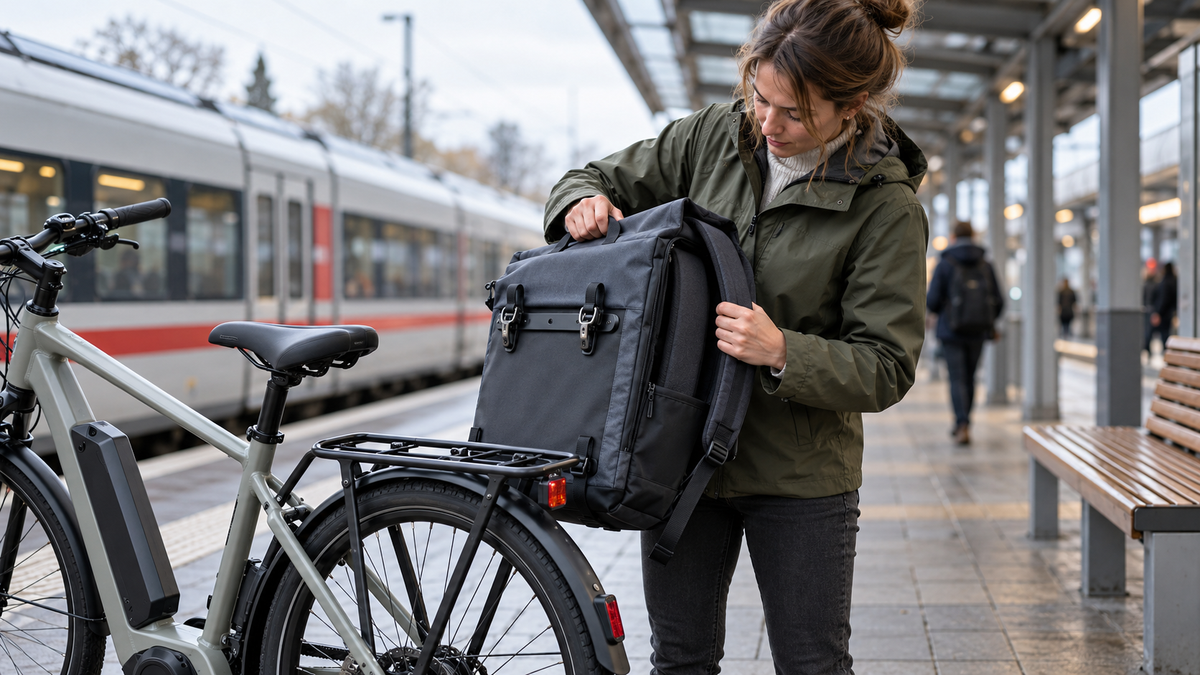
A pannier backpack is designed to make switching between cycling, trains, and walking easier. People often search for this 2-in-1 hybrid using the phrase “pannier backpack hybrid”: on the bike, it attaches to the luggage rack; once you’ve parked, it converts into a backpack. But whether it really works for your daily commute depends on more than the marketing claims. What matters is how much you walk, how often you switch modes, what you actually carry, the mounting system, and weather protection. This guide will help you make a clear choice and show you what to test on your own bike before buying.
Pannier backpack or classic bag: the quick decision
A pannier backpack is a particularly good fit if you regularly cycle to the train station, transfer there, and then walk for a few more minutes. It saves you from repacking and keeps your back free while cycling. However, you’ll always be carrying the conversion components, even on days when you only ride your bike.
A classic pannier is usually the simpler choice if your walk is short, the bag stays mostly on your bike, or you need especially large storage capacity across two panniers. A regular backpack may be a better option if you walk long distances, don’t have a suitable luggage rack, or often switch between different bikes without compatible mounts. So choose based on your most common daily routine, not the rare exception.
| Everyday situation | Obvious choice | What to check before buying |
|---|---|---|
| Cycling, train, and a longer walk on almost every workday | Pannier backpack | Conversion, carrying system, and secure hook covers |
| Almost exclusively cycling, only a few meters on foot | Classic pannier | Carry handle, capacity, and mounting |
| Lots of stairs, long walks, changing bikes | Backpack or hybrid with a well-designed carrying system | Weight, back length, and pressure points |
| Lots of luggage or shopping on both sides of the bike | Two separate panniers | Bag and rack load capacity |
Which criteria really matter for commuting
Conversion time and clear separation of functions
A hybrid is only practical if you can switch modes reliably even when you’re rushing to make a connection. Check that the shoulder straps and mounting hooks are fully stowed or covered in the other mode. Loose straps must not be able to reach the wheel or spokes while riding. When carrying it, protruding hooks should not press against your clothes or back without protection.
Test switching modes with your usual load. A mechanism that works easily when empty may behave differently with a laptop, a drink, and a change of clothes inside. Don’t just count the seconds: what matters is that every part is securely in place at the end and you don’t have to hold a loose cover.
Capacity, internal dimensions and usable storage space
Capacity in liters alone tells you little about whether your work gear will fit. Measure your laptop, lunch box, lock and change of clothes. In particular, compare the laptop compartment's internal dimensions with the actual dimensions of your device; the screen diagonal isn't enough. The usable height of a roll-top closure can also depend on how many times it needs to be rolled to close as intended.
Weigh your everyday items once. Don't keep adding extra capacity just in case. An oversized bag can easily end up unnecessarily heavy in everyday use, while an undersized one may tempt you to leave it poorly closed. Allow a little extra room, but stay within the manufacturer's stated maximum load.
Weight and fit when carrying
The bag itself is part of the total weight. When you switch modes of transport, you carry its weight plus its contents. Look for adjustable shoulder straps, a suitable back length, a chest strap and a sensible position for heavy items. The manufacturer's information about padding can help you narrow down your options, but it cannot replace trying the bag on. Carrying comfort is personal and cannot be determined from a single material or marketing term.
Pack heavy, flat items close to the side that rests against your back, and secure small items. Try the bag on for a few minutes, climb a flight of stairs, then take it off and put it back on. This makes it easier to notice if the straps slip or the bottom of the bag gets in the way.
Mounting system and clearance on the bike
The bag must fit your existing rack. Check the tube diameter, strut positions, usable rail length and the rack's maximum load. Also check whether you need hooks, adapters or a separate mounting kit. A general claim such as “fits standard racks” is no substitute for taking these measurements.
Attach the loaded bag so your heel does not hit it while pedaling. Also check the clearance from the spokes, brakes, gears, lights and cables. On an e-bike, the battery, charging port and controls must remain accessible. A bag manufacturer's specifications do not automatically mean it is compatible with a specific bike model.
Use weather protection as a deal-breaker
Distinguish between waterproof, water-repellent and a rain cover included with the bag. An IP rating applies only to the specific product tested under the stated closure conditions; do not apply it to other models. For this comparison, simply ask whether the stated level of protection suits your commute. The exact meaning of IP64 and closure systems belongs in a separate guide to water protection.
How to interpret technical specifications using two examples
Manufacturer specifications are useful when you always check the specific version. For the ORTLIEB Vario 26L with Quick-Lock2.1, the current product page lists a capacity of 26 liters, a weight of 1,550 grams, and a maximum load of 9 kilograms. The laptop compartment is specified as 36 × 24.5 × 2.5 centimeters. The QL2.1 version comes with inserts for 8, 10, and 12 millimeters; the product information explains which other tube diameters are compatible. According to the manufacturer, the IP64 rating applies only when the roll-top closure is properly closed.
The VAUDE Cycle 20 II is an example of a different design. The official product page lists 20 liters, an empty weight of 1,200 grams, and a maximum load of 8 kilograms. It specifies that the QMR-2.0 system fits round luggage rack tubes measuring 8 to 16 millimeters in diameter. A rain cover is listed, and the outer fabric is described as water- and dirt-repellent. This is not equivalent to the IP64 rating of the other example.
These figures do not point to one clear winner overall. More capacity can be useful for a change of clothes, but it does not automatically make the bag more comfortable to carry. Lower empty weight can help on stairs, but says nothing about how well it fits your back. Use the spec sheets to check for deal-breakers: Does your laptop fit? Are the tube diameter and load capacity right? Is the stated weather protection sufficient for your route?
Practical checks before buying
- Note your daily route: Record cycling time, transfers, stairs, and walking distance separately.
- Measure and weigh your belongings: Take the laptop’s external dimensions, daily essentials, and seasonal extra clothing into account.
- Measure the luggage rack: Check the tube diameter, rail length, strut position, and permitted load against the manufacturer’s documentation.
- Hang it while loaded: Park the bike securely, check the lock according to the instructions, and gently pull the bag in the permitted directions.
- Check clearance: Only with the bike safely parked and the rear wheel free to rotate, slowly turn the crank; keep hands and loose straps away from the drivetrain and check clearance from your heel, spokes, brake, light, battery, and cables.
- Repeat the conversion: Switch from pannier to backpack and back several times; make sure no straps are loose.
- Test it as a backpack: Walk for a few minutes, use stairs, and assess the loaded carrying system for yourself.
- Start the test ride carefully: Test the brakes, turns, and stopping at low speed in an area without traffic.
Only take the final step with the bag securely attached. Stop the test if the bag shifts, touches any components or causes the bike to react noticeably unevenly. If in doubt, have a specialist check the bag and rack combination.
Avoid common purchasing mistakes
- Choosing based only on laptop screen size without measuring the device’s casing.
- Confusing bag volume with the permitted load.
- Guessing the tube diameter and overlooking the need for adapters.
- Treating a rain cover, water-repellent material and an IP rating as equivalent.
- Testing the conversion only when the bag is empty, even though you carry it fully loaded every day.
- Failing to consider the rack’s load limit together with other luggage.
- Assuming that one product variant represents all mounting systems in the same model range.
Frequently asked questions about pannier backpacks
Is a hybrid better than a regular pannier for every commute?
No. Its main advantage is when you regularly switch between cycling and walking. If the bag stays on the bike most of the time, a classic pannier may be simpler and lighter.
What size bag do I need for a laptop and work essentials?
That depends on your device’s external dimensions and what you carry each day. Check the actual interior compartment, not just the advertised screen size. Also allow room for a power adapter, food and weather-appropriate clothing.
Does every hybrid fit every rack?
No. Mounting systems, tube diameters, rail shapes, load limits and clearances vary. Compare the bag and rack specifications, and test the loaded combination before your first everyday ride.
How quickly should it convert into a backpack?
There’s no point in setting a general time limit in seconds. Practice switching with your usual load until the hooks and straps are stowed properly every time. A slightly slower, easy-to-follow process is more practical for everyday use than a quick conversion that leaves parts loose.
Can I leave the bag locked to the bike?
Some systems offer an optional security feature or lockable hooks. This does not necessarily secure the contents of the bag. Check exactly which part is protected, and always take your laptop and valuables with you when you leave the bike.
Conclusion: Let your commute determine the solution
Choose a pannier backpack if transfers and longer walks are a regular part of your day and it converts reliably while loaded. Choose a classic pannier if most of your luggage stays on the bike, and a standard backpack if walking is the main part of your commute or you don’t have a suitable rack.
Make the decision in this order: route, luggage, rack, mounting system, fit test and cautious test ride. This turns a versatile product idea into a solution that suits your actual commute.
Share:
Choosing a floor bike stand: Check tire size, weight, and stability
Choosing a bike multitool: Which bits you really need