

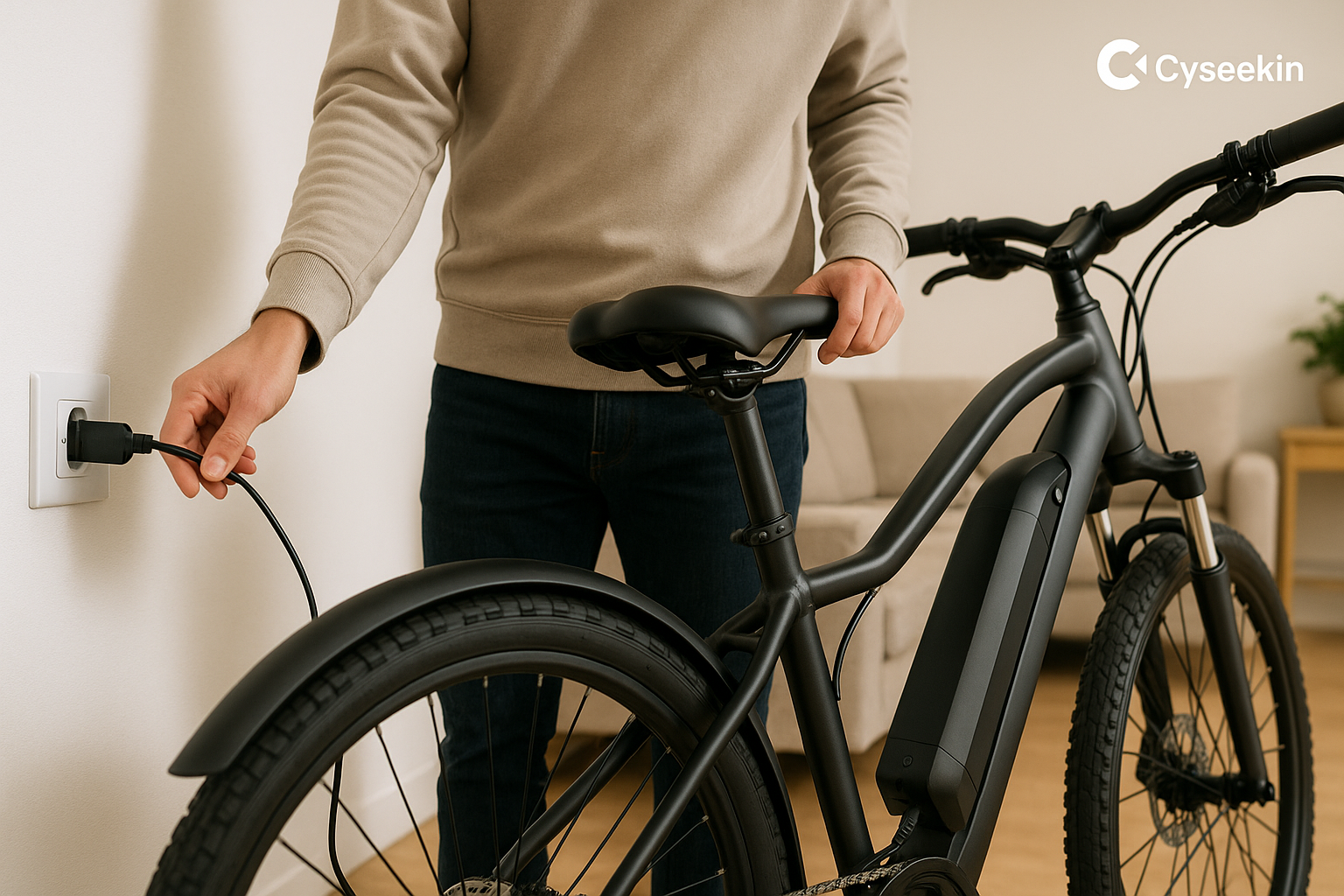
Charging your e-bike at home sounds simple—plug it in and you’re done, right? But to protect your battery and avoid fire hazards, there are a few important rules.
1. Yes—you can use any standard household outlet
Unlike in the USA (where the voltage is often only 110 V), Germany has a 230-volt power grid. That’s perfect for e-bikes.
-
The standard: Your charger is designed to convert the 230V AC from the outlet into the appropriate DC voltage for your battery.
-
Flexibility: Whether you have a removable battery (charge it indoors) or a permanently installed battery (charge it directly on the bike in the garage), any Schuko outlet will work.
-
Charging time: A full charge usually takes 4 to 6 hours, depending on the battery capacity (e.g., 500Wh to 750Wh).

2. Use only the original charger!
This is the most important safety tip of all. Never use cheap universal chargers or third-party power supplies that have not been explicitly approved by the manufacturer.
-
The risk: Cheap imports often lack a proper automatic shutoff. This can lead to overheating or even battery fires.
-
Look for certifications: In Germany, you can identify a safe charger by the CE marking and ideally the GS mark (Tested Safety).
3. Charge under supervision (and not while you’re asleep)
Even though modern lithium-ion batteries are very safe, most battery fires happen not while riding, but during charging.

Safety checklist:
-
Location: Charge on a dry, fire-resistant surface (e.g., a tiled floor—not on the sofa or carpet).
-
Surroundings: The room should have a smoke detector.
-
Time: Do not leave the battery charging unattended overnight. Unplug it when it is fully charged.
-
Temperature: If the battery becomes unusually hot while charging (more than warm to the touch), disconnect it from the power supply immediately!
4. The correct plugging sequence
To avoid voltage spikes (“sparking”), experts recommend the following sequence—unless your manual says otherwise:

-
First: Plug the charger into the wall outlet.
-
Then: Connect the charging cable to the battery/e-bike.
This protects the capacitors in the charger and extends the service life of your electronics.
5. Public e-bike charging stations vs. electric-car charging stations
A common misconception: You cannot charge your e-bike at an electric-car charging station (Type 2 plug). The voltage there is far too high, and the plug is not compatible.
What works: In Germany, more and more dedicated e-bike charging stations are available at tourist attractions, beer gardens, and hotels. These are usually standard 230V lockers.
-
Tip: Always take your own charger (“home charger”) on longer trips, as public cables are rarely universally compatible.
📝 Summary: The Safe Charging Checklist
| Tip | Why it matters |
| Use the original power supply | Ensures the correct voltage and prevents overcharging. |
| Observe room temperature | Ideally, charge between 10°C and 20°C (not in an ice-cold shed!). |
| Follow the correct sequence | Outlet first, then battery—helps prevent sparking. |
| Unplug it | When the battery is fully charged, disconnect it from the power supply. |
| Don’t share the outlet | Avoid power strips that already have high-power appliances (e.g., a washing machine) connected to them. |
Conclusion
Yes, you can safely charge your e-bike at any German outlet. But “simple” doesn’t mean “carefree.” Use high-quality equipment, charge at room temperature, and keep an eye on the battery. That way, you can enjoy your range for a long time.
References
CalBike. (2023). The real e-bike safety concern: Battery fires. Retrieved from https://www.calbike.org/the-real-e-bike-safety-concern-battery-fires
CBS8 News. (2024). How to safely charge e-bikes and prevent fires in California. Retrieved from https://www.cbs8.com/article/news/local/california/safely-charge-e-bikes-prevent-fires/509-1d2abda3-b15e-45aa-8a50-373b1359303d
Share:
E-Bike Laws in Germany: 7 Legal Pitfalls You Need to Know Before Buying
Align the crossbar and frame correctly on the Cyseekin C10