

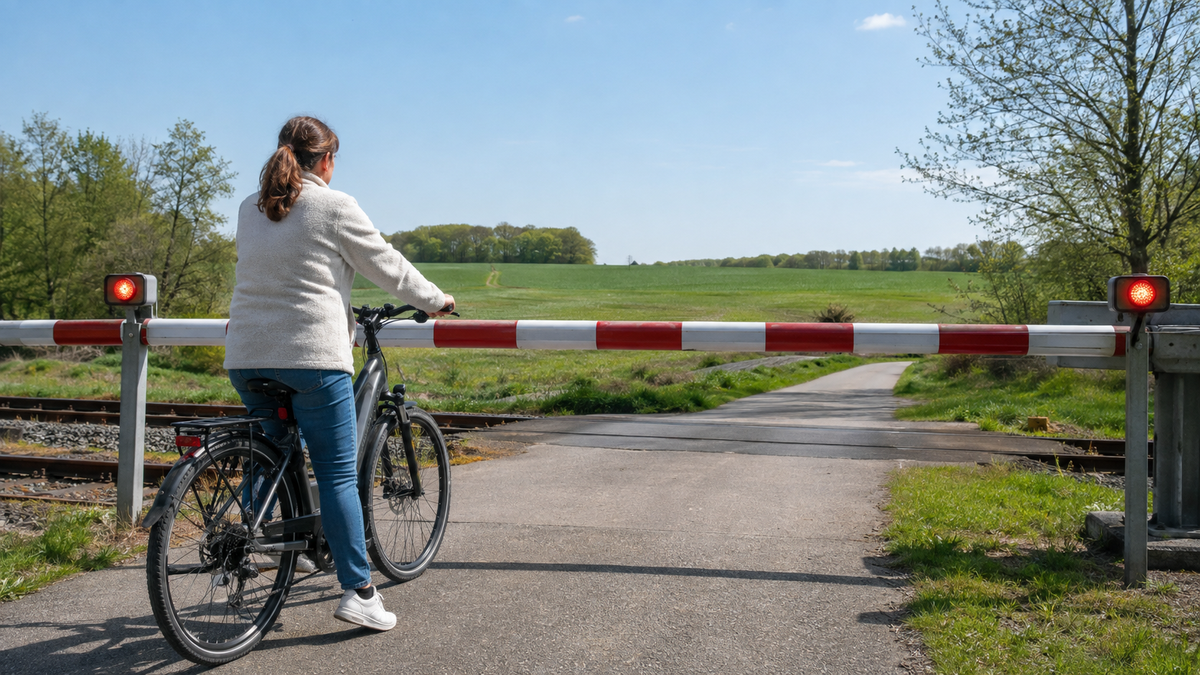
A level crossing requires a clear sequence when cycling: reduce your speed, check the signals and tracks, keep the exit beyond the tracks clear, and cross only when you can clear the crossing completely. A train cannot swerve and has a long braking distance. Therefore, schedules, group pressure, and a queue that is already waiting do not take priority over crossing safely.
Recognize signs early
Warning signs 151 and 156 announce a level crossing. The St. Andrew’s cross indicates that rail traffic has priority. The signs and their meaning are described in Annex 1 and Annex 2 of the German Road Traffic Regulations. Reduce your speed as you approach instead of braking sharply only at the barrier.
Look at the lights, barriers, traffic controllers, and the area beyond the tracks. Headphones or wind noise can obscure acoustic signals. Never rely solely on your hearing. In poor visibility, wet conditions, or on uneven surfaces, it is better to dismount in good time.
Also allow enough braking distance. A group should wait at a distance from the roadway and block neither the sidewalk nor the opposite direction while waiting to cross together.
When you must wait
Section 19 of the German Road Traffic Regulations requires you to wait, among other situations, when a red or yellow light, a flashing red light, lowering or closed barriers, an approaching rail vehicle, a signal from railway personnel, or an audible signal such as a whistle indicates that you must stop. Wait before the St. Andrew’s cross, the light signal system, or the barrier; if there is no such marking, wait at a safe distance before the crossing.
A barrier that has not yet fully closed is not a window of opportunity. Never ride underneath it, pass around it, or ride between half-barriers. Do not turn around on the tracks either. Deutsche Bahn summarizes the correct behavior at crossings in its “Attention, St. Andrew’s Cross” campaign.

The exit must be clear
You must not enter a level crossing if you would be unable to clear it without stopping because of a traffic queue. This also applies when the barrier is open and the light is green. Before setting off, check that there is enough room beyond the last track for your entire bicycle, a trailer, and, if applicable, the group.
If a car is stopped directly beyond the tracks, wait before the crossing. Do not position yourself between the barrier and the track. At crossings with several tracks, the entire area up to the safe side must be clear; a gap between two tracks is not a designated waiting area.
Cycle path without a St. Andrew’s cross
A crossing on a footpath, field path, forest path, or cycle path may be signposted differently from the adjacent road. Under Section 19(4) of the German Road Traffic Regulations, road users must behave there as though a St. Andrew’s cross were present, even when it is not. Rail vehicles have priority. The absence of a sign therefore does not mean that you may ride through without checking.
On little-used routes, expect restricted sightlines, vegetation, and uneven rail grooves. Stop where you can see in both directions without entering the track area. If visibility is insufficient, cross only once it is clearly safe.
Cross the tracks in a controlled manner
Set off only when the signals permit crossing, no barrier is moving, no train is approaching, and the exit remains clear. Select a suitable gear beforehand. Cross promptly and without stopping. Avoid abrupt steering or shifting on the tracks.
Rails can be slippery in the rain and can deflect narrow tires. Cross them at a clearly defined angle whenever possible, without moving into oncoming traffic or leaving the designated area. If the geometry, wet conditions, or a trailer makes it difficult to maintain a safe line, dismount before the crossing and walk. When walking, signals, barriers, and priority rules remain fully binding.
With children, groups, or trailers
A group should begin crossing only when everyone is likely to be able to clear the entire track area. Do not split up because a barrier is closing. One responsible person should ride or walk at the front, and a second should bring up the rear. Give children a short, clear instruction before the crossing and do not leave them alone among the adults.
With a trailer, cargo bike, or heavy e-bike, you need more time and space. Check whether bumps, narrow chicanes, or rail grooves could obstruct the combination. If in doubt, dismount and walk, but only if you can move the vehicle steadily and without stopping in the track area.
Overtaking at a level crossing
From warning sign 151 or 156 up to and including the crossing, Section 19 of the German Road Traffic Regulations prohibits drivers from overtaking motor vehicles. The wording is more precise than the blanket statement that all overtaking is prohibited there without exception. For cyclists, however, this still provides no sensible reason to pass a line of vehicles waiting at the tracks.
Near the tracks, distances, signals, and barrier positions can change quickly. Stay behind waiting vehicles if you do not have a complete view of the signals or the exit. Never overtake a closed or lowering barrier, and do not pass people who are waiting because a train is approaching. The general rules in Sections 5 and 1 of the German Road Traffic Regulations also remain applicable.
If your bicycle breaks down in the track area
Deal with a technical fault before the crossing, not on it. If the chain comes off or luggage becomes detached in the track area, first get yourself and other people out of the danger zone. If possible, take the bicycle with you without putting yourself at further risk for longer than necessary. If a vehicle or object remains on the tracks, immediately call 112 or use an available emergency call facility and describe the location.
Do not return to the track area on your own if a train is approaching or the system is issuing a warning. Follow the instructions of railway personnel, the police, and the control center. The Deutsche Bahn safety instructions emphasize: stop first, then check both directions and cross without stopping.
Quick check before every crossing
- Reduce your speed early and remove your headphones.
- Check the lights, barrier, signals, and both directions of the tracks.
- Wait before the crossing if there is a warning signal or an approaching train.
- Set off only when the exit beyond all the tracks is clear.
- Cross the tracks in a controlled manner and without stopping.
- Check again after a train has passed; another train may follow on a second track.
Frequently asked questions
Can I always cross when the barrier is open?
No. A light or sound signal, an approaching train, or a blocked exit may still require you to wait. Check the entire crossing.
Can I go around a half-barrier?
No. A closed or lowering barrier must not be bypassed, avoided, or crossed underneath. Wait until the system clearly permits crossing again.
Does rail traffic have priority on an unsigned cycle path too?
Yes. At crossings on footpaths, field paths, forest paths, or cycle paths, Section 19(4) requires you to behave as you would at a St. Andrew’s cross, even if one is not present.
Should I ride across wet rails?
Only if you can safely control your line, angle, and the surface. If you are unsure, dismount before the crossing and walk once the system permits you to cross completely.
Share:
Overtaking on the right by bicycle: rules for waiting cars
Overtaking on the right by bicycle: rules for waiting cars