

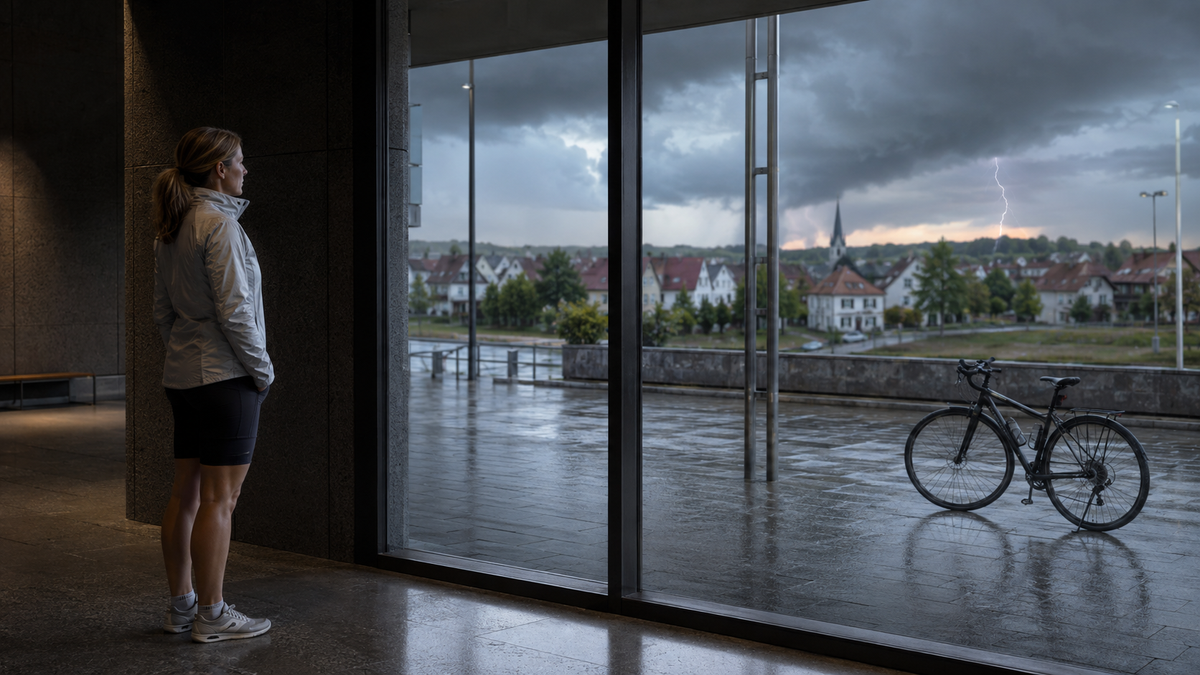
Cycling during a thunderstorm is not a situation that can be solved with a waterproof jacket and a little extra caution. Lightning strikes, storm-force gusts, hail, and suddenly flooded paths can make a ride unsafe within minutes. Anyone who hears thunder should end the ride and seek suitable shelter. This also applies when the rain is still light or the sky looks brighter in the direction of travel.
Before the ride: Check warnings for the route and time
On the day of the ride, check not only the weather app for your starting point. The destination, elevation, and planned time period are also important. The German Weather Service warning map displays official regional warnings. For use while travelling, the DWD provides the WarnWetter app. If thunderstorms are forecast, plan a shorter route, a later start, or a connection that can be abandoned at railway stations and safe buildings.
A probability of rain alone does not describe the lightning risk. Therefore, monitor the warning level, how the situation is developing, and the direction in which the storm is moving. Charge your phone, save the return route, and identify permanent buildings along the route in advance. A café, railway station, or publicly accessible building is more useful as an alternative point than an open shelter in the forest.

Save the warning regions for the start, turnaround point, and destination. On a long route, the warning situation can change significantly. Tell a contact person your planned route and latest expected return time, especially if you are travelling alone on rural paths.
Thunder is the signal to stop
According to the VDE lightning protection guidance, audible thunder means that the thunderstorm is less than approximately ten kilometres away. If no more than ten seconds pass between the lightning and thunder, there is an immediate danger. Therefore, do not wait for the first drops and do not try to “outrun” the storm by increasing your speed.
Ride in a controlled manner to the nearest suitable shelter while the route there is still safe. Avoid high, exposed points, forest edges, isolated trees, poles, fences, and open banks. Stopping on a bridge or an exposed embankment is not a good temporary solution. If gusts make it difficult to keep your line, get off and find the shortest safe route instead of continuing to ride against the wind.
What counts as safe shelter
A closed building with lightning protection or a completely enclosed car with a metal body offers the best protection. In the car, keep the doors and windows closed. Park the bicycle so that it blocks neither access nor an escape route. You do not have to take the bicycle into the shelter if this would waste time or endanger others.
An open bus stop, awning, pavilion, tent, or simple wooden hut is not automatically lightning-safe. Bicycle tyres also do not protect against lightning. The guide from the Federal Office of Civil Protection and Disaster Assistance recommends not holding bicycles or other metal objects and keeping away from trees, poles, and metal fences.
If no building is reachable
Outdoors, there is no equivalent substitute for a safe building. If you are nevertheless caught by surprise, leave exposed points, open areas, and the immediate vicinity of water. Keep away from isolated trees and the forest edge. Find a lower-lying area that is not at risk of flooding. Leave the bicycle several metres away and do not touch it.
In an unavoidable emergency, the VDE recommends crouching with your feet close together and keeping your contact area with the ground as small as possible. Do not lie flat on the ground. Groups should spread out, rather than standing close together. These measures reduce individual risks, but they do not make staying outdoors safe. If someone is injured, call 112, follow the instructions of the emergency services dispatcher, and provide first aid within the limits of your own safety.
Lightning is not the only danger
- Storm-force gusts: Crosswinds can push the bicycle off course. Branches and objects can fall onto the path.
- Hail: Visibility and grip deteriorate; shelter under a closed, stable structure is more important than completing the planned stage.
- Heavy rain: Markings, rails, wooden footbridges, and leaves become slippery. Braking distances increase.
- Flooding: Underpasses and low-lying areas can fill quickly. Never ride into water whose depth or current you cannot safely assess.
- Poor visibility: Switch on the required lights, but do not remain on a dangerous route for that reason alone.
The BBK provides information on severe-weather preparedness and warning channels. If an official warning for a severe thunderstorm or extreme severe weather is in effect, postponing the ride is usually the sensible decision.
How a group should respond
Before the ride, designate one person to monitor warnings and agree on points where the ride will be abandoned. At the first sound of thunder, the group should clearly say “Stop”, count everyone, and ride together to the shelter while keeping enough distance. No one should be sent back alone to collect equipment. Children or inexperienced riders should not continue under time pressure.
If the group is stranded outdoors, its members should spread out so that not everyone is affected by the same event, without unnecessarily losing visual contact. Keep phone calls brief so that the battery remains available for warnings and emergency calls. A live location can help, but it does not replace a clear description of the location, including a road, path junction, or rescue point.
When the ride can continue
A bright sky is not yet an all-clear. The VDE recommends leaving a safe area only 30 minutes after the last audible thunder. Then check the DWD warning again and assess the storm’s further direction of travel. If a second storm line is approaching or paths may have been damaged by wind and water, abandon the ride.
Before continuing, check the tyres, brakes, lights, and for visible damage. On an e-bike, keep the battery connection, display, and charging socket closed and handle them according to the manufacturer’s instructions. Do not switch on a system that has been submerged, fallen, become unusually hot, or been damaged. Have it professionally inspected.
Practical quick plan
- Check DWD warnings for the entire route and riding time.
- Mark closed buildings, railway stations, and points where the ride can be abandoned.
- End the ride and seek shelter as soon as you hear thunder.
- Avoid open shelters, isolated trees, hilltops, banks, and metal fences.
- Wait at least 30 minutes after the last thunder.
- Reassess the warning situation, route, and bicycle before continuing.
Frequently asked questions
Is cycling in the city less dangerous during a thunderstorm?
Closed buildings are usually easier to reach there. However, the risk from lightning and storms remains while you are outdoors on a bicycle. Use the proximity of safe buildings to end the ride early.
Can I wait under a large tree?
No. Isolated trees and the forest edge are among the areas you should avoid. A suitable closed building is the better choice.
Do rubber tyres protect against lightning?
No. Thin bicycle tyres do not make a person outdoors lightning-safe. What matters is suitable shelter and ending the ride in good time.
Is half an hour after the last flash enough?
Use the last audible thunder as your guide, not just the visible lightning. The VDE specifies a waiting period of 30 minutes after the last thunder before leaving the safe area.
Share:
Bicycle chain skipping under load: safely narrow down the causes
E-bike batteries on airplanes: capacity limits and safe alternatives