

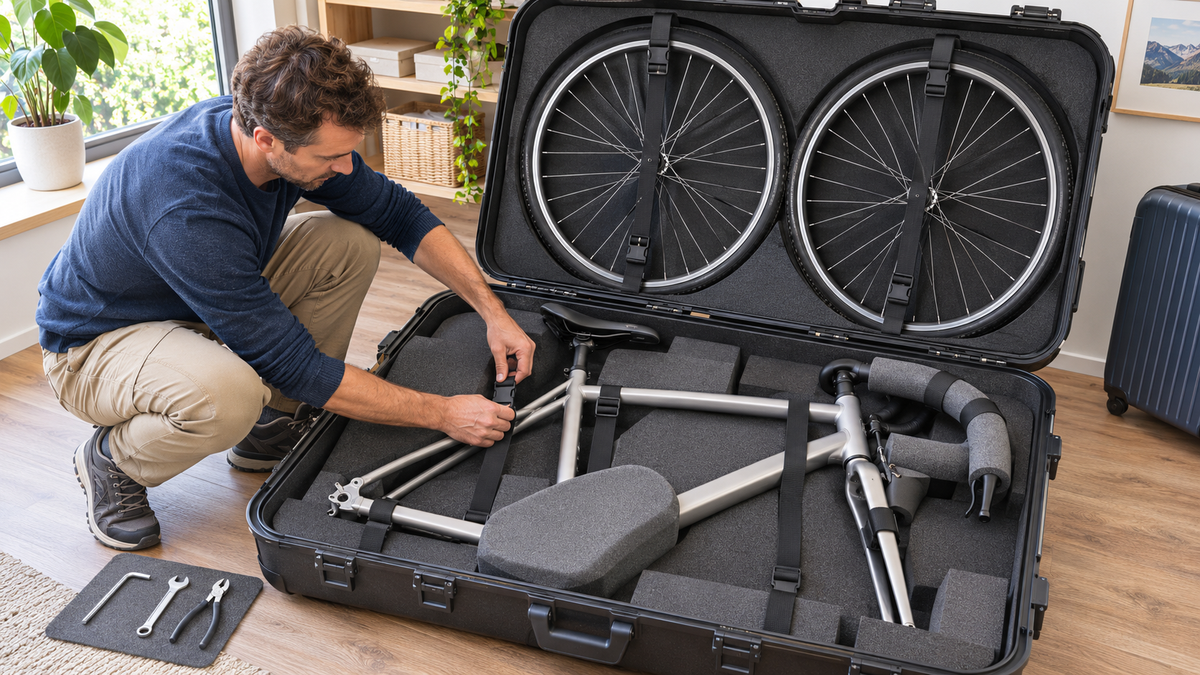
Anyone who wants to take a bicycle on a plane needs more than a sturdy box. A standard non-motorized bicycle must be registered as sports or special baggage, confirmed by the operating airline, and packed according to its requirements. Fees, weight limits, and maximum dimensions vary by airline, route, and fare. So check not only the booking page, but also the airline actually operating the flight and the confirmation for each leg.
Taking a bicycle on a plane: the short answer
First book a flight that offers bicycle transport and correctly declare the unpacked dimensions or expected packed dimensions. Wait for confirmation before buying a non-refundable bike case or booking a connection. Then pack the bike according to the operating airline’s rules and allow extra time to get to the oversized baggage counter.
- Before booking your flight: Check the operating airline, connections, weight, packed dimensions, and available capacity.
- After booking: Register the bicycle as sports baggage for all affected flights and save the confirmation.
- Before departure: Follow the packaging requirements, weigh the bike, and secure loose parts.
- At the airport: Know the check-in deadline and location for oversized baggage, arrive early, and keep your receipt.
This guide covers only an ordinary, non-motorized bicycle. An e-bike or a bicycle with a lithium battery is not covered by this guidance.
Lufthansa, Eurowings, and Condor: compare the rules first
The following overview reflects the official provider information as of November 3, 2026. It is a checklist, not a guarantee of carriage. Codeshare flights often follow the rules of the operating airline.
| Airline | Registration | Packaging and limits | Check before payment |
|---|---|---|---|
| Lufthansa | As early as possible, no later than 72 hours before departure; a confirmed entry is required for guaranteed transport | Suitable bicycle case or bike bag; check the booking’s maximum size and free baggage rules | Confirmation for each segment, capacity, fare, and any applicable flat fee |
| Eurowings | Book early; online booking possible until web check-in closes, subject to available cargo space | Maximum 32 kg; transport case or adequately padded bag or box; handlebar parallel, remove pedals and protruding parts, reduce tire pressure | Operating airline, current fee schedule, and booked additional service |
| Condor | Must be registered; official conditions specify registration up to 8 hours before departure, but booking earlier is safer | Up to 30 kg; packed in a bicycle case or bag recommended; published size options 200 × 40 × 100 cm or 300 × 40 × 60 cm | Flight zone, price per leg, packed dimensions, weight and partner airline rules |
Don’t rely on a price from an old forum post. Condor sets different fees by flight zone, Eurowings refers to its current fee schedule, and Lufthansa distinguishes, among other things, between free baggage allowance and size. The binding amount is the one confirmed for your booking and route.
Before booking: five details must match
Check the operating airline, not just the flight number
With a codeshare, a familiar brand may appear on the ticket, while a partner airline operates the flight. Its baggage rules may differ. Check each flight segment for “operated by.” For a trip with multiple airlines, get confirmation that the bicycle will be accepted and forwarded on every leg.
State packed dimensions and weight realistically
Measure the outside of the box, including wheels, handles and bulges. Weigh the complete piece of luggage with padding, tools and permitted accessories. The weight of an unladen bicycle is of little use at check-in. If the box is close to a limit, allow a margin for scale discrepancies and extra protective parts.
Get written confirmation of capacity
Sports equipment is carried only if sufficient cargo space is available. A general statement on a website therefore does not replace confirmed inclusion in your booking. Save your booking summary, baggage receipt and message from the airline offline. After a flight schedule change, check again whether the bicycle is still listed.
Pack the bicycle securely for transport
The airline’s and case manufacturer’s exact packing instructions take precedence. A tried-and-tested procedure for a standard bicycle is as follows:
- Clean the bike and photograph any existing damage. Document the frame number, components and accessories.
- Move the gears to a protected position. Protect vulnerable parts such as the derailleur, brake discs and dropouts with suitable spacers.
- Remove the pedals according to the instructions and pad them separately. Use the right tools and note that the threads turn in different directions.
- Align or remove the handlebars as required by the airline and transport case. Cables must not be kinked or put under tension.
- Only remove the wheels if the packaging requires it. Secure the brake caliper on hydraulic disc brakes with a suitable transport protector.
- Pad all parts to prevent movement. Nothing should rattle loose inside the case or press against the outer wall.
- Follow the airline’s specific tire pressure requirements. Do not deflate completely as a general rule unless required.
- Close the case, measure its exterior dimensions and weight again, and attach contact details inside and outside.
Lufthansa notes that bicycle packaging is not available at the airport. So bring materials for the return trip too, or arrange a reliable source at your destination in advance. CO₂ cartridges, liquids, tools, and other items may be subject to separate baggage or dangerous goods rules and should not be placed in the bicycle case without checking first.
Calculate fees, dimensions, and connecting flights correctly
Before booking, work out the total cost. In addition to the airline fee, you may need to pay for a bicycle case, airport transfer, an oversized baggage surcharge on a connecting flight, storage at your destination, and a larger rental vehicle. Compare the total with bicycle rental or rail transport at your destination, not just the base airfare.
- Does the fee apply per flight, segment, or entire booking?
- Is the bicycle included in the baggage allowance, or is there always an extra charge?
- What are the maximum dimensions and weight for the selected fare?
- What happens if a partner flight has a lower limit?
- Is a second piece of baggage allowed with the bicycle, or must everything fit in exactly one case?
- What is the check-in deadline at the specific airport?
Condor’s published sports baggage fees apply per flight and may change. Eurowings says carriage is subject to availability. Lufthansa requires advance registration and booking confirmation. These three points show why a verbal answer without reference to your booking is not enough.
At the airport and after landing
Allow more time than for a regular suitcase. At some airports, you check in the bicycle first and are then directed to a separate oversized baggage counter. Condor advises arriving especially early for sports and special baggage in its conditions of carriage. Check the latest recommendation from your departure airport and airline.
Photograph the closed case just before drop-off. Remove old luggage tags and attach current contact details. Keep the baggage receipt. At your destination, inspect the case and bicycle in the baggage area if possible. Report damage or delayed baggage immediately, following the airline and airport procedures, and keep photos and the reference number.
Make sure your assembly tools are accessible for continuing your journey, without carrying prohibited items in your hand luggage. Assemble the bicycle in a safe place and perform a full safety check before your first ride: handlebars, wheels, axles, brakes, gears, and tire pressure.
A note on e-bikes and lithium batteries
An e-bike is not standard bicycle baggage. Eurowings and Condor explicitly exclude bicycles with electric motors; lithium batteries are also subject to dangerous goods regulations. Don’t try to register an e-bike as a regular bicycle or take the battery separately without notifying the airline. For details, see our dedicated guide to e-bike batteries on planes. This article deliberately makes no claims about battery capacities.
Frequently asked questions about flying with a bicycle
Can I register my bicycle at the airport?
Some airlines allow you to register your bicycle at short notice, but only if capacity is available and often on less favorable terms. To plan your trip with confidence, register your bicycle as soon as you book your flight and wait for confirmation.
Is a bicycle box enough?
That depends on the airline. Eurowings accepts cardboard boxes only with protective inner material or adequate padding. Lufthansa requires a suitable bicycle case or bag. Follow the strictest requirements across all legs of your journey.
Do the tires need to be completely deflated?
No, you shouldn’t assume that as a blanket rule. Eurowings requires reduced tire pressure. Other airlines state their requirements differently. Follow the current instructions of the operating airline and make sure your tires and rims are protected.
What happens if my booking is changed?
Check your sports equipment confirmation again. A new flight number, a different aircraft type, or a new operating airline can change capacity and conditions. Have the additional service transferred to the new itinerary in writing.
In short: Get confirmation before packing
Air travel with a standard non-electric bicycle is easy to plan when the airline, flight segment, packed dimensions, weight, and fee all work out. Check the operating airline for each segment, measure your actual packaging, and register your bicycle well in advance. Only finalize your transfer and packaging after receiving written confirmation. Save all receipts offline and allow plenty of time at the airport to drop off your bicycle at the oversized baggage counter.
Share:
Bike parking garage at the station: Check booking, access, and backup plan
Sun protection while cycling: Plan your ride around the UV index