

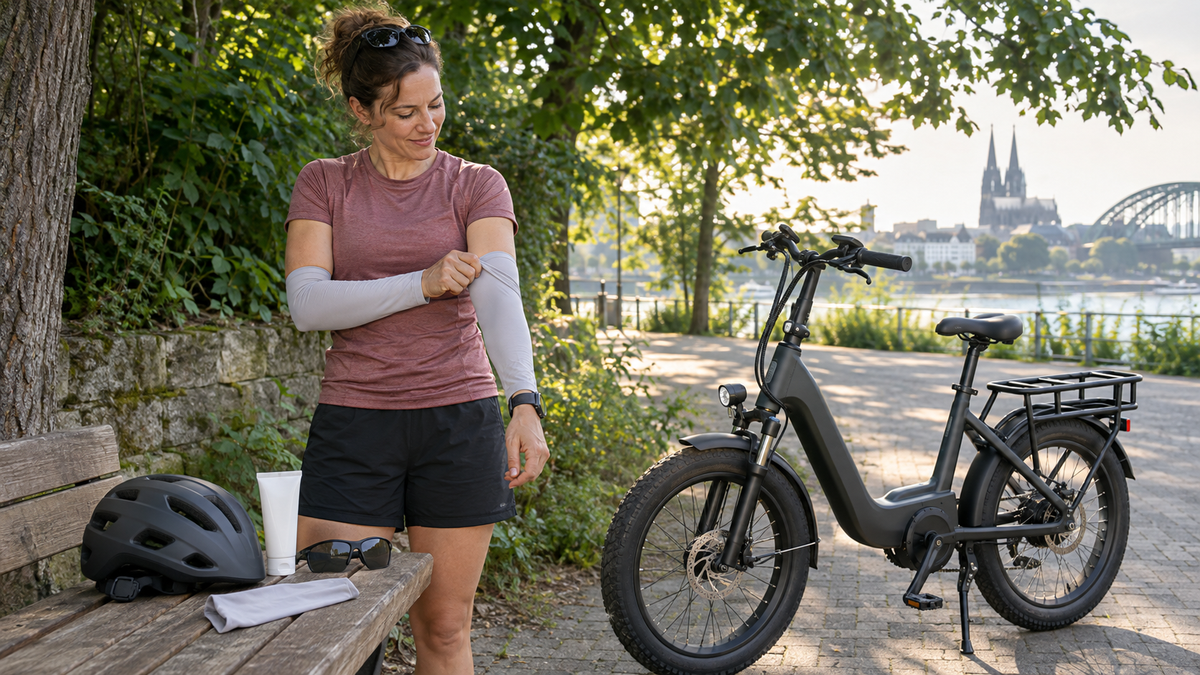
Sun protection while cycling starts with the UV Index, not how warm it feels. Even on a mild or partly cloudy day, UV exposure may make protection necessary. For ride planning, this means checking the forecast for your location and the time of day, combining protective measures from a UV Index of 3, and moving your ride out of the intense midday sun when values are very high.
A bicycle helmet protects your head in a fall, but does not cover your face, ears, neck, hands, or often large parts of your arms and legs. That is why clothing, a securely fitting helmet, suitable eye and skin protection, and planned breaks in the shade all work together. Sunscreen is a supplement, not a way to extend your time riding in strong sunlight indefinitely.
Sun protection while cycling: the short answer
Before setting off, check the UV forecast from the German Weather Service or the Federal Office for Radiation Protection. From a UV Index of 3, protective measures are advisable or necessary. Whenever possible, plan long rides for earlier or later in the day, wear tightly woven, comfortable clothing, and protect exposed skin with broad-spectrum sunscreen with at least SPF 30. Sunglasses should provide verified UV protection.
- Before you go: Check the UV Index for your route and the time of day.
- Plan ahead: Reduce exposure to intense midday sun and long stretches without shade.
- Cover up: Prefer clothing to sunscreen, without compromising freedom of movement or helmet fit.
- Apply sunscreen: Apply generously to exposed skin and reapply after sweating.
- Protect your eyes: Check for labels such as UV 400 or 100% UV protection.
The UV Index measures radiation, not heat or glare. Heat alerts and visibility issues require separate decisions and cannot be inferred from the UV value.
What the UV Index means for a bike ride
The German Weather Service describes the UV Index as a measure of the expected peak daily level of sunburn-causing UV radiation. Its meaning is the same worldwide, and the scale has no upper limit. The higher the value, the faster unprotected skin and eyes can be damaged.
| UV Index | Classification | Planning your bike ride |
|---|---|---|
| 0–2 | Low | For the general population, special protection is usually not needed; however, consider individual sensitivity and long periods outdoors. |
| 3–5 | Moderate | Plan for clothing, sunscreen, and UV-protective sunglasses; use the shade at midday. |
| 6–7 | High | Reduce exposed stretches during the most intense part of the day and plan breaks in the shade. |
| 8–10 | Very high | Use additional protection and try to avoid long periods outdoors around midday. |
| 11+ | Extreme | Consistently avoid exposure during the most intense part of the day and combine all protective measures. |
The table is not a personal “minute counter.” Skin type, previous exposure, elevation, reflections, and time spent outdoors all affect individual risk. So don’t plan a ride around a supposedly safe time to sunburn.
Plan your route and timing around UV exposure
Check the forecast the evening before your ride and again in the morning. The starting location is not the only thing that matters. A long route may pass through areas with different UV levels, and the daily peak often occurs around solar noon. If possible, plan longer stretches in the open before or after this period.
A shady bike path is helpful, but shade does not block UV radiation completely. The World Health Organization notes that UV radiation can be scattered and reflected, especially near water, bright surfaces, or snow. So even a lakeside path with occasional groups of trees is not a UV-free area.
Cloud cover is not a reliable substitute for the forecast either. Clouds can reduce visible light more than UV radiation. If you make decisions based only on brightness or how warm it feels, you may underestimate your exposure. The specific UV index is a better basis for planning.
This schedule concerns UV exposure only. Hydration, effort management, and heat warning signs belong in a separate heat strategy. A high UV index also does not indicate glare or visibility.
Combine clothing, a helmet, and sunscreen
The most effective coverage comes from tightly woven clothing that covers as much skin as possible without chafing while riding. Lightweight long-sleeved tops or UV-protection sleeves can reduce exposed arms. Light-colored or thin fabrics are not automatically sufficient; the fabric, its condition, and any stated UV-protection rating are what matter. Wet or heavily stretched textiles may offer different protection than when dry.
Keep the helmet adjusted according to the manufacturer's instructions. Thick hats, makeshift scarves or wide brims worn under the helmet can affect its fit and strap placement. Use only thin, helmet-compatible options approved by the helmet manufacturer. For the neck and ears, options include a high-neck jersey, a compatible neck cover or sunscreen on exposed areas.
Before setting off, check for common gaps: between sleeve and glove, the neck above the collar, ears, face, hands, and the area between trousers and socks. When leaning forward on the bike, different areas of skin may be exposed than when standing in front of a mirror.
Plan how to apply sunscreen to exposed skin
The government health portal gesund.bund.de recommends using a sunscreen with UVA and UVB filters and at least SPF 30 when UV exposure is high. Very high protection is recommended at high altitudes, in snow, near water or in particularly sunny regions. Choose a product you can tolerate in sufficient quantities and will actually use.
Before setting off, apply it generously to all uncovered areas, following the product instructions. Commonly missed areas include the nose, ears, lip area, neck, backs of the hands, knees and the strip of skin between clothing items. The WHO recommends renewing broad-spectrum protection after about two hours and especially after heavy sweating, swimming or exercise. Always follow the specific product instructions.
Reapplying sunscreen does not extend the safe time outdoors indefinitely or reset the UV dose you have already received. Sunscreen supplements shade and clothing. If you justify a long midday ride solely by using a high SPF, you are using sun protection incorrectly.
If you have a skin condition, known intolerances or take medication that may affect light sensitivity, it is advisable to seek individual medical or pharmaceutical advice. This guide does not replace it.
Protect your eyes without confusing glare with UV
The level of UV protection does not depend on how dark a lens looks. The gesund.bund.de portal recommends sunglasses labeled “UV 400” or “100% UV protection” and with adequate side protection. A close-fitting, cycling-friendly design can reduce light entering from the sides, but must not compromise your field of vision, ventilation or helmet straps.
Polarization, tint color, and contrast enhancement are different properties. On their own, they do not prove that a lens provides adequate UV protection. Check the product labeling and seek professional advice if you wear prescription lenses or are unsure. Replace scratched lenses and loose arms if they affect your vision or a secure fit.
This section covers protecting your eyes from UV radiation. Staying safe in traffic when the sun is low, light levels change sharply, or oncoming traffic is dazzling is a separate road safety issue.
Practical checklist for setting off and taking breaks
Before setting off
- Check the UV forecast for your route and planned riding time.
- Reroute to avoid exposed midday stretches when UV levels are high.
- Check that your clothing, helmet, and glasses fit securely without leaving gaps.
- Apply sunscreen to exposed skin as directed on the product.
- Keep a small pack of sunscreen within easy reach instead of at the bottom of your bag.
On the ride
- Take breaks in effective shade, but don’t assume shade provides complete UV protection.
- Reapply sunscreen after heavy sweating or as directed on the product.
- Adjust sleeves, collar, and glasses if they have shifted.
- Reassess your protection plan if your route changes or your ride takes significantly longer than planned.
Frequently asked questions about sun protection while cycling
Do I need sun protection when it’s cloudy?
The UV index is what matters. Clouds can let some UV radiation through; brightness and temperature are not reliable substitutes.
Does a bicycle helmet fully protect your head?
No. Openings and exposed areas on the face, ears, and neck still matter. Do not modify your helmet or compromise its fit to add sun protection.
Is sunscreen with a high SPF enough on its own?
No. Official recommendations combine avoiding intense sunlight, seeking shade, wearing protective clothing, and protecting your eyes and skin. Sunscreen should not be used to artificially extend the time spent in the sun.
Is sun protection only necessary in midsummer?
No. The DWD and BfS point out that high UV levels can also occur in spring and at higher elevations. Check the daily value rather than just the month.
Conclusion: Check the UV index before every longer ride
Before your next ride, check the local UV forecast and note the expected peak value. If it is 3 or higher, plan your riding time, stretches in the shade, clothing, glasses, and sunscreen. Pack the sunscreen where you can reach it during a break. This quick routine is more reliable protection than thinking, “It doesn’t feel hot today.”
As of November 3, 2026. This article covers UV protection when planning a ride and does not replace advice from a dermatologist, ophthalmologist, or pharmacist.
Share:
Bike parking garage at the station: Check booking, access, and backup plan
S-Pedelec on the bike path: When is it allowed?