

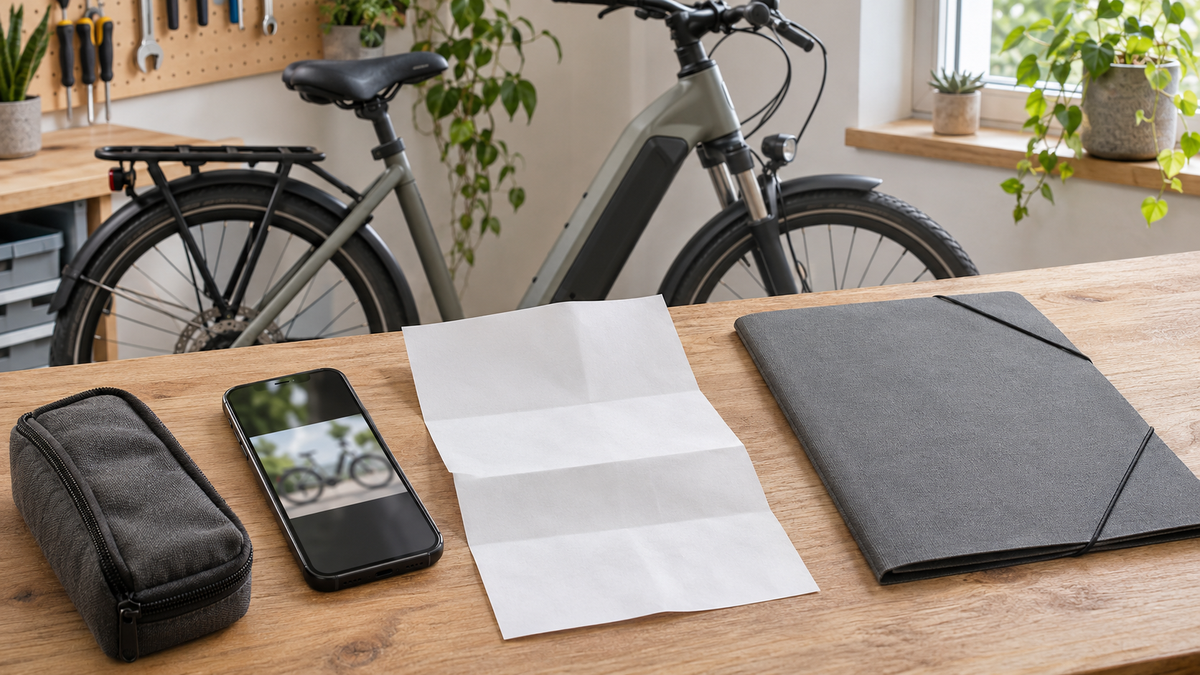
When a defect occurs, statutory liability for defects and an e-bike warranty are often confused. For statutory liability for defects, the seller is generally your point of contact. A warranty, on the other hand, is an additional, voluntary promise from the warrantor—often the manufacturer—and applies only under its terms. So first check the purchase date, seller, symptoms, and warranty documents. Contacting the wrong party directly or treating wear and tear as a defect wastes time and makes documentation more difficult.
E-bike statutory liability for defects or warranty: the short answer
If the e-bike has a defect whose cause was already present at the time of delivery, the statutory rights regarding defects apply against the seller. The first step is subsequent performance: repair or delivery of a defect-free item. A manufacturer’s warranty may also apply, but does not replace these rights.
| Aspect | Statutory liability for defects | Voluntary warranty |
|---|---|---|
| Contact | The seller under the purchase contract | The warrantor named in the warranty |
| Legal basis | BGB and specific purchase contract | Warranty statement and warranty terms |
| Basis | A defect caused by circumstances that existed at the time of delivery | Promised durability, functionality, or component coverage |
| Initial remedy | Subsequent performance subject to the statutory requirements | Only the service promised in the document |
| Costs | For valid subsequent performance, the seller bears the necessary transport, travel, labor, and material costs | According to the warranty terms; statutory rights remain unaffected |
| Typical documents | Proof of purchase, defect report, photos, correspondence | Also provide the warranty statement, serial number, and any required supporting documents |
The terms alone do not establish whether a specific battery, motor, sensor, or mechanical component is covered. The deciding factors are the cause, timing, contract, and, in the case of a warranty, its exact scope.
What rights does the BGB provide in the event of a defect?
Section 437 BGB sets out the buyer’s rights. If there is a defect and the relevant requirements are met, the buyer can demand subsequent performance. Withdrawal from the contract, a price reduction, or damages are available only if the additional requirements for those remedies are met. It is therefore usually wrong to demand a full refund immediately after the first fault.
Repair or replacement with a defect-free item
Under Section 439(1) of the German Civil Code (BGB), the buyer can generally choose between remedying the defect and supplying a defect-free item. The seller may refuse the chosen remedy if it is possible only at disproportionate cost; in that case, the claim may be limited to the other remedy. Whether a complete replacement or repair of a component is appropriate for an e-bike cannot be determined from the price of the part alone.
The e-bike must be made available to the seller for a remedy. Agree in writing in advance on drop-off, collection, or shipping. Do not send a heavy e-bike or battery using an unsuitable parcel service without authorization. Transport and hazardous goods requirements continue to apply regardless of consumer sales law.
Which costs does the seller cover?
Section 439(2) specifically lists transport, travel, labor, and material costs as necessary expenses for providing a remedy. This applies to a valid warranty claim. Confirm the procedure and coverage of costs before asking an independent repair shop to carry out work. A repair arranged without prior agreement may make it harder to obtain reimbursement later.
What does the reversal of the burden of proof in the first year mean?
If, in a consumer sale, a condition that does not meet statutory requirements becomes apparent within one year of the transfer of risk, § 477 BGB presumes that the goods were already defective when the risk was transferred. This presumption does not apply if it is incompatible with the nature of the goods or the condition. This is not a one-year comprehensive warranty and does not automatically prove every instance of damage.
Once this year has passed, a possible claim does not automatically disappear. However, proving the case becomes more difficult because the buyer generally has to show that the cause of the defect was already present when the goods were handed over. So record the first occurrence of the fault, the mileage, any displays and the circumstances promptly. Keep diagnostic reports and replaced parts as agreed.
For new goods, the standard limitation period for claims for defects is two years. For consumer sales contracts from 31 July 2026, the original limitation period is extended once by twelve months if the remedy is provided by repair (§ 475e(5) BGB; Art. 229 § 72 EGBGB).
What a voluntary e-bike warranty can cover
A warranty may be provided by the manufacturer or seller and may cover certain components, features, or periods. Section 479 of the German Civil Code (BGB) requires consumer warranties to be explained clearly and simply. Among other things, the explanation must identify the warrantor, the procedure, the goods covered, the duration, and the geographical scope. It must also state that statutory rights in respect of defects are free of charge and are not limited by the warranty.
Don't just check the warranty period on a promotional webpage. Read the full terms:
- Does it cover the entire e-bike or only the frame, motor, battery, or electronics?
- Is a specific remaining battery capacity guaranteed, or only that it will function?
- Are wear parts, commercial use, racing, falls, or water damage excluded?
- Are inspections or registrations listed as requirements?
- Who pays for transport, diagnosis, labor, and reinstallation?
- Does the warranty still apply after resale and in your current country of residence?
An exclusion in the voluntary warranty does not automatically eliminate a statutory claim against the seller. Conversely, an expired statutory warranty period does not turn normal wear and tear into a warranty claim.
How to report an e-bike defect properly
- Safety first: If the battery becomes unusually hot, smells, smokes, or has deformed components, or if there are braking or steering problems, do not continue riding or charging it. Follow the manufacturer's instructions and contact a specialist workshop.
- Establish who you bought it from: Find the invoice, order number, handover date, and seller. A bank statement can provide additional evidence of the purchase.
- Document the fault: Record the date, mileage, conditions, display message, and photos or a short video, without conducting any potentially dangerous tests.
- Request a remedy in writing: Describe the fault precisely and set a reasonable deadline. Do not claim a cause that has not yet been diagnosed.
- Check the warranty separately: Use the warranty provider and process only if the terms are more favorable or otherwise helpful in your case.
- Document the handover: Note accessories, keys, battery, charger, visible damage, and mileage when handing over the bike.
- Keep records of communications: Collect emails, shipping receipts, workshop reports, and commitments in one file.
Avoid tampering with sealed battery housings, motors, or safety-critical components. This can be dangerous and make it harder to identify the technical cause.
Distinguishing wear and tear, used bikes, and the “right to repair”
Brake pads, tires, the chain, and the battery wear out with use. Wear and tear is not automatically a defect. However, unusually early failure may need to be investigated if the agreed or objectively expected condition is not met. Blanket statements such as “batteries are always subject to wear and tear” or “everything is free within two years” are therefore unreliable.
For used goods purchased from a retailer, deadlines may be agreed differently under certain legal conditions; private sales are subject to different rules. Read the contract and the specific description of the item’s condition. A known defect that was expressly agreed upon is assessed differently from a defect discovered later that was concealed.
The term “right to repair,” used since July 31, 2026, should not be applied broadly to every complete e-bike. The separate claim against manufacturers applies only to certain product groups and is not the same as a free repair under statutory warranty rights. Whether a specific component is covered must be assessed separately. This article does not constitute legal advice.
Frequently asked questions about e-bike statutory rights for defects and warranties
Do I have to contact the manufacturer?
The seller is generally responsible for statutory rights relating to defects. The manufacturer is the right warranty partner only if its warranty terms say so. The seller cannot reject your claim solely because a manufacturer’s warranty is available.
Can the retailer charge an inspection fee right away?
If you are entitled to a remedy, the seller must cover the necessary costs. If the cause is unclear, agree transparently in advance on the scope of the inspection, any potential costs, and when they are due. Consumer advice centers point out that retailers cannot simply charge you during the warranty period without a valid basis.
Is a receipt mandatory?
You must be able to prove the purchase. Depending on the case, an invoice, order confirmation, or bank statement may also be sufficient. Additional proof may be required for a voluntary warranty if its terms validly provide for this.
When should I seek advice?
If your claim is rejected, repeated attempts to remedy the defect fail, the cause of an accident is disputed, consequential costs are high, or deadlines are unclear, contact a consumer advice center or seek qualified legal advice. Preserve evidence before any parts are discarded or modified.
Conclusion: Contact the seller and pursue your statutory rights for defects first, then check the warranty terms
Don’t classify your case based only on the word “warranty.” Keep proof of purchase and documentation of the defect, report the problem to the seller in writing, and initially request a remedy. Also review the warranty statement and its exclusions. The next sensible step is to compile a complete case file with the date, photos, mileage, and a clear deadline. Seek independent advice early in cases involving legal or technical disputes.
Share:
Bike parking garage at the station: Check booking, access, and backup plan
Sun protection while cycling: Plan your ride around the UV index