

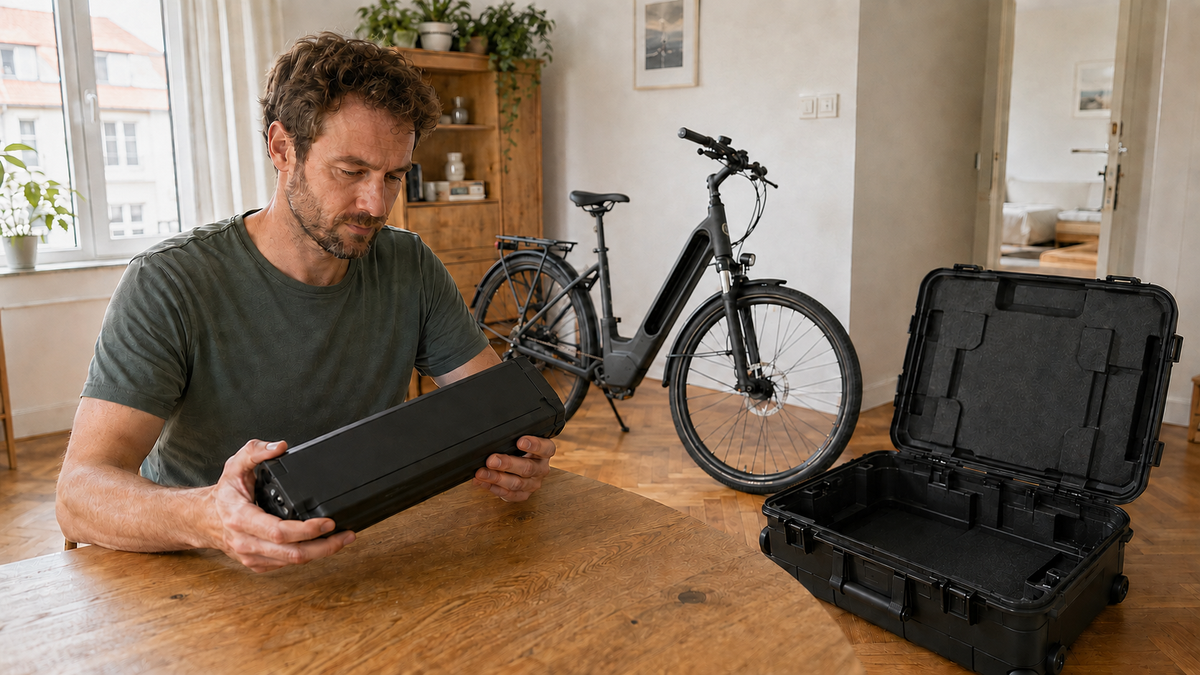
An e-bike battery is not ordinary luggage for air travel. The decisive factors are the energy in watt-hours, the battery’s condition, and the rules of the operating airline. The general limits for lithium-ion batteries help provide context, but they do not automatically permit you to bring an e-bike. That is why planning starts before booking, not at the oversized-baggage counter.
Watt-hours are the first checkpoint
The rating plate usually shows the voltage in volts and capacity in ampere-hours, or the watt-hours directly. If the Wh value is missing, it can be calculated by multiplying the nominal voltage by the ampere-hours. Use only the manufacturer’s specifications for this. An illegible rating plate, an unknown replacement battery, or a self-estimated capacity is not sufficient for flight approval.
The European Union Aviation Safety Agency EASA explains the specific risks of lithium batteries. For passenger baggage, the general rule is: up to 100 Wh, the normal rules for permitted portable electronics apply; above 100 and up to 160 Wh, approval from the airline is required; and above 160 Wh, transport is possible only as properly prepared dangerous goods. These thresholds do not yet mean that a specific e-bike or its battery will be accepted.
Why carry-on baggage is not a simple solution
According to the IATA guidance for travelers, spare batteries may not be placed in checked baggage. Permitted loose batteries must be protected and carried in carry-on baggage; their contacts must be secured against short circuits. Batteries between 100 and 160 Wh also require the airline’s approval. A battery above 160 Wh does not become suitable for carry-on baggage as a result.
A removed battery is still a loose lithium-ion battery. Wrapping it in clothing, distributing it between two bags, or describing it at the counter merely as “bicycle accessories” changes neither its capacity nor its dangerous-goods status. Incorrect or incomplete declaration can lead to refusal and creates an avoidable safety risk.
The airline may impose stricter rules
Airlines may go beyond the general battery limits. In its battery and baggage overview, Lufthansa lists e-bikes, pedelecs, and S-pedelecs as battery-powered means of transport that are not permitted in passenger baggage. The ban there also applies to a corresponding vehicle without an installed battery. Other airlines may treat bicycles without a motor or an e-bike without its battery differently.
Therefore, check the conditions of the actual operating airline for every flight segment. A ticket may be sold under a familiar brand but operated by another airline. Before purchasing, request written confirmation covering the bicycle type, battery removal, packaging, dimensions, and weight. The general statement “sports equipment permitted” is too vague for this purpose.
Damaged or recalled batteries stay at home
A battery with a crack, swelling, unusual heat, a burning smell, leakage, or visible accident damage belongs neither in the cabin nor in the hold. The same applies to batteries recalled by the manufacturer for safety reasons. EASA explicitly warns of the risks of heat, fire, and short circuits from damaged, defective, or recalled lithium batteries.
Do not “quickly run down” such a battery before the trip, and do not send it via a standard parcel service. Deactivate the system as specified by the manufacturer, keep it away from combustible materials, and clarify the next steps with the manufacturer, a specialist business, or a municipal collection point. In the event of smoke, intense heating, or fire, call emergency services at 112.
Four realistic alternatives to taking the battery with you
- Rent an e-bike at your destination: This is often the simplest solution because the vehicle, battery, and charger remain together as a coordinated system on site.
- Take the bicycle without the battery: This works only if the airline and bicycle manufacturer permit it and a legally available, exactly compatible original battery is available at the destination.
- Use rail or travel by land instead: For trips within Europe, a connection without air freight may be more practical. The applicable transport conditions still need to be checked.
- Arrange specialized freight: A dangerous-goods service provider can assess whether compliant freight transport is possible. This is different from normal travel baggage or a standard parcel.
A rented battery does not fit merely because the plug looks similar. The housing, mount, voltage, communication, charger, and approval must match the system exactly. Without written compatibility confirmation, the rented-battery idea is not a reliable travel plan.

How to contact the airline correctly
- Which bicycle or pedelec is to be transported on which specific flight?
- Is the drive battery removable, and what is its rated energy in Wh?
- Will the bicycle be accepted without its battery as sports or special baggage?
- What packaging, dimensions, weight limits, and advance-registration requirements apply?
- Does the approval apply to all operating airlines and connecting flights?
- Which documents must be presented at check-in?
Save the response together with the booking number and transport conditions. A telephone statement without reference to the specific itinerary can be difficult to verify at the airport. Check the rules again shortly before departure, as airlines may change their dangerous-goods and baggage requirements.
Preparing the bicycle without its battery
If explicit acceptance has been confirmed, pack the bicycle according to the manufacturer’s and airline’s instructions. Protect the motor connection and the contacts of the removed battery in accordance with the system instructions, without inserting conductive objects. Secure loose accessories; the packaging must not place stress on the brakes, gears, or wheels.
Hydraulic brakes, shifting components, and sensitive displays require a transport-safe position. Remove components only if the instructions provide for this and you can correctly reinstall and inspect them at the destination. An e-bike without its battery is heavier than many conventional touring bicycles, so carrying distance and permitted baggage weight must also be included in the planning.
If the battery is rejected at the airport
Plan in advance who could take back the battery if necessary. It must not be left unattended, disposed of in the waste, or spontaneously handed to a stranger. Without a safe return or storage option, the entire trip may fail. Clarifying this in writing beforehand reduces the risk but does not eliminate the security check.
After a refusal, do not try to use another type of baggage or a second counter without disclosing the classification. The current decision of the responsible airline and security authorities remains decisive. If in doubt, renting an e-bike at the destination is the more robust solution.
Frequently asked questions
Can an e-bike battery up to 160 Wh always be taken on a plane?
No. The Wh limit is only one part of the dangerous-goods rules. Between 100 and 160 Wh, airline approval is required, and the airline may completely exclude e-bikes or their batteries.
Can I check in the e-bike as a bicycle without its battery?
Only if the operating airline confirms this for the specific itinerary. Some airlines accept an e-bike without its battery, while others exclude the vehicle as well.
Can I send the battery ahead with a parcel service?
Not as an ordinary parcel. Lithium-ion batteries may be subject to dangerous-goods regulations. A suitable service provider must assess the classification, packaging, labeling, and transport route.
What is the simplest solution for air travel?
In many cases, renting an e-bike at the destination is easier than transporting the vehicle and battery. Availability, size, range, and return conditions should be reserved in advance.
As of: September 6, 2026. The current dangerous-goods and baggage rules of the operating airline, as well as the requirements of the battery and bicycle manufacturer, are authoritative.



Share:
Cycling During Thunderstorms: Check Warnings and Seek Shelter in Good Time
Bicycle chain skipping under load: safely narrow down the causes