

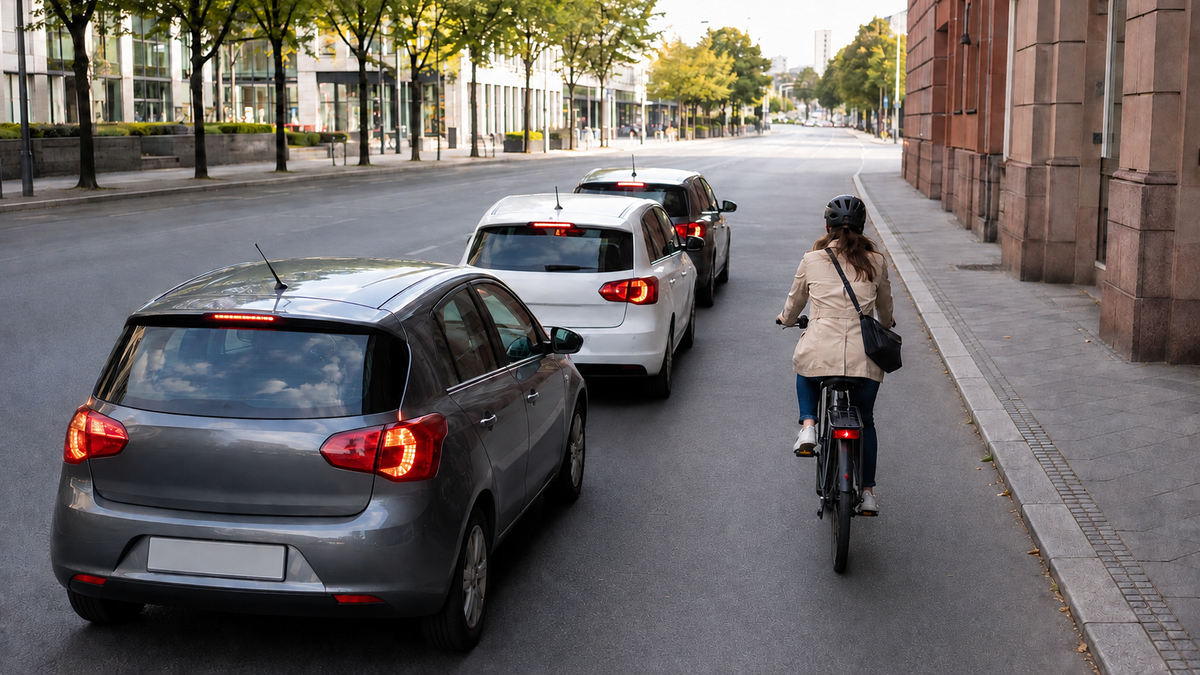
In a traffic jam or at a red light, people often ask: May a bicycle pass cars on the right? Germany’s Road Traffic Regulations allow this under strict conditions. It is neither a general right to overtake on the right nor an obligation to use every gap. The decisive factors are waiting vehicles, sufficient space, moderate speed, and particular caution.
The rule in Section 5(8) of the StVO
Section 5(8) of the German Road Traffic Regulations (StVO) allows people riding bicycles or mopeds to pass on the right, at a moderate speed and with particular caution, vehicles waiting in the right-hand lane if sufficient space is available. Each of these conditions is part of the permission. If there is not enough safe space or the line of cars starts moving, the special rule no longer applies unchanged to the situation.
The provision does not specify a blanket minimum distance in centimeters or a fixed maximum speed. What is “sufficient” depends on the vehicle’s width, the curb, the condition of the surface, doors, visibility, and possible movements. “Moderate” means a speed at which you can react immediately to a door opening, a swerve, or a person crossing.
Do not assess the gap only at its widest point. A protruding mirror or a bottleneck shortly before the traffic light can make the entire passage unsuitable. Anyone who would have to stop there should not ride alongside the line in the first place.
Waiting is not the same as moving slowly
The special rule expressly refers to waiting vehicles. A slowly moving line of cars is therefore not a free pass to continue riding on the right between the vehicles and the curb. When the line starts moving again, reduce your speed, merge safely, or stay behind it. Do not force your way alongside a vehicle.
Slaloming between lanes is also not covered by this rule. Passing on the right does not mean using the sidewalk, a hatched area, or a side area where cycling is not permitted. If there is a mandatory or permitted cycle path, its own traffic signs and traffic signals apply.
When there is not “sufficient space”
- Only a narrow, uneven gap remains between the vehicle and the curb.
- Parked vehicles may open their doors into your path.
- A truck or bus may obscure people, bicycle traffic, or the intersection area.
- Mirrors, trailers, or parts of vehicles swinging out can narrow the passage.
- Potholes, tracks, leaves, snow, or a groove can prevent you from maintaining a stable line.
- Pedestrians may cross the road between waiting vehicles.
In these cases, stay behind the vehicle. Under the principle set out in § 1 StVO, no one may harm or endanger anyone else, or obstruct or inconvenience others more than unavoidable. Being physically able to just squeeze through a gap does not make it a sufficiently safe space.
Spot right-turning vehicles early
Intersections, driveways, and petrol stations are particularly critical. A vehicle may be signaling right, already be slightly turned, or be waiting because of a crossing pedestrian. Stay out of the area directly beside large vehicles. The driver may fail to see you there despite mirrors and driver-assistance systems; the rear wheels of a turning truck also take a tighter line than the front.

§ 9 StVO requires turning vehicles to show particular consideration for bicycle traffic and to wait if necessary. Nevertheless, do not rely on having been seen. Eye contact is helpful, but not proof. If the turn signal, wheel position, or vehicle movement is unclear, stay behind.
The risk posed by vehicle doors
People may get out on the right side of a stationary line of vehicles. Under § 14 StVO, anyone getting in or out must behave in a way that rules out endangering others. Nevertheless, a door zone remains a real hazard for your decision-making. Do not ride into a gap if a door could occupy the entire available space at any moment.
Watch for brake lights, movement inside the vehicle, parked taxis, delivery vehicles, and vehicles carrying children. These indications are no guarantee. Exercising particular caution also means refraining from passing even when the car is still waiting.
Before the traffic light: don’t blindly ride all the way to the front
The closer you get to an intersection, the more potential conflict points arise. Pedestrians cross between vehicles, cars turn, and signals can change. Proceed only as far as you can safely see the intersection area, traffic lights, and clear space. Stop before the stop line or at the waiting area designated for bicycle traffic.
A dedicated bicycle signal applies to the bicycle traffic to which it is assigned. If there is no dedicated signal, its applicability depends on the specific traffic layout. Do not set off on a signal whose assignment you cannot clearly identify. An open gap on the right never permits you to run a red light.
When traffic starts moving again
- Immediately adjust your speed to the new situation.
- Do not accelerate alongside a vehicle that might move to the right.
- Continue only when the space is clearly free.
- Otherwise, slow down in a controlled manner and merge in behind the vehicle.
- Do not force your way into a gap with your bell, shouting, or physical contact.
A heavy e-bike requires good balance when traveling slowly and stopping. Choose a gear that allows you to set off again in a controlled manner, and keep one foot ready to support yourself safely. The motor assistance must not unexpectedly pull you into a narrow gap; use a low assistance level and follow your system’s operating instructions.
Cycle lanes and advisory cycle lanes
A marked area on the right can make traffic guidance clearer, but it does not eliminate conflicts at junctions and doors. Hold your line, pass at an appropriate speed, and expect vehicles to cross the area when turning. If the lane is blocked, you must not abruptly move into the traffic lane without looking back first.
Before making a necessary lane change, check the traffic behind you, clearly signal the change of direction, and change lanes only when there is a sufficiently large gap. If this is not possible, stop in a safe place. An obstacle does not justify making a sudden move into moving traffic.
A simple decision-making sequence
- Are the vehicles actually waiting in the right-hand lane?
- Is there sufficient space throughout the entire passage?
- Are doors, pedestrians, right-turning vehicles, and road damage easy to see?
- Can you stop at any time while traveling at a moderate speed?
- Does the situation remain stable? If not, do not pass.
Frequently asked questions
May I always pass on the right in a traffic jam?
No. The vehicles must be waiting, there must be sufficient space, and you must proceed at a moderate speed and with particular caution. If in doubt, stay behind.
Is there a fixed lateral clearance for this?
Section 5(8) does not specify a blanket distance in centimeters. The gap must be sufficiently safe under the specific conditions. The door zone, curb, and possible vehicle movements all need to be taken into account.
May I pass a waiting truck on the right?
Being close to a right-turning or hard-to-see truck is particularly risky. If in doubt, stay well behind it and outside the lateral danger zone.
Do I have to use the permission?
No. You may always wait behind the line of vehicles if the passage seems too narrow or unclear. Safety comes before saving time.
Share:
Crossing a railway crossing by bike: Wait, cross, and avoid tailbacks
Crossing a railway crossing by bike: Wait, cross, and avoid tailbacks