

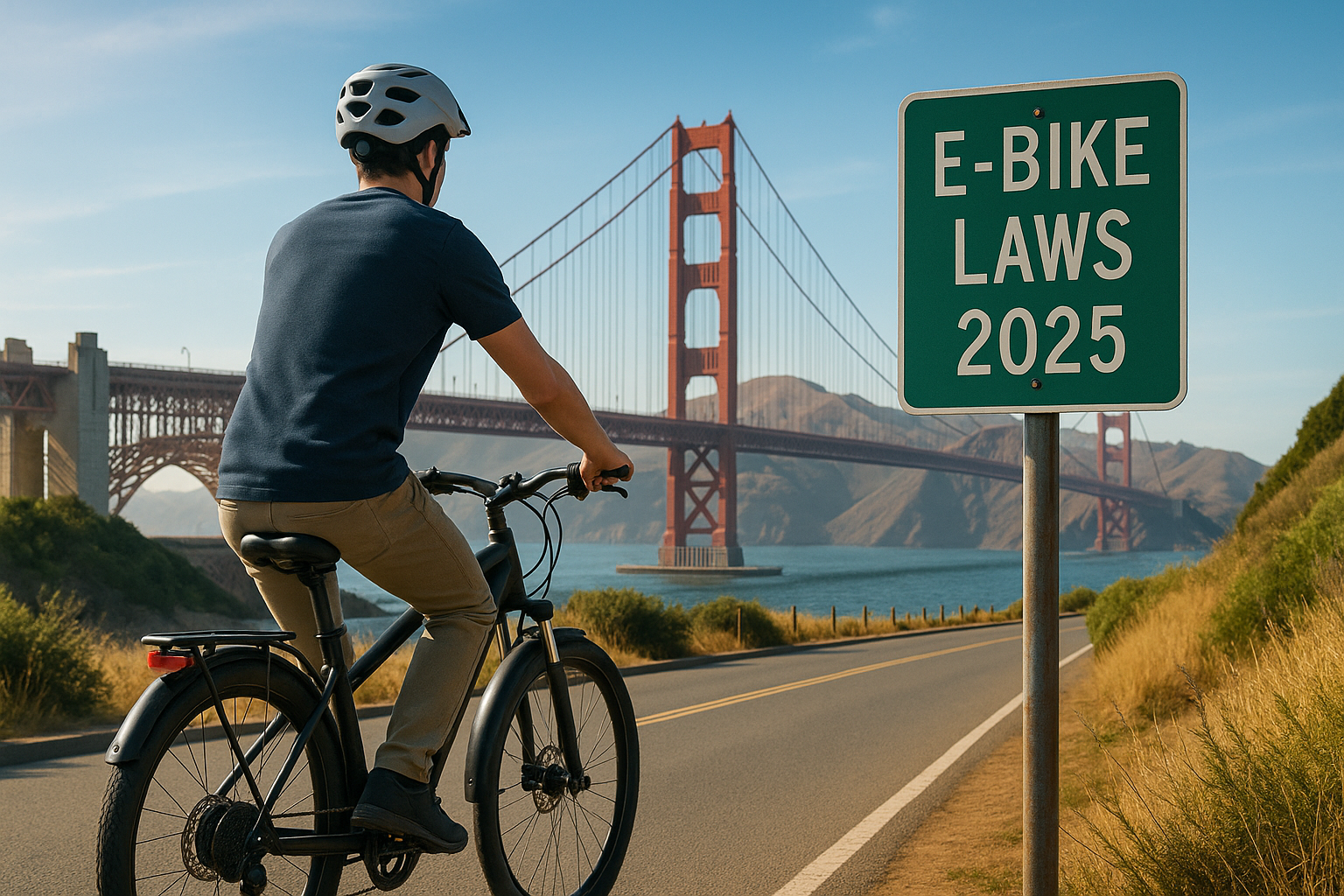
Are you worried about overlooking important legal details when buying an e-bike? While new laws such as SB 1271 apply in the USA, in Germany the StVZO (Road Traffic Licensing Regulations) is the ultimate authority.
Buying an e-bike requires more than just looking at the wattage. The wrong model can quickly lead to fines or insurance problems. Here are 7 mistakes you should avoid to stay legal and safe on the road.
1. The misconception about the “throttle” (thumb throttle)
In the USA, e-bikes with a throttle that can be ridden without pedaling are widespread. In Germany, this is illegal for ordinary pedelecs.
✅ The rule: A pedelec may provide motor assistance only when you are also pedaling.
The exception: A push-assist function up to 6 km/h is permitted.
The trap: Do not buy an imported bike that can reach 25 km/h or faster using a thumb throttle without you having to pedal. Legally, this is considered a motor vehicle (like a moped) and requires insurance and a helmet!
2. Exceeding the 250-watt and 25-km/h limits
Many international e-bikes advertise 750 watts or 500 watts of power.
The law: In Germany, a pedelec that does not require a driving license may have a maximum rated continuous power of 250 watts, and assistance must cut off at 25 km/h.
The risk: Anything beyond this (e.g., S-pedelecs up to 45 km/h) requires an insurance plate, an operating license, and a driving license (class AM).

3. Using S-pedelecs on the cycle path
If you consciously choose a fast S-pedelec (up to 45 km/h), different rules apply than for ordinary bicycles.
Where you may ride: S-pedelecs belong on the road.
The ban: Cycle paths are generally off-limits to S-pedelecs (unless they are explicitly opened to them by the “E-bikes permitted” sign—which is rare). Forest paths are also often prohibited.
Pedelecs (25 km/h): These are legally considered bicycles and may (and often must) use the cycle path.

4. Tuning and “Speed Unlocking”
There are many guides circulating online on how to remove the 25 km/h speed restriction (chip tuning).
The consequence: As soon as you tune your e-bike, its operating licence becomes invalid.
The pitfall: In the event of an accident, your personal liability insurance will not pay. You are liable with all your personal assets. Stay away from “speed modes” or tuning dongles on public roads!

5. Missing CE marking and inspection marks
The necessary certification is often missing, especially on inexpensive direct imports from the Far East.
What to look for: Look for the CE mark and confirmation of compliance with the EN 15194 standard.
Why? Without this marking, the bike may not be legally permitted on public roads in the EU. It is also an indicator of battery safety (fire protection).

6. Misunderstanding helmet and age requirements
Pedelec (25 km/h): There is no mandatory helmet requirement and no minimum age (recommended from around 12–14 years). Nevertheless, we strongly recommend wearing a helmet!
S-pedelec (45 km/h): A helmet is mandatory here (a suitable helmet compliant with ECE-R 22.05 or a special S-pedelec helmet), and the minimum age is 16 (AM driving licence).
7. Giving away financial benefits (leasing instead of vouchers)
While California talks about “vouchers,” Germany has a much better system: company bike leasing (e.g., JobRad, BusinessBike).
The advantage: Through salary conversion, you can save up to 40% compared with buying directly.
Tip: Before buying, check whether your employer offers e-bike leasing.
✅ Short legal checklist (Germany)
| Rule | What to do |
| Speed | Assistance only up to 25 km/h (for bikes exempt from type approval). |
| Power | Max. 250 watts rated continuous power. |
| Throttle | Only permitted as a push-assistance function up to 6 km/h. |
| License plate | Not required for pedelecs (required for S-pedelecs). |
| Bike paths | Pedelecs: Yes / S-pedelecs: No (usually). |
| Safety | Look for CE certification and EN 15194. |
| Save | Use company bike leasing instead of paying in cash. |
Conclusion
German e-bike law (StVZO) is strict, but it ensures safety. Avoid illegal imports with throttles or overly powerful motors. Choose a legal pedelec that complies with EU standards—so you can ride not only relaxed, but also insured and safely.
Stay informed. Ride responsibly.
Additional sources on e-bike safety and traffic law:
ADAC. (2024, August 15). E-bikes and pedelecs: The most important traffic rules. Source: https://www.adac.de/rund-ums-fahrzeug/zweirad/fahrrad-ebike-pedelec/vorschriften-verhalten/e-bike-regeln/
ADFC. (2025, March 10). Legal information for cyclists: What rules apply to pedelecs and S-pedelecs? Source: https://www.adfc.de/artikel/rechtliches-fuer-pedelec-fahrer
Police NRW. (2024, November 05). Illegal e-bike tuning: A dangerous trend with costly consequences. Source: https://polizei.nrw/artikel/e-bike-tuning-kein-kavaliersdelikt
Finanztip. (2025, January 20). Company bike leasing: How to save up to 40% when buying an e-bike through your employer. Source: https://www.finanztip.de/dienstfahrrad/
Stiftung Warentest. (2024, June 02). How to charge and store e-bike batteries safely: How to prevent fires. Source: https://www.test.de/E-Bike-Akku-Sicherheit-5892134-0/
Share:
E-Bike Buying Guide: 7 Mistakes That Will Cost You Dearly
Can I charge my e-bike at a regular power outlet? 5 Safety Tips