

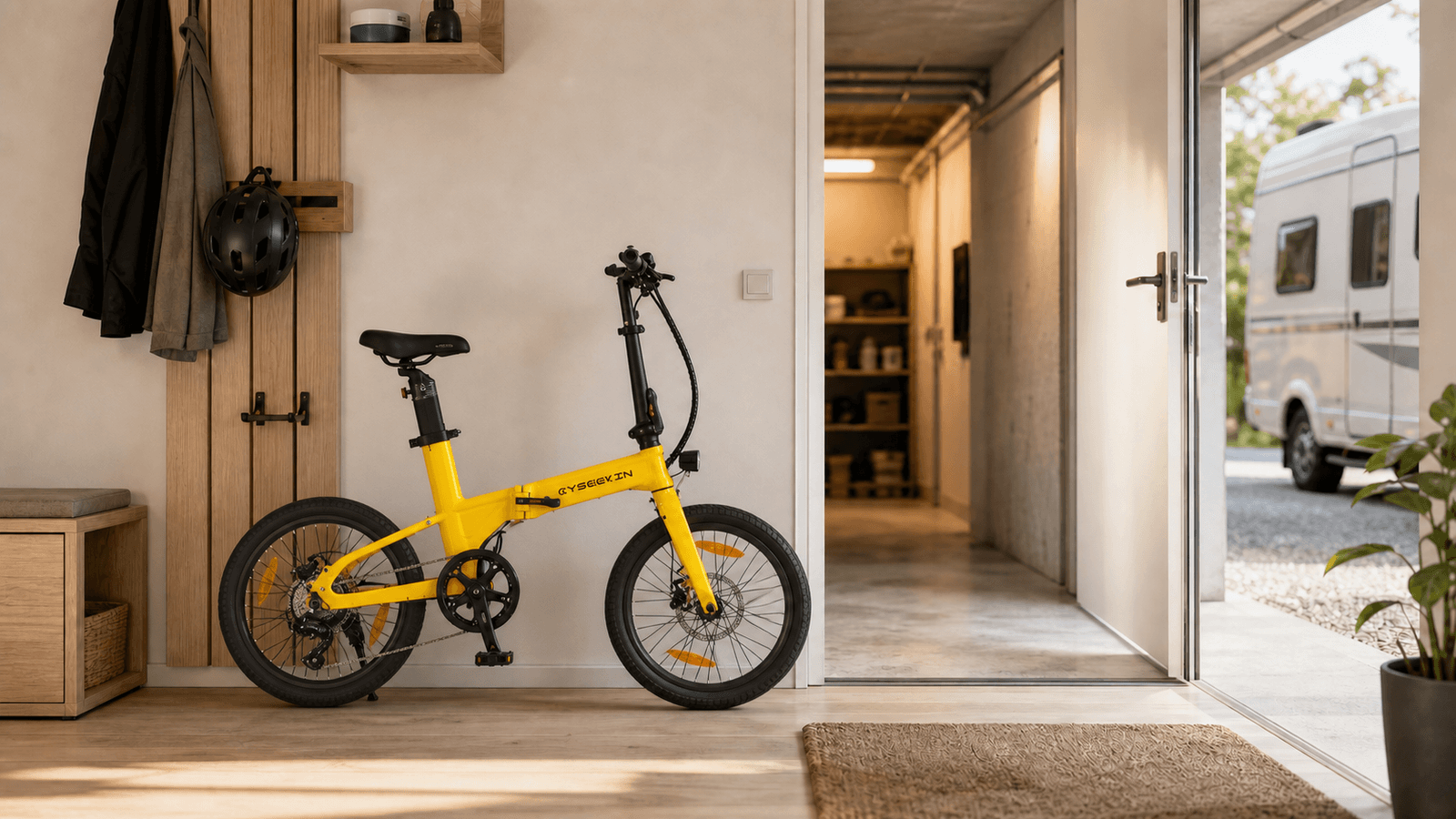
An e-bike is a good fit for an apartment, basement, office, or motorhome when not only its folded dimensions are suitable, but its weight, carrying route, battery removal, charging location, and daily handling also match the actual storage space. Checking these points before buying helps prevent ending up with a bike that seems compact on paper but is too heavy, too wide, or too awkward to move in everyday use.
This guide explains which dimensions and everyday situations really matter and when a lightweight folding e-bike or a more compact mini cargo e-bike is the better choice.
Why folded dimensions alone are not enough
With a folding e-bike, people often look first at its folded dimensions. This is important, but it answers only part of the question. The bike also has to reach its storage space: through doors, around tight corners, into an elevator, up stairs, or into a motorhome’s storage compartment.
So do not measure only the available floor space. Also note the width of the narrowest door, the elevator depth, the turning area in the hallway, and any steps. If the e-bike needs to be carried regularly, its weight is often more important than a difference of a few centimeters in the folded dimensions.
Seven points to check before buying
1. The daily carrying route
A level route from the entrance to the storage room presents different requirements than an apartment on the third floor without an elevator. Think realistically about how often you will need to lift the bike. Even a compact e-bike remains significantly heavier than a regular folding bike because of its motor, battery, and sturdy frame.
For regular carrying, a model that is as light as possible therefore makes sense. If the bike rarely needs to be lifted, comfort, tire width, range, or transport options can be given greater weight instead.
2. The narrowest point along the route
Measure the narrowest doorway, not just the storage space. Also consider handlebar width, pedals, and protruding attachments. In a basement corridor, the length of an unfolded e-bike can be more problematic than its width; in a car trunk or motorhome, the folded height is usually the key factor.
3. How often it is actually folded
Anyone who switches daily between the train, office, and home needs a simple, repeatable folding process. If the bike is only folded for a trip or the winter break, the process can take a little longer. What matters is not an advertising claim, but whether you can safely fold, push, and set up the bike again without improvised maneuvers.
4. Weight and balance when pushing
The weight alone does not indicate how controllably an e-bike can be maneuvered. Also check where the battery and motor are located and whether the bike can be pushed when folded. A removable battery can make handling easier when parking and allows it to be charged separately from the bicycle.
5. Where to charge
Before buying, it should be clear where the battery will be charged. A socket in a dry indoor space is more practical than a makeshift extension cable running through the hallway. Only use the charger intended for the respective e-bike or approved by the manufacturer, and follow the operating instructions.
6. Everyday use or additional transport needs
A folding e-bike that is as small as possible is particularly suitable for limited storage space and frequent changes of location. However, if you regularly carry shopping bags, work items, or accessories, you may need a front basket, luggage rack, or more robust transport options. In that case, a slightly larger model with more versatile equipment may be the better solution for everyday use.
7. Parking space and theft protection
Even in a basement or shared garage, you should be able to secure the bike to a fixed point. Check whether there is enough space for the lock and frame. Removable components should not be left loose in shared areas. In an apartment or office, the parked bike must also not block escape and emergency routes.
Lightweight folding e-bike or compact mini-cargo e-bike?
The right design depends less on a general ranking than on your daily journey. The following overview will help you make the right choice.
| Everyday situation | Particularly important | Suitable approach |
|---|---|---|
| Apartment with stairs | Lower weight, simple folding process, manageable carrying | Lightweight folding e-bike |
| Small basement or office | Door width, turning area, secure parking space, battery removal | Folding e-bike or compact city model |
| Motorhome or trunk | Folded dimensions, vehicle payload, secure fastening | Compact folding e-bike |
| Groceries and daily luggage | Front basket, luggage rack, stable kickstand, and easy step-through | Mini-cargo or everyday e-bike |
| Level, easily accessible storage space | Riding comfort, range, and equipment | Choose based on intended use rather than weight alone |
Cyseekin C10: when weight and flexibility take priority
According to the current product page, the Cyseekin C10 Folding E-Bike weighs 18.6 kg and has a two-stage folding mechanism. It is therefore particularly suitable for people with limited storage space who move the bike frequently or want to store it at the office, in an apartment, or while traveling.
The C10 is not a blanket recommendation for every staircase: 18.6 kg still need to be carried safely. Before purchasing, you should therefore check the actual route to the parking location.
Cyseekin C20: when everyday use and transport matter more
The Cyseekin C20 Mini Cargo E-Bike combines a step-through frame with an optional front basket and rear rack. The current product page lists folded dimensions of 84 × 78 × 44 cm and a net weight of 30 kg. The C20 is therefore better suited to ground-level parking spaces, easily accessible basements, garages, or larger vehicle storage areas than to being carried regularly up several flights of stairs.
Its advantage lies not in the lowest weight, but in combining a more compact semi-cargo concept with easy access and additional transport options for shopping and everyday use.
You can compare other models in the All Cyseekin E-Bikes overview.
How should an e-bike battery be stored?
The bicycle’s parking location and the battery’s storage location do not have to be the same. A removable battery is particularly practical in low temperatures because it can be stored and charged separately from the bike in a dry indoor space.
The Verbraucherzentrale recommends storing the battery in a dry place at around 10 to 20°C and with a charge level of approximately 30 to 60 percent during longer periods of non-use. The ADAC also points out that ideal storage conditions may vary by manufacturer. The instructions in the manual for the specific battery therefore always take precedence.
- Store the battery and charger in a dry place.
- Use only the approved charger.
- Do not leave the battery connected to the charger permanently.
- Do not continue using damaged, deformed or abnormal batteries.
- Follow the manufacturer's specifications for temperature and state of charge.
Buying checklist for limited storage space
- Measure the storage area in length, width and height.
- Check the narrowest door, elevator and turning area.
- Note the number of steps and how often you will carry the bike each day.
- Compare the unfolded and folded dimensions.
- Assess the weight realistically – including any potential accessories.
- Designate space for the battery and charger.
- Determine your transport needs for bags, groceries or work luggage.
- Ensure there is a secure attachment point at the storage location.
- When using the e-bike in a motorhome, check the permitted vehicle payload.
- Check the product dimensions and operating instructions before making a decision.
Frequently asked questions
Can you store an e-bike in your apartment?
Yes, provided there is enough space, no escape routes are blocked and the bike is stored securely. On stairs, weight and controlled carrying are more important than folded dimensions alone.
Is a basement a good place to store an e-bike?
A dry, easily accessible and lockable basement can be suitable. In a cold or damp room, the battery should be stored separately according to the manufacturer's instructions.
Which e-bike is suitable for a small apartment?
A lighter folding e-bike is usually the better choice. However, door width, stairs, storage space and how often the bike will be folded or carried are decisive.
Can a folding e-bike be transported in a motorhome?
Generally, yes, provided the folded dimensions, weight and available payload are suitable. The bike must be securely fastened during transport. Storage space and vehicle limits should be checked precisely beforehand.
When is a mini-cargo e-bike the better choice?
If you regularly transport groceries, bags or everyday luggage and the storage area is accessible without frequently climbing stairs, a compact mini-cargo concept may be more practical than the lightest possible model.
Conclusion
There is no single best e-bike for limited space. The C10 focuses on lower weight and flexible storage. The C20 offers greater everyday carrying capacity and comfort, but its higher weight means it needs a more accessible storage location. Measuring the entire route from the entrance to the storage area before buying usually leads to a better decision than comparing just one folded-dimensions figure.
Share:
Charging an E-Bike on the Go: Where It Works and What to Bring
E-bike with chain or belt: What are the actual drivetrain costs?