

Tour checklist · As of 5 August 2026
Charging on the go works most reliably at an outlet or e-bike charging station confirmed in advance. I bring the charger that matches the battery and is approved by the manufacturer, ask for permission on site, and charge only in a dry, stable location away from flammable materials. I do not plan to use a standard USB power bank as a substitute.
Where can I charge an e-bike while travelling?
“Charging station” can mean different things: a freely accessible outlet, a locker with an outlet, or a system with its own cables. That is why I ask not only about a symbol on the map, but also about the connector, access hours, and permission.
Bicycle-friendly accommodation
- Clarify in advance
- Is an e-bike charging facility available and can it be reserved?
- Bring along
- Compatible charger, key, and only explicitly approved adapters
Café, restaurant, or tourist information office
- Clarify in advance
- May I charge here, where is the battery stored, and are there any costs?
- Bring along
- Your own charger and sufficient break time
Public station or locker
- Clarify in advance
- Socket type, opening hours, access code, and payment
- Bring along
- Depending on the station, bring your own charger; check the operator’s current information
Hotel or campsite
- Clarify in advance
- Is charging allowed in the room, or is a separate charging area required?
- Bring along
- Charger approved by the manufacturer and battery key
For Bett+Bike accommodations, the map search can be filtered by “E-Bike charging station”. This is a good starting point, but no guarantee of a specific connector or an outlet accessible around the clock. For a longer tour, I call ahead briefly.

My pre-tour planning
Estimate range conservatively
Headwinds, temperature, tyre pressure, climbs, luggage, and assistance level affect the actual range. I plan with a reserve and at least one alternative option.
Note charging time, not just kilometres
A location only helps if the break is long enough. A safe partial charge may be sufficient for the remaining distance; the instructions for the specific battery remain decisive.
Confirm the charging location
I save the phone number, address, and opening hours. At a restaurant or accommodation, I explicitly ask for permission; a visible outdoor outlet is not an automatic invitation.
Set a backup plan
If a station is occupied, closed, or faulty, I need a shorter route, a second charging option, or enough remaining energy.
Charge safely: my short checklist
Check the condition
I check the battery and charger for visible damage, moisture, and excessive heat.
Choose a suitable location
The surface is dry, stable, and nonflammable; escape routes remain clear.
Use a suitable charger
I use only the charger suitable for the system and approved by the manufacturer.
Follow the manual
The user manual for the specific e-bike determines the connection sequence.
Stay nearby
During the break, I do not cover the battery or charger and keep them in sight.
Store in a dry place
After charging, I disconnect everything according to the manufacturer's instructions and store the cable and charger in a dry place.
The consumer advice center recommends approved chargers, a dry environment, and keeping a distance from flammable materials. If a battery becomes unusually hot, deforms, develops an unusual smell, or emits smoke, I stop charging, keep my distance, and follow the emergency instructions of the local emergency services. A burning lithium-ion battery is not something to attempt to extinguish yourself.
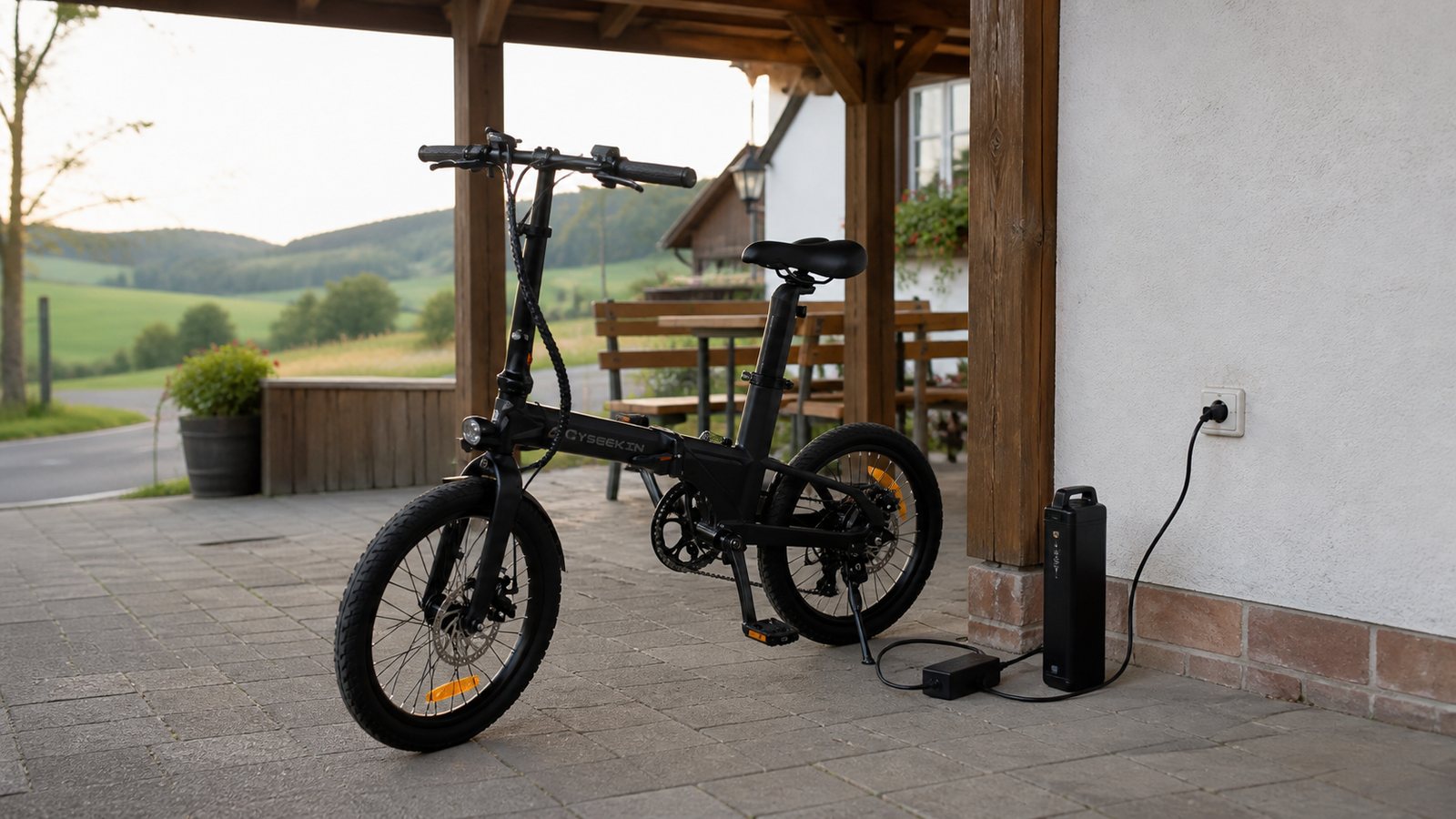
Practical example: charging on the go with the Cyseekin C10
With the Cyseekin C10, the battery can be taken along for a confirmed charging break. I follow the supplied manual for the specific connection sequence and temperature limits.
Important: The product page does not mention approval for direct charging with a standard USB power bank. Therefore, I would not use an improvised DC solution, an arbitrary inverter, or a universal power supply. Anyone who wants to charge without access to a mains outlet should first ask the manufacturer for a suitable solution in writing.
For charging at a standard household outlet at home or at an authorized stopover, the existing Cyseekin article “Charging an E-Bike Battery from a Household Outlet: 5 Safety Tips” covers the basic safety rules.
Packing list for a charging break
- Suitable charger approved by the manufacturer
- Battery and frame keys
- Contact details for the planned charging locations
- Weatherproof bag for the charger and cable
- A second route or charging location as a backup plan
- User manual saved digitally or offline
FAQ about charging on the go
Do I need to bring my own charger to an e-bike charging station?
Often yes, but not always. Some stations offer only an outlet or a locker, while others provide fixed cables. I check the operator's information in advance and bring the appropriate charger as a precaution.
Can I simply use an outlet in a café?
No, not without permission. I ask the staff where the battery may be placed safely and whether a fee applies. Escape routes, wet outdoor areas, and flammable surfaces are unsuitable.
Does charging the battery only partially damage it?
With modern lithium-ion batteries, interrupted charging is generally possible. The instructions from the respective manufacturer remain decisive. I do not have to wait for 100 percent while on the road if a safe partial charge is sufficient for the remaining distance.
Can I charge my e-bike with a power bank?
A standard USB power bank does not replace the e-bike mains charger. Without the manufacturer's explicit approval, I use neither universal adapters nor improvised inverter solutions, because the voltage, power, communication, and safety functions must be compatible.
What should I do if the battery gets hot or behaves unusually while charging?
In the event of unusual heat, deformation, an odor, smoke, or vapor, I stop the process, keep my distance, and call the fire department in an emergency. Verbraucherzentrale warns against attempting to extinguish a battery that is already on fire yourself as a layperson.
Prepare your charging break
Before your trip, check the current battery data for your model and compare your planned stop with the basic outlet and safety rules.
View C10 battery data Read the outlet checkSources and date
- Verbraucherzentrale: Batteries for electric cars, pedelecs, and similar vehicles, as of 07/16/2026, accessed on 05/08/2026.
- Bett+Bike: Bicycle-friendly accommodations and the “E-bike charging station” filter, accessed on 05/08/2026.
- ADFC Cycling Tourism: Kocher-Jagst Cycle Path, example of designated charging options at bicycle service stations, accessed on 05/08/2026.
- Cyseekin: C10 product page, current information on battery, charging time, and input voltage, accessed on 05/08/2026.
Editorial note: The charging locations and chargers mentioned have not been personally tested. Charging connections, opening hours, and operator rules may change. Confirm the charging location shortly before your trip and always follow the instructions for your specific battery and charger.

Share:
How wide should a bicycle saddle be? Sit bones instead of gut feeling
Storing an E-Bike in an Apartment, Basement, or Motorhome: What Really Matters Before Buying