

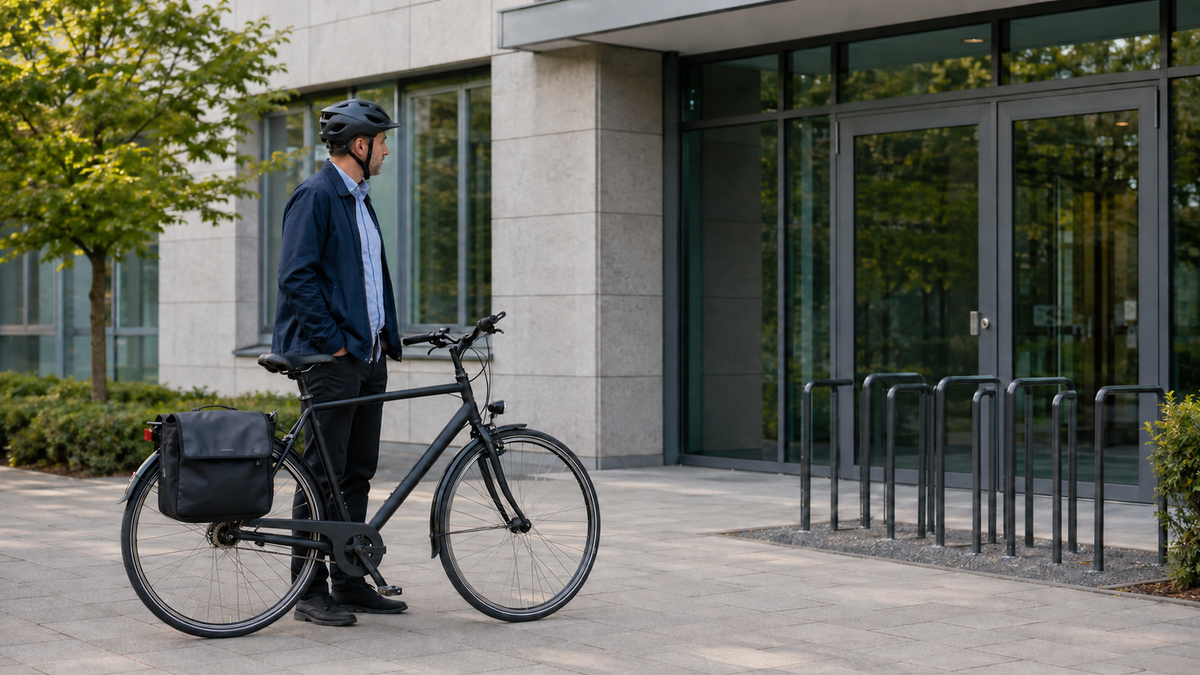
How far can you commute by bicycle? A kilometre figure alone does not answer whether your commute fits into your daily routine. What matters is the actual route, your personal effort, and the total time from your apartment door to your workplace. The journey home also has to fit into your day. This can be assessed with a few manageable observations.
This guide is intended for people who already own a suitable bicycle and are familiar with it. It is not a performance test and does not recommend a fixed minimum speed. You do not have to ride every day or immediately replace your entire existing commute to find out whether individual cycling-to-work days are practical.
Define the framework before your first ride
Write down when you actually need to be ready for work and which appointments are fixed after work. Also determine what “arrived” means: standing in front of the building, being at the time-recording point, or already changed and sitting at your desk? Use the same endpoint for every comparison. Otherwise, you are comparing pure cycling time with a complete car or bus journey.
First choose a clear, bicycle-suitable route. A digital time estimate is an initial guide, not a guarantee for your journey. Check unfamiliar sections without time pressure. If a connection is legally unclear, closed, or uncomfortable for you to ride, clarify the situation or find another route. Saving time does not justify taking a risky shortcut.
Record door-to-door time instead of average speed
Start recording your time at the apartment door and finish at the previously defined destination. The journey may also include walking to the bike cellar, traffic-light stops, locking the bike, and walking through the building. Write down the individual times only when safely stationary or after arriving. For this test, there is no need to use your phone while riding.
The following calculation example is entirely fictional. It only illustrates the method and describes neither a measured commute nor a recommended speed. The assumed nine kilometres are not a guideline for other people. All times must be replaced with your own observations for your route.
| Section in the example | Time | What is included? |
|---|---|---|
| From the apartment door to ready to ride | 4 minutes | Get the bike, unlock it, attach the luggage |
| 9-kilometre journey | 36 minutes | Time in motion, excluding separately recorded stops |
| Waiting times along the way | 4 minutes | For example, traffic-light stops, without counting them again as travel time |
| Parking at the destination | 5 minutes | Park the bike, lock it, remove the bag |
| To the workplace | 6 minutes | Walk through the building and the tasks required in the example |
| Total | 55 minutes | Without any additional planned buffer yet |
If your app already displays the complete elapsed time, including stops, do not add traffic-light times again. What matters is the verifiable total time. In the example, this total is what first explains why a pure riding time of 36 minutes is not sufficient for scheduling. Conversely, an easily accessible parking space can make the process easier—but this must be checked at your own destination.

Briefly check the workplace as well
The AOK lists bicycle parking spaces and changing facilities as support that employers can offer. Therefore, check on site what is actually available and accessible during your working hours. The test does not require comprehensive advice on clothing: simply note which additional steps you personally need and how much time they take.
Also consider a locked entrance, necessary keys, or a different access situation after a late shift. Ask about it instead of assuming that conditions from a weekend visit will apply. If the organizational obstacle can be resolved, repeat precisely this part of the test. You do not need to reassess every ride because of each minor change.
Observe several typical weekdays
A relaxed test ride helps you get to know the route. For an everyday decision, you also need impressions from the times you would actually be traveling later. As a voluntary observation plan, you can choose two or three days within a suitable week to commute by bike and record your usual connection on the other days. This is an editorial suggestion, not a training program or a prescribed number.
For each direction, record the total time, conditions, unusual delays, and how you felt upon arrival. Was the route easy to navigate? Did you have to hurry? Did the luggage fit into your routine? Distinguish between a one-off search for the entrance and a recurring obstacle. However, do not simply discard an unfavorable day because it worsens the calculation you want.
A small personal sample does not allow for a reliable annual forecast. It initially shows whether the chosen days work. Darkness, other seasons, or changed working hours still need to be assessed separately. Do not seek out dangerous weather conditions for a test, and do not continue riding just to obtain a complete dataset.
Consider the return journey and reserve time before making a decision
Assess the return journey separately. After work, other appointments, different traffic conditions, and how you are currently feeling may determine how things unfold. Also write down how much free time actually remains before your next commitment. A journey to work that is just barely manageable is not yet a dependable plan for the entire day.
An ADAC commuting sample from autumn 2025 includes observations and surveys by seven regional clubs. The published article emphasizes, among other things, time buffers and viable alternatives. It does not provide a forecast for your route. Set your buffer based on your own fluctuations and scheduling requirements, not on a blanket recommendation for a number of minutes.
Before a commuting day, clarify what happens if you do not want or cannot cycle back. Is another connection accessible? Can the bicycle remain parked somewhere suitable until it can be picked up? If an alternative requires taking the bicycle with you, its specific conditions must be checked in advance. “Then I’ll just take any train” is not yet a reliable return plan.
Frequently asked questions about the commuting test
Is 20 kilometers by bike to work too far?
There is no general answer to this. Routes, elevation changes, experience, and available time vary. Check both the outward and return journeys within your capabilities. If this does not currently work, individual days or a differently organized connection may be more sensible than persevering every day.
Can I simply use the travel time from the navigation app?
As an initial guide, not as a complete door-to-door calculation. Compare the forecast with your own trips and add any unrecorded routes at the start and destination. Make sure not to count waiting times twice.
Do I have to cycle to work every working day right away?
No. You are evaluating a personal everyday option, not a continuous series without interruption. A plan for two suitable days can already be a useful result. Choosing another mode of transport on an unsuitable day does not make the previous observations worthless.
When is the test successful?
When you can make an informed decision about which days the route works with a reserve, a suitable return option, and a reasonable amount of effort. “Not currently practical” is also a result. Missing safe connections or consistently unsuitable time windows should not be compensated for by cycling faster.
As of September 7, 2026. Original editorial test template with a fictional calculation example. No general guarantee regarding travel time, performance, or suitability for a specific route.
Share:
Practice the school route by bike: find a suitable route together
Practice the school route by bike: find a suitable route together