

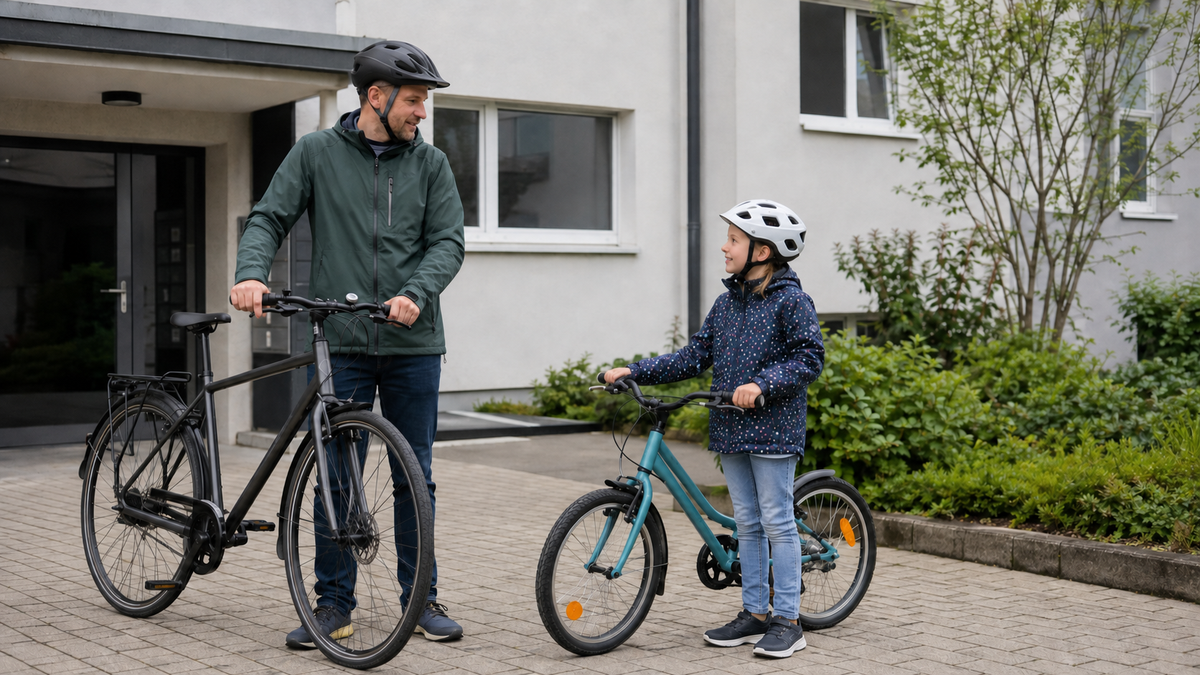
The journey to school by bicycle does not begin with a stopwatch. First, parents and children need to know which route is suitable and where it requires particular attention. This guide helps with joint preparation when the child can already ride a bicycle. It concerns the child’s own bicycle—not being transported in a child seat or trailer.
A checklist does not determine when a child can ride alone. It makes open questions visible. If the route seems unsuitable, the child is overwhelmed, or the rules remain unclear, another solution and, if necessary, expert support are needed. More practice alone cannot eliminate dangerous infrastructure.
First, ask for an up-to-date bicycle route-to-school plan
Ask the school or local authority whether an up-to-date plan explicitly also shows bicycle routes to school. A marked pedestrian route is not automatically a suitable bicycle route. The Baden-Württemberg portal Gib Acht im Verkehr explains the distinction between pedestrian and bicycle route-to-school plans. It also describes how local problem areas can be incorporated into planning. However, a plan does not replace getting to know the route together.
Check the plan’s publication date, direction, and destination. Does it lead to the correct school entrance, or does it end only at the school grounds? Ask about changes caused by construction work. Note who can answer questions about the route. An unclear connection should not be replaced with a spontaneously chosen shortcut simply because it looks shorter on a general map.
Get to know the route there and back separately
For the bicycle route to school, the ADFC recommends choosing the route together and practising it repeatedly in both directions at the actual times the journey to school takes place. Clear crossings and less traffic matter more than the shortest route. This also includes obscured visibility, such as at driveways or beside parked vehicles.
Begin your preparation with a calm inspection. Discuss challenging areas from a suitable place outside moving traffic. Let the child describe what they see and what is unclear. Do not explain an entire intersection at the same time while the child has to steer, brake, and watch out for others. An open question should be clarified before the next practice section, not guessed at on the way.
Turn observations into specific agreements
“Pay close attention” is not very helpful as the only feedback. A short description is better: Which area do we mean, what makes it difficult, and what have we agreed to do about it? The following template is an editorial worksheet created for this purpose. The examples are fictional and do not describe a verified route. Enter only agreements that fit the actual situation and the applicable rules.
| Area | Observation | Next step together | Still open? |
|---|---|---|---|
| Start of the route | The transition from the property to the path is unclear | Clarify the local routing and required behaviour first | Tick off only after clarification |
| Section with limited visibility | Child and parents cannot properly assess the situation | Check a suitable alternative with the school or a specialist agency | Do not approve it just to save time |
| School entrance | The route ends before the actual bicycle parking area | Include the final section and arrival | Ask about the rules on the school grounds |
| Return journey | A section feels unfamiliar from the other direction | Discuss it separately and get to know it with supervision | Make a separate note for this direction |
Keep the notes for your own use. You need neither a public GPS track nor the child’s names, photos, or timetable in a shared post. To report an issue to the responsible authority, an objective description of the problem with a precise location is sufficient. Document it only from a safe standing position, never while riding.

Keep practice time flexible instead of setting a target date
Choose times without any subsequent pressure to be somewhere on time. The ADAC Nordbaden also emphasises sufficient time and discussing difficult areas in its general guidance on practising the journey to school. Its advice there about walking must not be adopted without checking it as cycling instructions for a child. Traffic rules and suitable supervision must fit the specific situation.
Agree beforehand how the child will signal that they need a break or feel uncertain. Stop in a suitable place for a discussion. Afterwards, a few specific questions are enough: Which area was clear? Where was too much happening at once? What should you look at again next time? The answers are not a test. A child may change an earlier assessment and need supervision again.
Consider arriving, riding home, and changes
Include arrival in your preparation: Where will the child get off the bicycle, where will it be parked, and which entrance will be used? Clarify the rules on the school grounds with the school. Also check whether the child can manage with their usual luggage. The first joint practice session should not test an unfamiliar route, new equipment, and a tight schedule all at once.
Make a clear agreement for a blocked route, a bicycle that is not roadworthy, or a changed pick-up arrangement. A contact plan is more helpful than telling the child to somehow find another route. Ask the child how they can get help if the phone is missing or not working. Choose contact people together and agree on their role in advance.
Review the agreements when there is a different school finishing time, construction work, or a new route. A sheet completed once is not permanent proof that the route remains suitable. Report structural problems to the school or local authority instead of placing responsibility for them on the child. Parental supervision and clear traffic routing serve different purposes.
Frequently asked questions about practising the journey to school together
How often should we practise the bicycle route to school?
There is no fixed number for this planning process. Repeat the sections that are still unclear in particular, and consider both directions. What matters is what still requires support on this route, not the number of completed rides.
When can my child ride to school alone?
This guide does not provide a blanket age recommendation. The route, skills, applicable rules, and the assessments of both parents and child must fit together. The ADFC advises approaching independent cycling without pressure when both feel ready for it. If in doubt, continue accompanying the child and seek advice.
Is the cycling proficiency test enough preparation?
Do not treat participation in or a certificate from a cycling proficiency test as an assessment of every individual section of the journey to school. Look at the specific route together and at what the child must manage there. Unknown or changed areas remain a reason for further preparation.
What should we do if no suitable route can be found?
Do not force a bicycle route to school. Discuss problematic areas with the school or the responsible traffic authority and initially organise another suitable option. A safety concern is not a lack of ambition on the child’s part and cannot be offset by a faster travel time.
As of: September 7, 2026. Editorial planning aid created for this purpose; not approval of a specific route and not a substitute for local assessment or applicable traffic rules.
Share:
Test your route and travel time for commuting by bike
Test your route and travel time for commuting by bike