

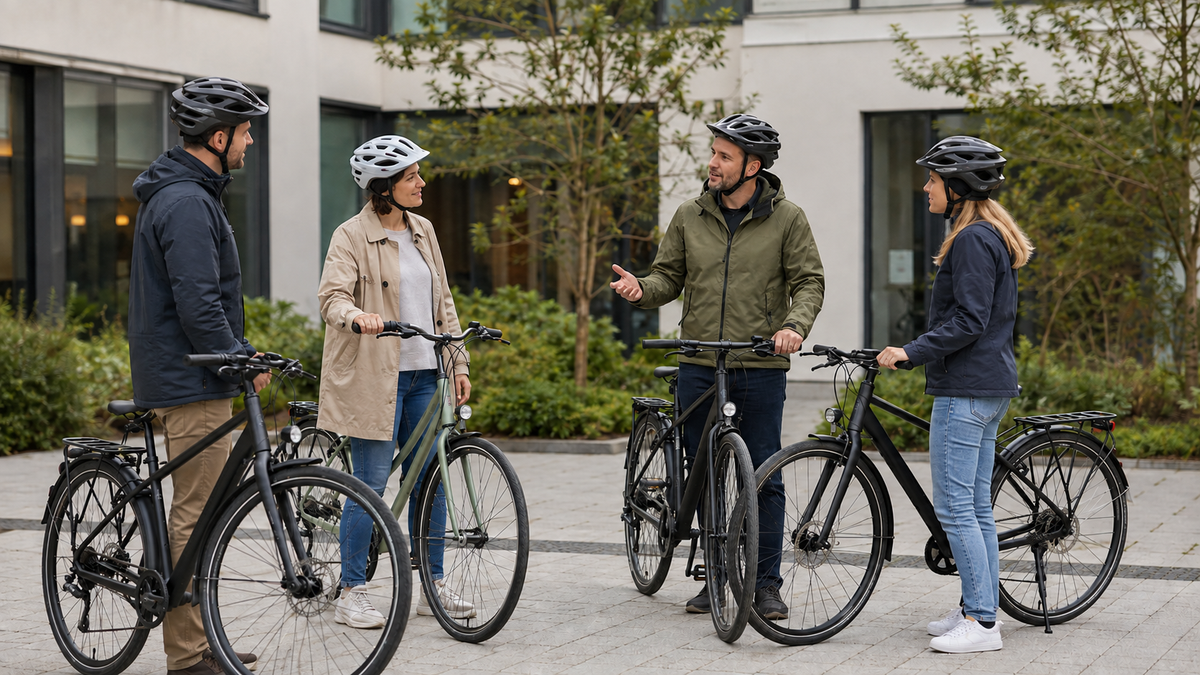
Would you like to offer cycling safety training at your company? Start by asking who is to participate and what these people would like to practice. A course for experienced commuters is different from an offering for adults who cannot yet ride a bicycle. Only then can you sensibly choose a provider, group size, and date.
This planning guide is intended for people organizing an event. It does not replace the course instructor or a company risk assessment. The aim is a suitably prepared learning opportunity—not a promise that all journeys will be risk-free after one session.
Assess needs without turning it into a performance test
A brief voluntary response is sufficient at first: Which bicycle will be used? How familiar is the person with it? Which everyday situation would they like to handle better? Offer a confidential way to respond. No one should have to explain to the team why starting off or riding slowly is difficult for them. A summarized description of the group is sufficient for the initial inquiry to the provider.
Separate different levels of experience. The ADFC cycling schools distinguish among beginner, return-to-cycling, cycling safety, and Pedelec courses, among others. Whether participants need to bring their own bicycle also depends on the course. If some employees first want to develop basic riding skills, ask about a suitable separate offering rather than quietly assigning them to an advanced training course.
Compare the specific course, not just the heading
The DVR describes its company cycling training as building on existing riding experience. It specifies 10 to 14 people with their own bicycle or Pedelec, as well as theory and practical stations. An excursion to local hazardous locations is included in the version lasting at least five hours. These details refer to this program and are not a general standard for cycling courses.
Other formats are structured differently: For example, the ADAC Württemberg Pedelec training offers places for no more than ten participants, use of their own Pedelec, and approximately three hours. Therefore, ask explicitly which format is suitable for your group and whether a company booking is possible. An event listed publicly is not yet a confirmed appointment for your company.
These details belong in the initial course inquiry
The following table is an editorial aid for making inquiries, not a prescribed procedure. First send the provider the information that has already been finalized. Mark any open points. This helps you avoid bindingly reserving a room, area, or date before the course instructor has assessed the conditions.
| Planning point | Information from the company | Clarify with the provider |
|---|---|---|
| Target group | Approximate number, experience, bicycle types | Is the group a good fit, or are separate courses needed? |
| Learning objective | Two or three specific everyday topics | Which content is included in the booked format? |
| Area | Location, surface, use by others, available times | Which area is suitable, and who will inspect it beforehand? |
| Bicycles and equipment | Own bicycles available or need to rent | What participation and equipment requirements apply? |
| Organization | Preferred date, contact person, rooms | Setup, breaks, weather contingency, and cancellation conditions? |
| Costs | Available planning framework | What does the offer include, and what additional costs will arise? |
Plan the training location and operations together
An apparently empty parking lot is not automatically a suitable training area. Describe deliveries, access routes, shift changes, and other uses. Have the organizer assess its suitability. Agree who will keep the area clear and who will make decisions on site if vehicles appear or conditions change. The specific design of the exercises remains the responsibility of the qualified course instructor.
Also consider the routes around the training area: Where will participants arrive with their bicycles? Where can those waiting stand without blocking the practice area? Is there an accessible room for the theory section and a designated contact person? Clarify responsibilities for first aid and a possible cancellation in advance. A single organizer should not have to resolve such questions between two exercises.

Document the invitation, costs, and participation conditions
A useful invitation specifies the target group, meeting point, duration, equipment to bring, and contact for questions. Include only requirements agreed with the provider. This also includes what happens if a bicycle is unsuitable or not roadworthy. Safety training is not a substitute for necessary repairs; do not plan spontaneous repairs as a fixed part of the training if they are not offered.
The DVR mentions possible subsidies from accident insurance funds or employers’ liability insurance associations upon request. This does not create an automatic entitlement. Before booking, ask the responsible provider whether support may be available and under what conditions. For your planning, the specific response matters—not a blanket subsidy amount from another company.
Discuss working hours, participation requirements, insurance, and data protection with the responsible departments at the company and the event organizer. This article does not provide a case-specific legal assessment. Record organizational commitments in writing. It is particularly important to establish clearly who will be informed in the event of bad weather and whether the course will be postponed, adapted, or cancelled.
After the course: open issues instead of rankings
Afterwards, ask for brief voluntary feedback: What was helpful? Which question remained unanswered? What makes cycling at the location more difficult? Do not treat riding times or supposed tests of courage as measures of success. Appropriate follow-up might, for example, reveal that another opportunity to practise is desired or that access to the bicycle storage room should be discussed with the responsible department.
Separate personal learning goals from problems with the surroundings. A course cannot structurally change a confusing exit route. Pass on such observations to the appropriate people and designate someone to organize feedback. For a follow-up session, a precise open question is more useful than claiming that the first event resolved the issue.
Frequently asked questions about workplace cycling training
Is it possible to take a joint course for bicycles and pedelecs?
That depends on the format. The DVR program described mentions both types of bicycle. Share the planned group composition and have the provider confirm whether the content and requirements are suitable for your specific group.
Does everyone have to bring their own bicycle?
Not for every offering. The DVR training mentioned and the ADAC pedelec course described require participants to bring their own bike. The ADFC cycling schools refer to the respective course for information about rental options and requirements. Clarify this before sending invitations.
Can funding be included in the budget with certainty?
Only after receiving a reliable confirmation from the responsible provider and clarifying the conditions. “Available on request” does not mean that every event or every person will be funded. Do not book on the assumption that reimbursement has already been approved.
What are the signs of a well-organized course?
The group, learning objective, and course format fit together, responsibilities are clear, and open questions are followed up. Participation does not guarantee that accidents will be prevented. Feedback should highlight further learning needs, not evaluate employees against one another.
As of September 7, 2026. This checklist is an independent editorial planning aid. Confirm the course conditions with the respective provider before booking.
Share:
Practice looking over your shoulder while cycling and staying in your lane
Learning to ride a bike as an adult: Getting started step by step