

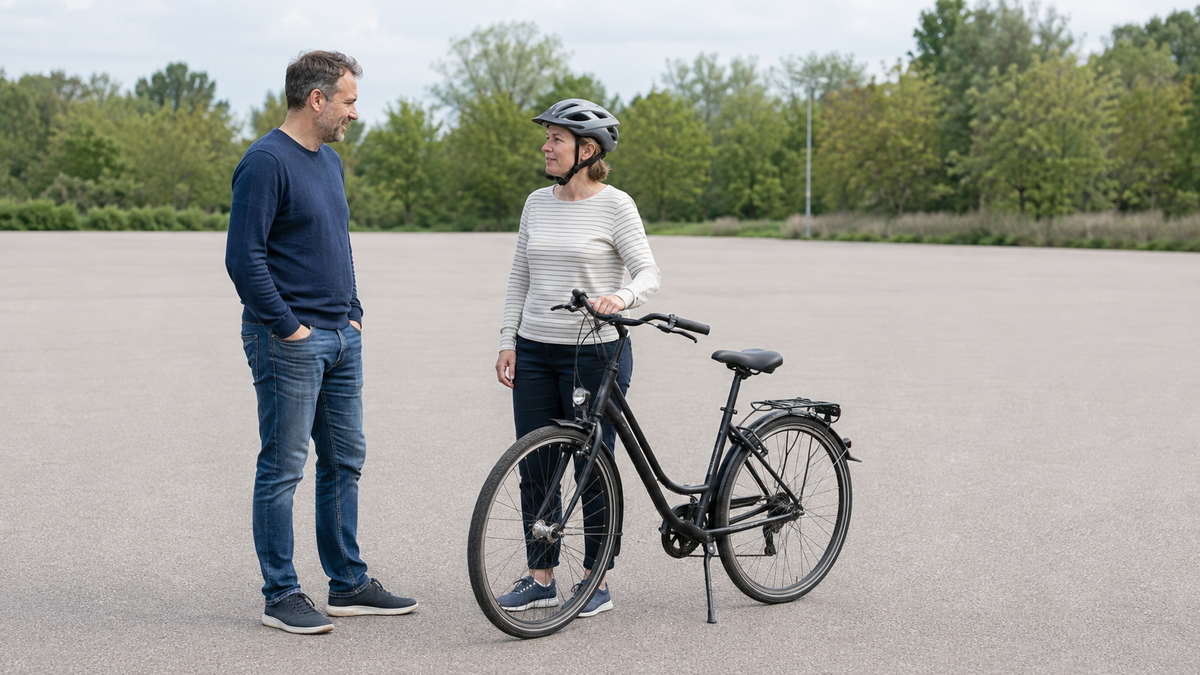
Are you an adult and still unable to ride a bicycle? You are not too late. What matters is a starting point suited to your abilities: a suitable bike, a protected place, and small learning steps without time pressure. This article will help you plan the beginning and choose a suitable course. It does not replace instruction from a qualified person on site.
Describe your starting point honestly
“I’m unsure” can mean different things. Perhaps you have never ridden independently. Maybe you can pedal but cannot stop. Or perhaps you want to return to cycling after a long break. When inquiring about a course, write down what you can actually do and which actions you need help with.
The ADFC cycling schools for adults distinguish between beginners’ courses, refresher courses, and advanced training. They also cater to people with no previous riding experience. The learning period varies from person to person. A weekend course and a course lasting several weeks are different offerings, not a promise that everyone will reach the same level afterward.
Clarify the framework before your first attempt
First, ask about a genuine beginners’ course. A guided bike tour or an e-bike safety training course may already assume that you can ride independently. Clarify the entry requirements directly with the organizer instead of simply searching for the nearest available date. Also explain if you need instruction in a particular language or a particularly calm learning environment.
Plan your journey so that you do not have to cycle to the course yet. Make a note of the meeting point, contact details, and when the event ends. Ask about breaks, the arrangements for bad weather, and the materials you will need. An uncomplicated journey there and back takes organizational pressure off your first session, even if you do not yet complete a full lap that day.
A learning bike must be easy to handle
To start with, what matters is whether you can control the bike, mount it safely, and reach the controls. The ADFC tips for learning to ride a bike describe a smaller bike with a low step-through frame as a good way to get started. For initial rolling exercises, you should be able to place your feet safely on the ground. Have the course instructor assess the appropriate setup.
This is not a reason to modify your existing bicycle yourself or remove components. The school can provide a suitably prepared learning bike. According to the ADFC, your own bike is often not necessary in beginner courses; the specific school decides. Therefore, do not buy a model before registering solely on the basis of a picture or a general size recommendation.
For the first sessions, we recommend a properly fitting bicycle helmet, closed-toe shoes, and clothing without loose parts near the bike. Clarify the equipment with the course provider. If you would later like to ride an e-bike, mention this as your goal. However, motor assistance is not a substitute for learning balance and stopping; the school should choose the appropriate starting point.

What comes before the first pedal stroke
First learn how to hold, push, and bring the bike to a stop. This includes the corresponding brake levers and a safe procedure for mounting and dismounting. Have unfamiliar controls explained to you. Do not start riding until you know how to end the ride safely and under control.
Rolling and balancing exercises can prepare you for pedaling. Which option is appropriate depends on the bike and your learning progress. You do not have to try all the exercises in one day. An accompanying person should neither push you unexpectedly nor secretly let go. Discuss beforehand what assistance you would like and how you will announce that you need a break.
Work with learning objectives instead of daily deadlines
The official ADFC course objectives range from mounting and riding in a controlled manner to observing other road users. Our table translates this idea into questions for your learning discussion. It is not a test or a sequence that must be completed independently of your abilities.
| Learning area | Observable objective | Question for the course instructor |
|---|---|---|
| Getting to know the bike | You can guide it and know how to operate the controls | What should I repeat first while the bike is stationary? |
| Getting on and off | You begin and end the movement without rushing | Is the bike suited to my safe starting position? |
| Rolling and stopping | Before rolling off, you know how to stop again | Which preparatory task is right for me now? |
| Starting and pedaling | You start independently and then come to a controlled stop | Should I practice starting separately from longer rides? |
| Line and direction | You ride through a clearly visible section in a controlled manner | What additional task would still be too much right now? |
| Immediate surroundings | You can combine the basic tasks | What supervised next step makes sense now? |
A suitable area is more than an empty parking lot
Choose an approved, level, clearly visible practice area without moving traffic. It needs enough open space at the sides and at the end. A parking lot where vehicles may appear at any time is not automatically suitable. Pedestrians, playing children, and dogs should also not be on your practice route.
The ADFC recommends a traffic-free area and, if in doubt, permission to use it. Our additional planning aid: inspect the intended area beforehand and check access points, uneven surfaces, and possible conflicts. In wet conditions, on loose surfaces, or in strong winds, another date is the better starting point. Do not start on a slope to compensate for insufficient momentum.
How a companion can really help
For one run, agree on just one manageable task. Afterward, you can stop calmly and give feedback. Describe as specifically as possible what was difficult: getting your foot onto the pedal, raising your gaze, or reaching the brake in time. This is more helpful than the blanket statement that it “didn’t work again.”
A companion does not need to call out instructions continuously while riding. Our recommendation: explain first, then allow an attempt without additional demands, and discuss it afterward. If neither of you knows what to do next, take a break or look for a cycling school. More pressure and a longer practice day are not a reliable response to being overwhelmed.
The first round is not yet approval for road use
Pedaling independently is an important step, but additional tasks arise while riding. You need to be able to stop in a controlled manner, maintain your direction, and observe your surroundings. A single successful attempt does not prove that this combination already works when you are distracted. Agree with the instructor on which skills you should continue consolidating and which environment would be appropriate next.
Keep brief notes on your progress: What worked reliably today? What worked only once? Which exercise is planned for the next session? If you become tired, your fear increases, or movements hurt, end the session. Physical discomfort is not resolved by forcing yourself to continue practicing. Professional support can help both with choosing the right learning step and with selecting suitable equipment.
Frequently asked questions about learning to ride a bicycle as an adult
Can I start without any prior experience?
Yes. There are dedicated beginner courses for adults. State when registering that you cannot yet ride independently, so the course is not accidentally an advanced course.
How many days will I need to learn?
There is no reliable general rule for this. Ask about the course structure and other practice opportunities. Focus on actions you can repeat with control rather than a fixed date.
Do I already need my own bicycle?
Often not, but check with the relevant provider about loan equipment and suitable sizes before buying a bike.
Can a friend replace a course?
Calm support can help. However, it does not replace qualified instruction, especially if suitable learning steps are missing or you feel severely overwhelmed.
Conclusion: Organizing a suitable start
The first sensible step is not necessarily the first pedal stroke. Assess your current level, choose a suitable offering, and prepare the bike, location, and travel arrangements. After that, focus on progress you can repeat—without pressure and with a clear option to stop at any time.
As of September 7, 2026. The learning questions and table are editorial aids only and do not constitute instructional certification or a guarantee of success. Confirm the course conditions and required materials directly with the provider.
Share:
Organize a suitable bicycle safety training course at the workplace
Practice looking over your shoulder while cycling and staying in your lane