

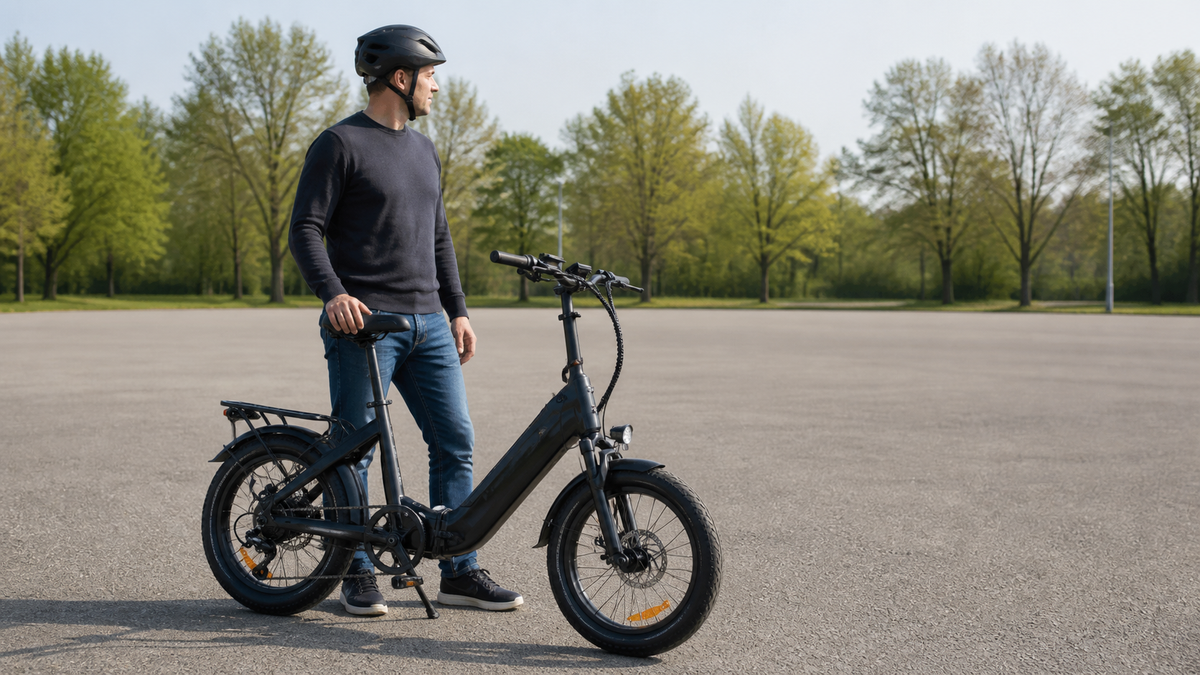
Does your bicycle pull to the side when you look over your shoulder? Then it is worth practising looking around separately from turning. The goal is not the largest possible head movement, but a brief look behind while maintaining a controlled riding direction. Prerequisite: You can already set off independently, ride straight ahead and stop safely. For your first attempts, you need a suitable place, not road traffic.
Looking back and changing direction are two separate tasks
Looking behind provides information. It should not already move the handlebars in the new direction. So first observe what happens with you: Do you change your grip when looking around? Do you turn the handlebars as well? Do you simultaneously take one hand off? Such observations help with practice, but they do not explain every possible cause of an uneasy riding sensation from a distance.
The ADFC course objectives list briefly looking to the side and behind without losing balance as a skill in its own right. This is more than a rule to remember. Anyone who loses their direction while doing so needs a suitable learning exercise and, if necessary, feedback from a qualified instructor.
Keep the practice area deliberately simple
Choose a permitted, dry, level and clearly visible area without traffic, pedestrians or crossing paths. There must be plenty of open space ahead and to the sides. Parked cars, kerbs, walls and narrow passages are not helpful boundaries. A car park that appears empty and straight with open entrances does not automatically meet these conditions.
Our suggestion is a broadly conceived corridor with a clearly visible target area ahead. If markings are permitted, light chalk markings can help with orientation. Do not place ropes or objects in the possible riding line. The corridor should provide feedback, not create additional pressure through narrowness. If you remain unsure whether the area is suitable, practise in supervised training.

First, assess the initial situation without looking back
Use a familiar, functioning bicycle and a properly fitting helmet. For this session, also avoid additional luggage and trying out new equipment. If you are using a pedelec, you should already be familiar with starting and assistance on it; do not change the settings during the task. A new bike with unfamiliar handling is an additional learning task that does not need to be undertaken at the same time here.
First ride straight through the clear section and stop in the agreed spacious target area. Keep both hands on the handlebars and look ahead. If even this attempt feels unsteady, leave out the shoulder check. Reducing the difficulty is more sensible than adding a new head movement to a basic task that is not yet reliable.
Add a brief look back
Before riding, clarify where you want to look. First practise the movement without riding and without pressure. During the subsequent attempt, choose only one side. First ride steadily in a straight line, briefly look over the relevant shoulder, and then direct your gaze forward again. Keep both hands on the handlebars. You should take in some information, not spend a long time looking backwards.
Keep your direction of travel as unchanged as possible. A companion can observe from a safe position outside the corridor whether you are deviating sideways. They must not stand in your run-out area, pull on the bike alongside you, or touch you while you are looking back. Discuss the result only after you have stopped.
Do not try to look backwards and at a narrow line on the ground directly in front of the front wheel at the same time. After looking back, use the target area ahead again for orientation. If you have to make hectic corrections or your grip becomes unsteady, end the attempt in a controlled manner. Then repeat the easier straight-line ride or ask for guidance.
Practise with specific feedback instead of “that was good”
The following table is our own observation aid. It does not replace a riding safety assessment and is not intended to force millimetre-perfect tracking. What matters is whether observing and controlled riding can be achieved together without creating new uncertainty.
| Observation | Question after stopping | Sensible next step |
|---|---|---|
| Unsteady even when riding straight | Did the initial ride feel controlled? | Leave out the shoulder check and reinforce the basic task |
| Handlebar moves when looking back | Did your grip change together with the rotation? | Discuss the movement without riding; get help from a trainer if needed |
| Long look behind you | Were you trying to notice too many details? | Practice only a brief glance followed by looking forward again |
| One hand released at the same time | Did a hand signal slip in unnoticed? | Practice exclusively with both hands again |
| One side is clearly more difficult | Was the movement possible freely and comfortably? | Consider each side separately; do not force anything |
| Repeat the controlled run-through | Did your gaze, direction, and stopping remain steady? | Take a break, then consciously repeat the same sequence |
The accompanying person does not give surprise tasks
Agree on one single task before each attempt. For example, at first, observe only whether your riding line remains steady when looking back over your left shoulder. The person at the edge does not call out additional changes of direction and does not suddenly step onto the route. Later, the other side can have its own run-through, provided the movement is possible without discomfort.
When you are alone, it is harder to assess deviations. Do not repeatedly ride back while looking at your tire track, and do not film yourself with a device in your hand. If you are unsure, a course with direct feedback is the more suitable solution. Practicing independently does not have to mean that you must solve every difficulty on your own.
Treat the hand signal as a separate learning step first
The ADFC learning tips explicitly emphasize carrying out checking over your shoulder and giving arm signals one after the other. That is why your hand remains on the handlebar during this shoulder-check exercise. Riding one-handed and signaling are not added as spontaneous extra tasks.
Even after a good run-through, you will not immediately be able to judge how to position yourself between cars. A controlled review in a designated area is only part of the preparation. Your sequence of glances, signals, other people, and the local traffic layout will later have to be managed together. This article is therefore not instructions for turning left directly in traffic and does not approve any particular intersection.
When supervised practice is useful
Seek support if you repeatedly deviate significantly, cannot control your hand position, or already feel tense before looking back. Describe the specific difficulty to the provider. For example, the ADAC Württemberg training description mentions getting to know the bike’s handling and interacting with other participants. Clarify with the specific course which exercises are included and what skills are required.
If you have pain or restricted head movement, do not force the turn. Stop the exercise and have persistent symptoms medically assessed. The instructor can discuss suitable next learning steps, but cannot determine a health-related cause from a riding attempt. A mirror is also not proof that every observation task has thereby been solved for you.
Frequently asked questions about shoulder checks
Why do I ride in a curve when looking around?
Have someone accompany you and check whether you unintentionally move the handlebars or change your grip when turning. This is an observation question, not a reliable remote diagnosis. If the deviation persists, an instructor can provide targeted assistance.
How often should I repeat the exercise?
In a way that allows you to remain attentive and in control. There is no prescribed number of repetitions here. A few manageable attempts with feedback are more useful than increasingly difficult attempts despite fatigue.
Can I practice the hand signal at the same time?
Not for this introductory exercise. Keep both hands on the handlebars and separate the tasks. The ADFC recommends looking around first and then giving an arm signal, not doing both at the same time.
Do I need to turn my head as far as possible?
No, the maximum angle of rotation is not the aim of the exercise. You need a usable observation while riding in control. Painful or impossible movements must not be forced.
Conclusion: Master one task calmly
Initially practice shoulder checks separately: on an open area, riding reliably in a straight line, with both hands on the handlebars, followed by brief feedback after stopping. Reduce the difficulty as soon as you lose control.
As of September 7, 2026. The corridor, observation table, and feedback procedure are editorial aids only, not an official assessment or individual clearance for training.
Share:
Organize a suitable bicycle safety training course at the workplace
Learning to ride a bike as an adult: Getting started step by step