

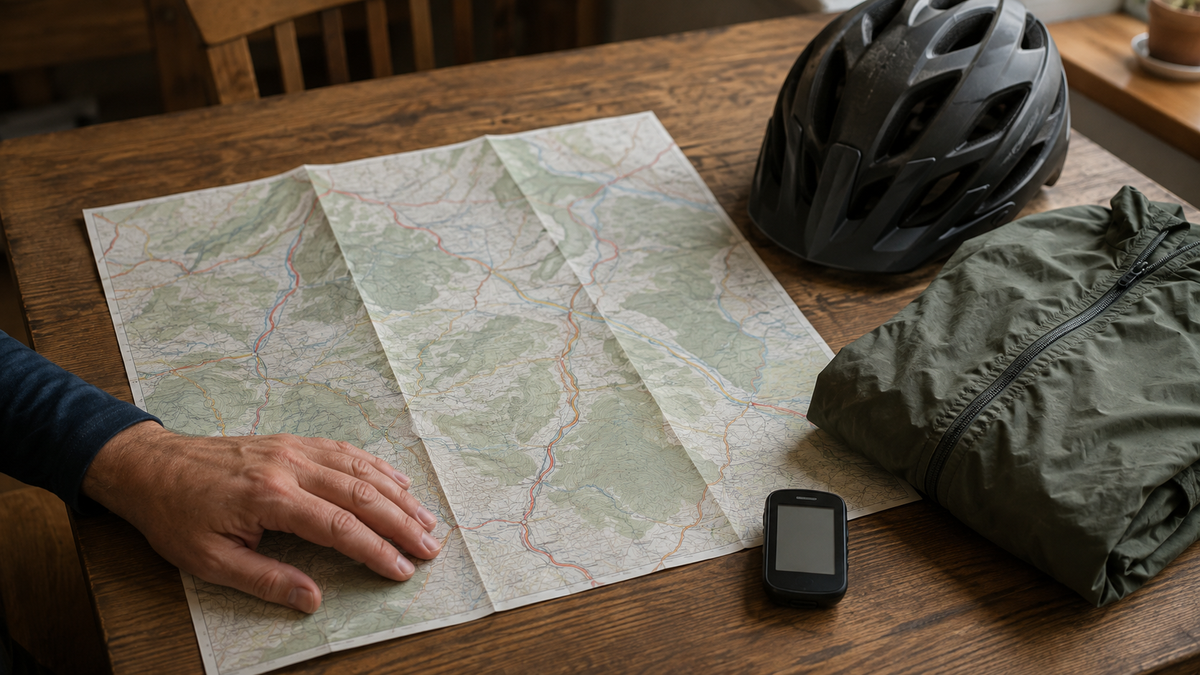
A good cycling holiday does not begin with as many kilometers as possible, but with a daily schedule that works. You need to get to the starting point, take breaks along the way, reach your accommodation, and eventually get home again with your bicycle. Plan these points together. You can then choose the route in between so that even a slower day fits into the holiday.
Set the framework first
Before searching for a route, write down five things: available days, travel companions, your own bicycle, preferred type of accommodation, and how you will get there. Do not automatically count the days of arrival and departure as full cycling days. Anyone arriving at the station at noon still has luggage, orientation, and possibly a journey to the hotel ahead of them.
Also decide what matters more to you: reaching a new place every day or using the same accommodation as your base. A point-to-point trip requires coordinated daily destinations. With a base-based trip, it is easier to swap longer and shorter excursions between days. The ADFC Cycling Travel Regions are designed, among other things, for day trips from a fixed base.
Calculate riding time, not just distance
A distance figure does not yet tell you when you will arrive. Use a recently completed tour with similar terrain and luggage as your starting point. It is more useful for planning than your fastest time on a short after-work ride. With several people, choose a pace that everyone can maintain over several days.
A simple example: 48 kilometers at an average moving speed of 12 kilometers per hour result in four hours of riding time. Add one hour for meals, half an hour for photos, and half an hour as a buffer, and you have six hours on the road. These figures are a self-selected planning example, not a recommendation for your fitness level. Elevation gain, surface, and traffic can significantly change the calculation.
Therefore, don’t look only at the total elevation gain. A longer climb shortly before the hotel can shape the day more than the same elevation gain spread across several sections. An e-bike makes some things easier, but it cannot replace breaks or a route suited to your own bicycle. Plan your battery reserve based on your experience with this exact bike and a comparable load.
Check the route for practical obstacles
Open the bike path details page and compare the route, surfaces, elevation profile, and any information about ferries, stairs, and construction sites. A line on the map does not prove that every section is comfortable to ride with your bike and luggage. Use official route information in addition to the route planner and note when the information was last updated.
First set the points you actually need: a train station, accommodation, a place to shop, and, if applicable, a confirmed charging option. Only then add additional attractions. This shows whether a supposedly short detour would require two additional journeys. If an important section is unclear, ask the local tourist information office or choose a comprehensible alternative.
Bring together the most time-critical bookings first
Before making a binding booking, check whether the outward journey, first accommodation, and return journey are fundamentally compatible. For a train journey, the bike must also be taken into account. A connection suitable for passengers traveling alone is not sufficient. The DB information on bikes and trains provides the relevant conditions for local and long-distance transport.
Where possible, reserve the hardest-to-replace components in one coordinated planning step. Check the deadlines and conditions for each individual booking rather than assuming uniform change options. The ADFC information on planning stages and accommodations describes the conflict between pre-booked rooms and spontaneous flexibility. A sensible compromise depends on the season, region, and number of available accommodations.
A five-day framework with four overnight stays
The following table is an editorial example without specific locations, hotel bookings, or verified routes. It shows how days can be structured with different levels of exertion. Apply the pattern to a real route only after checking its sections and connections.
| Day | Main task | Deliberately leave open |
|---|---|---|
| 1: Getting there | Reach the starting point, organize the bike and luggage, and get to the first accommodation | Just a short optional exploration ride |
| 2: First leg | Get into the rhythm of the trip with a manageable daily goal | Add an extra stop only if there is enough time |
| 3: Longest planned cycling day | Start early; ride the more demanding stage without a late fixed commitment | Clarify a shorter daily destination in advance as an option |
| 4: Shorter stage | Create time for sightseeing and the final accommodation near the return journey | Laundry, shopping, or an extended break |
| 5: Return journey | Reach the booked train or meeting point without a tight approach schedule | No additional distance that your journey home depends on |
If only three vacation days are available, you should not simply make every day fuller. Shorten the travel section instead or stay in one location. An attractive route does not have to be completed in full for the trip to be a success.
Note a workable plan B for each day
A contingency plan needs specific points of contact. Note an earlier destination, a possible accommodation, and an alternative return journey. Check with the railway whether bicycles can actually be taken on the alternative connection. Local rules apply to replacement transport; according to DB for local transport, bicycles are often excluded.
Agree in advance when to reassess your plans, for example during the lunch break before a longer section with no further shortcuts. If you only realize shortly before the last ferry departure that the day has become too long, fewer options remain. A plan B does not mean you are obliged to continue riding in bad weather.
Choose luggage and accommodations to suit the trip
Pack for the type of trip you have actually booked. A tour with hotel stays requires different items than a camping trip. Separate the luggage you need during the day from what you will only unpack in the evening. The ADFC packing tips can help with this organization. A complete trial pack shows early on whether the space and permitted load are sufficient.

Ask accommodations not only whether they have a bicycle storage room, but also about access and opening hours. Clarify charging separately if you are traveling with an e-bike. For a specific Cyseekin model, the user manual, approved load capacity, and suitable charger remain authoritative; a general travel offer does not confirm compatibility with the model.
The final check before setting off
- Check connections again, including bicycle carriage and any replacement services.
- Read official notices about construction work and ferry services.
- Take weather conditions and daylight into account when setting departure and arrival times.
- Keep accommodation addresses, arrival instructions, and telephone numbers available offline.
- Open and check the saved route on the device you will actually use.
- Test the bike with travel luggage on a short loop; resolve any outstanding issues before the trip.
Frequently asked questions about planning a cycling holiday
How many kilometres per day should I plan?
As many as fit into your timeframe, including breaks, on comparable terrain. Use a practice ride of your own as a benchmark. A blanket distance ignores luggage, experience, and climbs.
Do I need to book every overnight stay in advance?
Not for every trip. However, check how many alternatives are available at your daily destinations and when you will arrive. In sparsely populated regions or during highly sought-after periods, searching spontaneously can unnecessarily extend the stages.
What should I pack for a cycling holiday?
Start with clothing for the forecast conditions, personal belongings, travel documents, drinks, and suitable basic equipment for your bike. Add only what the type of accommodation and the specific stages require.
Where is the best place to take my first cycling holiday?
In a region with clear wayfinding, terrain that suits you, and several achievable daily destinations. Convenient access and short alternatives are often more useful for getting started than a famous route name.
Conclusion: Plan a trip, not just a route
The plan is solid when each day has an achievable destination, enough time, and a verified alternative. Keep the first stages manageable, coordinate bookings with one another, and make optional activities genuinely optional. This leaves room to adapt the trip to the actual conditions along the way.
As of: September 7, 2026. The five-day framework and the time calculations are planning examples only, not a pre-verified travel itinerary. Check schedules, bicycle carriage conditions, and availability before booking and departure.
Share:
Cycling trip with luggage transport: plan handover and daily luggage
Find bike-friendly accommodation: classify Bett+Bike correctly