

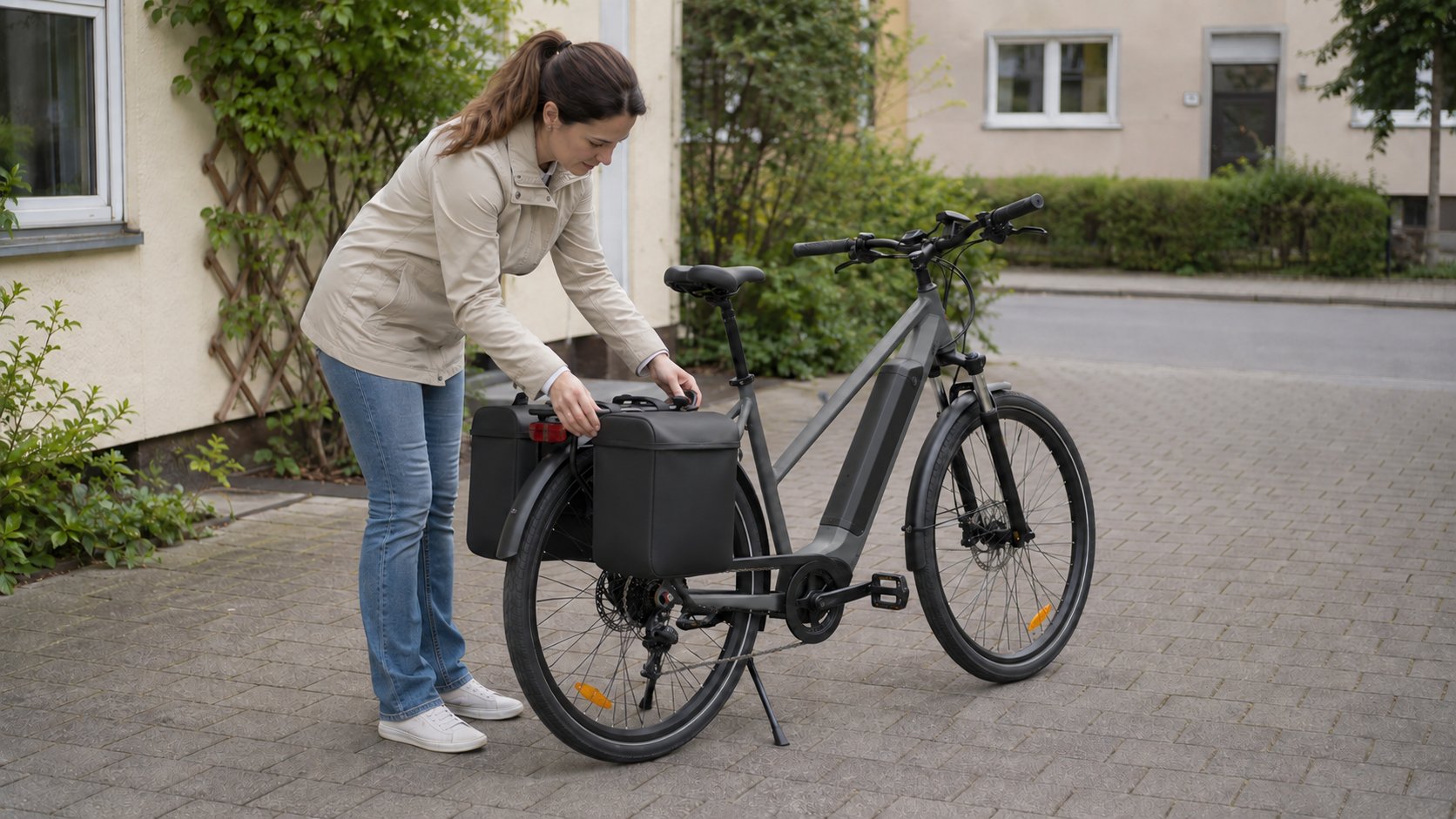
Luggage on a bicycle must not merely look secure. It must also stay in place during emergency braking or a sudden evasive maneuver. At the same time, it must not impair your vision, hearing, steering, brakes, or lights. For groceries, a laptop, or touring gear, following the right order is therefore more important than having as many bags as possible.
The basic legal rule for loads
Section 22 (1) of the German Road Traffic Regulations (StVO) requires loads and securing equipment to be stowed in such a way that they cannot shift, tip over, roll, fall, or create avoidable noise, even during emergency braking or a sudden evasive maneuver. This rule also applies to bicycles. A loose shopping basket does not become safe simply because the journey is short.
In addition, Section 23 of the StVO makes the person riding responsible for ensuring that their vision and hearing remain unobstructed, that the vehicle, load, and occupants comply with regulations, and that road safety is not compromised. A package in front of your face, a bag caught on the brake cable, or a strap in the wheel are therefore clear signals to stop.
First, determine the permitted weight
Check the bicycle’s permitted total mass in the owner’s manual or on the bicycle itself. Subtract the bicycle, rider, battery, accessories, lock, and permanently installed parts from this figure. What remains cannot automatically be used entirely for luggage: rear racks, front racks, baskets, and bags each have their own, often lower, load limits.
Add up actual weights instead of estimating. A full backpack, drinks, and a U-lock can quickly add up to more mass than expected. On a pedelec, the battery is part of the vehicle’s mass. No generic blog figure replaces the specific Cyseekin or component documentation; models and racks may have different approved limits.
Keep heavy items low and close to the center
A low center of gravity makes the bicycle more predictable when starting, steering, and parking. Heavy items should be placed as low as possible in sturdy panniers and distributed evenly on both sides. Light, bulky items can be placed higher up, provided they are securely fastened and do not obstruct your view.
A tall box on the rear rack increases the risk of tipping. A heavy basket on the handlebars can make steering unstable and strain the cables. If you use only one pannier, you will notice the imbalance particularly when starting slowly. Reduce or redistribute the load instead of masking the swaying by going faster.
Secure bags, baskets, and straps
With panniers, the upper hooks must engage fully with the rack, the locking mechanism must close, and a lower guide must prevent the bag from swinging outward. The ADFC describes adjustable hook systems that can be adapted to the respective rack. This information supplements but does not replace the bag’s instructions.

Elastic bungee cords age and can spring out of a hook. Use only intact securing equipment whose ends cannot reach the spokes, brake disc, or chain. Open baskets need a net or closed bag for loose items. Keys, glass bottles, and tools must not knock freely against one another or fall out.
Consistently avoid moving parts
After packing, spin each wheel by hand and move the handlebars through their intended range while the bicycle is stationary. Check whether straps, jacket sleeves, bags, or cables rub against anything. Then push each bag in several directions. Anything that can move as far as the wheel while stationary may actually reach it when riding over a pothole.
Also check heel clearance. If your shoe touches the bag while pedaling, it changes your pedal stroke and can cause a fall. Move the bag only within the position permitted by the system or use a more suitable solution. A makeshift cord around the frame is not a reliable locking mechanism.
Keep lights, reflectors, and markings clear
Rear bags or a package placed across the rack must not obscure the rear light or reflectors. The same applies at the front to the headlight and white reflector. A load that is wide at the sides can also reduce the visibility of the wheels and pedal reflectors. Check the loaded bicycle from several meters away, from the front, rear, and both sides.
Section 22 contains special dimensional and marking requirements for loads that extend far beyond the bicycle. In everyday cycling, it is usually safer to choose a suitable cargo trailer, cargo bike, or delivery service than to push these legal maximum limits. Long rods, panels, and other difficult-to-see objects must not simply protrude from the sides.
The controlled load test
- Hold the loaded bicycle stationary and check that the stand and frame remain stable.
- Start slowly and ride straight on an area free of traffic.
- Brake gradually with both brakes without attempting an improvised emergency stop.
- Ride wide curves in both directions and watch for swaying or rubbing.
- Stop, check all fastenings again, and only then ride in traffic.
If the steering, braking distance, or frame feels noticeably different, reduce the load. A motor only offsets the additional power required for acceleration; it does not automatically improve lateral stability, tire grip, or braking distance.
Everyday use: laptop and groceries
A laptop is better transported in a padded, water-resistant compartment on the rack than loose in a front basket. Secure heavy power adapters separately so they cannot hit the device. When shopping, place bottles and jars low, close the bags, and put fragile goods on top. A bag hanging from the handlebars can get caught in the front wheel and block the steering.
Plan for parking as well. A bicycle loaded heavily on one side tips more easily, especially when loading it onto a deployed stand. Hold the bicycle securely, carefully load the farther or heavier side first, and do not let children pull on the loaded bicycle.
Touring: leave a safety margin instead of maximizing the load
On a cycling trip, the total mass matters over many braking maneuvers, curbs, and rough roads. The ADFC points out that some bicycles can already reach their permitted total weight with only light luggage. Weigh the complete, trip-ready setup, including water, lock, and charger.
Pack frequently needed items so they are accessible without reaching into bags while riding. After the first few kilometers, check all mounts again. Rain can loosen straps, dust can make closures stiff, and uneven ground can shift a roll that initially seemed secure.
When a trailer or cargo bike makes more sense
Very heavy, wide, or long objects do not necessarily belong on a standard rear rack. A suitable cargo trailer redistributes the load, but it has its own limits for the coupling, tongue weight, total mass, braking distance, and lighting. A cargo bike is suitable only if its loading area and permitted load match the items being transported. Both solutions require their own test ride.
Frequently asked questions
Can I hang a shopping bag from the handlebars?
This is risky because the bag can swing or get caught in the wheel or brake. Use a closed, securely mounted basket or a suitable bag, and keep the cables and steering area clear.
How much weight can my bicycle carry?
The relevant limits are the bicycle’s permitted total mass and the lower limits of the individual racks and bags. Include the rider, bicycle, battery, and accessories in your calculation.
Can luggage obscure the rear light?
No. Required lights and reflectors must remain visible and functional. Check the loaded bicycle from behind before setting off.
Is one bungee cord enough?
Only if it is intact, suitable for the load, and fastened so that neither the hooks nor any loose ends can reach moving parts. For heavy items, a form-fitting, closed transport solution is better.
As of: September 6, 2026. Always check the owner’s manuals and load limits for your specific bicycle and accessories.
Share:
Keep right on a bicycle: A safe distance instead of riding in the gutter
Keep right on a bicycle: A safe distance instead of riding in the gutter