

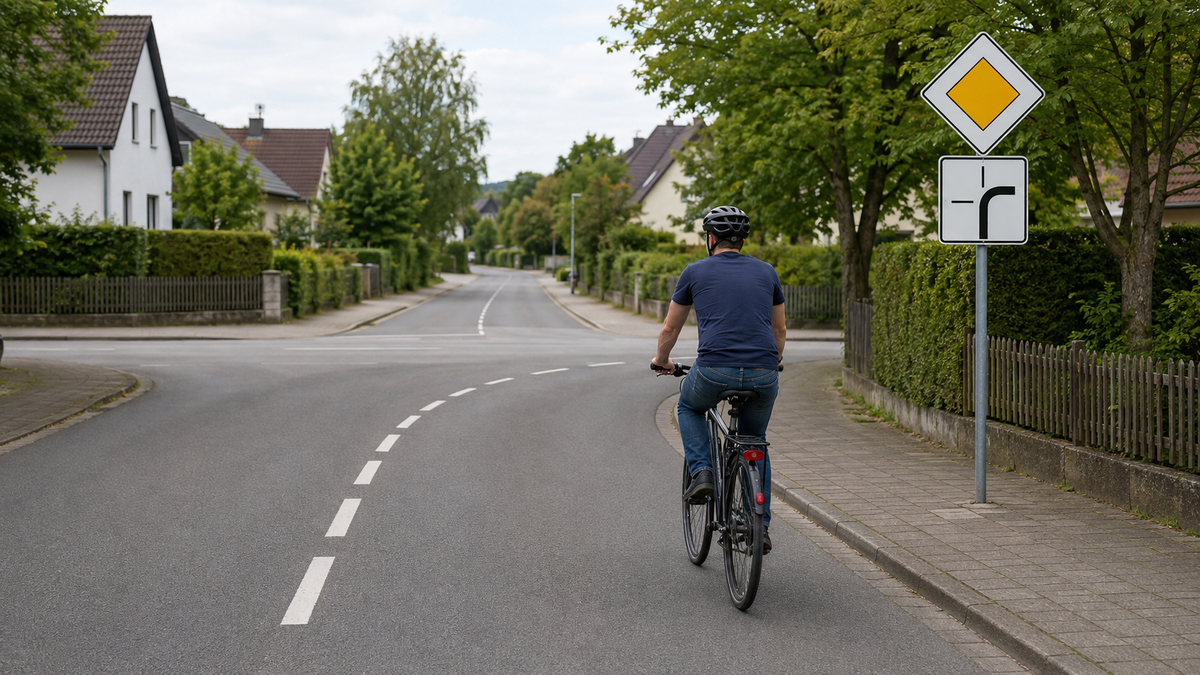
At a bend in a priority road, the thick line on the supplementary sign shows the course of the priority road. Thin lines represent the subordinate roads. Anyone cycling along the thick line into the bend is legally turning and must clearly signal the change of direction. Anyone riding straight ahead onto a thin line is leaving the priority road but does not give a hand signal solely for that reason.
How to read the diagram below the priority-road sign correctly
The small diagram looks like a simplified map of the intersection. The lower line normally shows the road from which you are approaching the sign. The thick line marks the priority route, while the thin lines represent the approaches that must yield. Do not mentally rotate the diagram toward north; read it from your direction of approach.
The supplementary sign appears either below sign 306, “Priority road,” or below sign 205, “Give priority,” or sign 206, “Stop. Give priority.” Annex 3 of the German Road Traffic Regulations requires road users on the priority road to signal in good time and clearly when following its bend. Particular consideration must be given to pedestrians.
Distinguishing four possible routes
- You follow the thick line to the right: You generally have priority over the thin approaches and signal that you are turning right.
- You follow the thick line to the left: You signal that you are turning left and watch for oncoming traffic, pedestrians, and cyclists.
- You ride straight from the thick line onto a thin line: You leave the priority road without pretending to change direction.
- You approach from a thin line: Sign 205 or 206 requires you to yield, regardless of whether you continue straight ahead or turn onto the priority road.
Priority only determines the order between vehicles at the intersection. It does not permit blind riding or cancel other obligations. Anyone following the bend must, for example, continue to watch for people crossing the road and must not cut off an oncoming cyclist.
Giving a hand signal without losing control
Bicycles normally do not have a standard factory-installed turn signal. You therefore signal the turn with your arm. The signal should be visible early enough, but it should not mean riding one-handed throughout the entire bend. Check traffic behind you, give a clear hand signal, and return your hand securely to the handlebars before the actual steering and braking phase.
A hand signal does not create priority. It informs others of your intention. If you turn from an approach that must yield onto the thickly marked road, you must still wait despite giving a signal. If you have priority and follow the bend, you must not assume that everyone has understood your intention. Brake in a way that allows you to react to someone else's mistake.
Riding straight ahead and leaving the priority road
Many misunderstandings arise when the priority road bends to the right but you want to continue straight ahead. You are then leaving the priority route. Nevertheless, from a geometric perspective you are not turning, and you should not signal left merely to explain that you are leaving the priority road. Such a signal could be understood as a genuine left-turn signal.

Your priority over approaches that must yield may continue to apply within the intersection even when you are riding straight ahead. The signs and the specific point of conflict are decisive. Reduce your speed because road users often follow only the thick road line and overlook someone riding straight ahead. Having priority is no substitute for eye contact.
If you are coming from the subordinate road
Sign 205 requires you to give priority. With sign 206, you must also stop. If there is no stop line at sign 206, stop where you can see along the other road. You may continue only once priority vehicles can proceed without being endangered or significantly impeded.
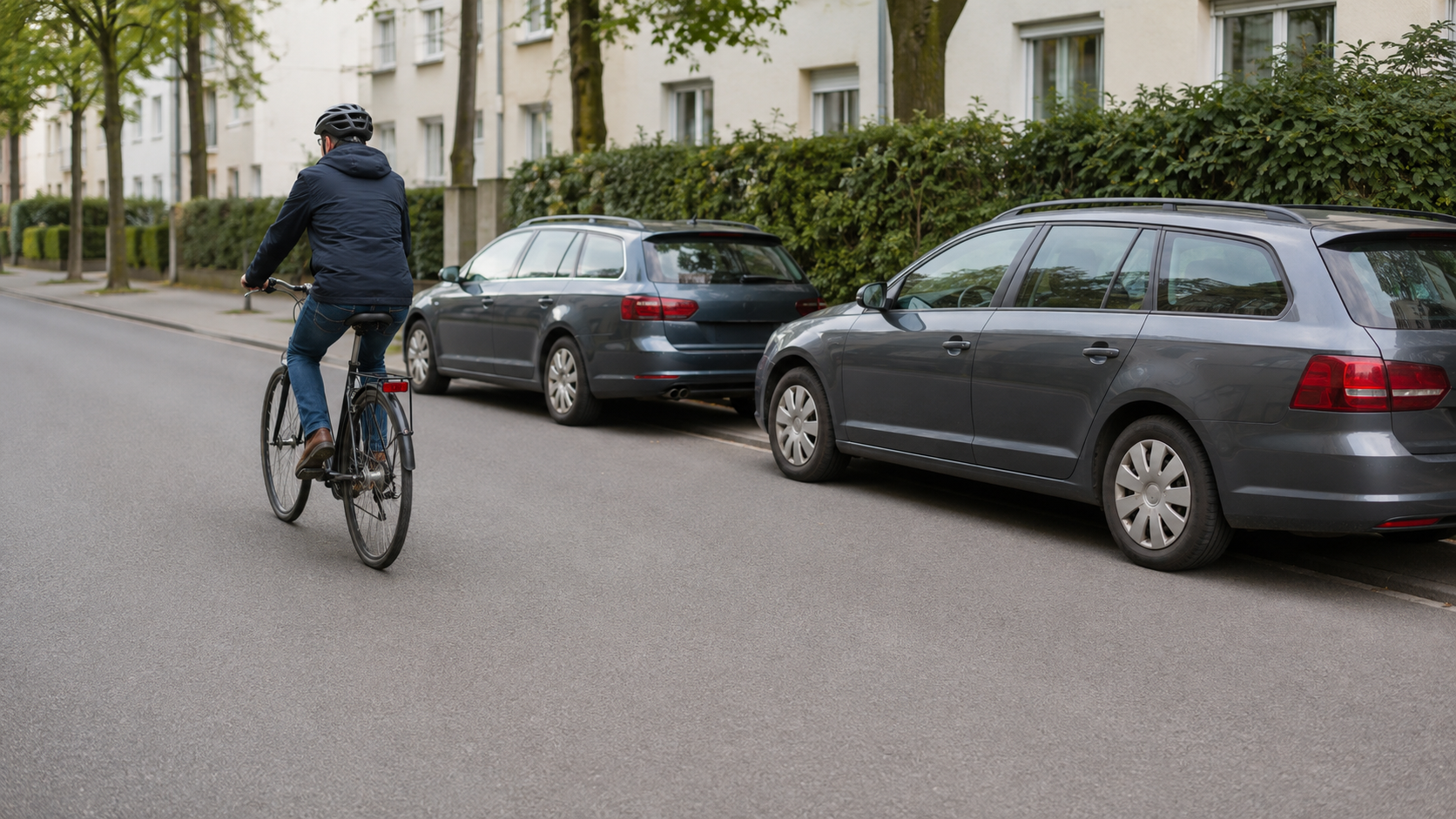
This also applies to bicycles on the priority road that bends. Their small size or low speed does not make them any less entitled to priority. Expect a cyclist to follow the bend, leave the priority road by continuing straight ahead, or ride unusually far into the lane from your perspective to keep clear of parked cars.
Assessing the cycle path and roadway separately
A cycle path running alongside the road can make the geometry more complicated. The thick line on the supplementary sign describes the course of the priority road, not automatically every cycling route. Therefore, also check cycle-path signs, crossings, and bicycle traffic lights. Anyone turning via a cycling route must follow it through the intersection; at the same time, special traffic signals may regulate the traffic.
If the cycle path runs behind an island or is clearly separated, the specific priority situation may differ from that on the roadway. Do not invent a separate priority rule from a colored cycle crossing. If the route is contradictory or difficult to recognize, a slow, defensive approach is better than a spontaneous shortcut across the sidewalk or onto the opposite side of the road.
Pedestrians have their own protected position
Anyone following the course of the priority road that bends must, under the German Road Traffic Regulations, show particular consideration for pedestrians and wait if necessary. The priority sign regulates vehicle traffic; it does not grant a right to ring at people crossing and force them aside. When turning right, also watch for people approaching from behind who are crossing the side road.
When turning left, you must also check for oncoming traffic. A bicycle on an opposite approach may continue straight ahead or turn right. The general obligation when turning under Section 9 of the German Road Traffic Regulations remains in force. A thick line on the supplementary sign does not erase oncoming traffic, cyclists, or pedestrians.
A safe observation sequence
- Identify the priority-road sign and the diagram below it early.
- Determine whether your approach is shown as a thick or thin line.
- Compare your intended direction with the thick route.
- Check traffic behind you and signal any actual change of direction.
- Check oncoming traffic, side roads, cycle paths, and pedestrians.
- Ride through the conflict area with both hands ready to steer and brake.
If the diagram is dirty, obscured, or not clearly readable from your position, reduce your speed early. Do not infer priority from the shape of the curb, the width of the roadway, or the behavior of another vehicle.
Frequently asked questions
Do I have to signal when following a bend in a priority road?
Yes. Following the bend is a turning maneuver. When cycling, you generally signal it with a timely and clearly visible hand signal.
Do I have to give a hand signal when leaving the priority road by continuing straight ahead?
No, not solely because you are leaving it. Signal only the actual change of direction. A false signal could mislead others about your route.
As a cyclist on the thick line, do I automatically have a clear right of way?
You generally have priority over the thin approaches. Nevertheless, you must show consideration, adapt your speed, and comply with your obligations toward oncoming traffic, cyclists, and pedestrians.
What does the thin line on my sign mean?
It represents a subordinate road. If you are coming from there, signs 205 or 206 indicate that you must yield or stop and wait.
As of September 6, 2026. The specific signs, traffic signals, and traffic routing at the location are authoritative.
Share:
Bicycle zone: rules, speed limits, and right of way in the neighborhood
Mandatory use of cycle paths: When the blue cycle path is truly compulsory