

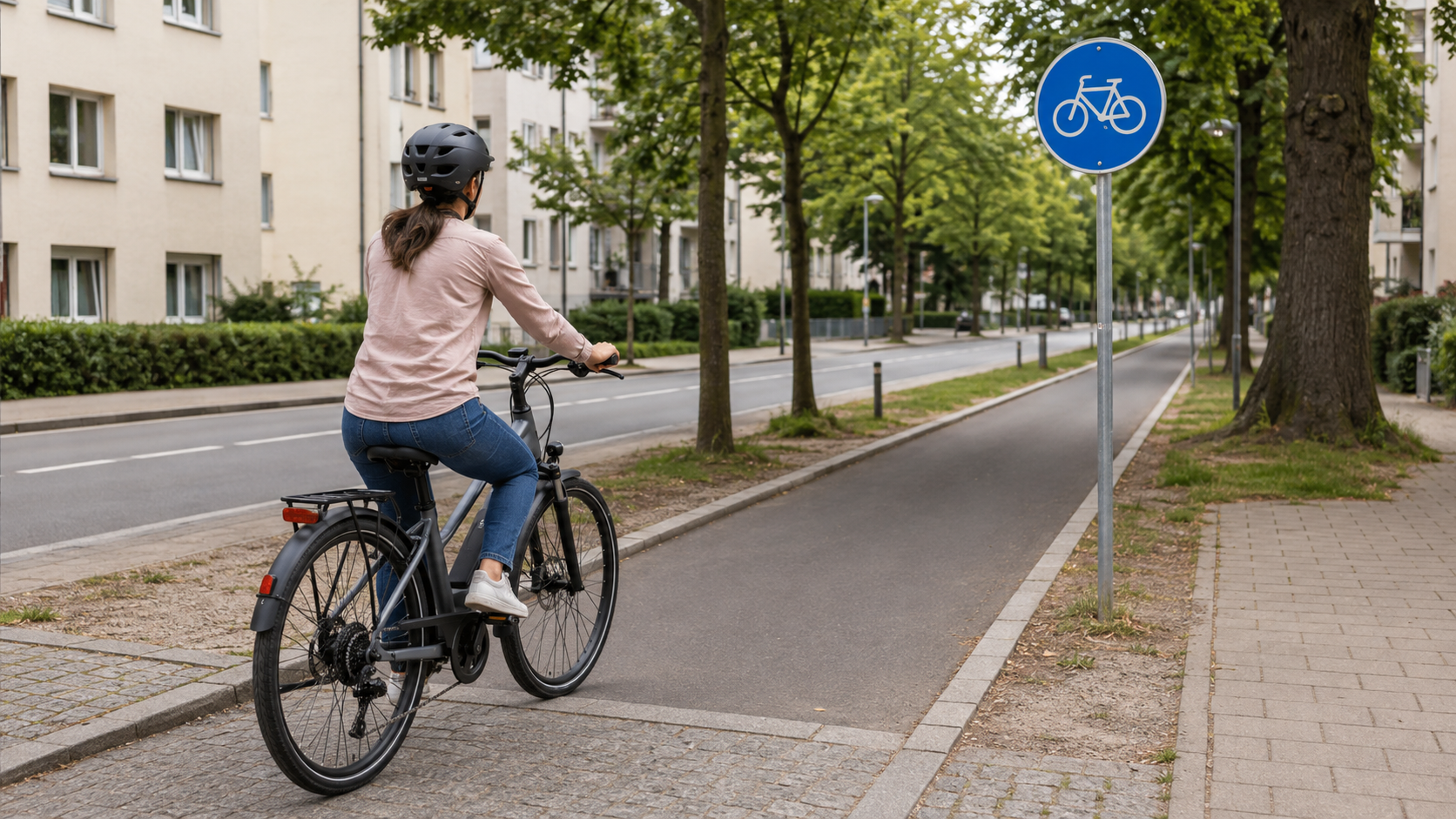
A cycle path does not become mandatory merely because it has red asphalt, a bicycle pictogram, or is located next to the road. What matters are the blue traffic signs 237, 240, or 241—and specifically whether they apply to your direction of travel. If there is no such sign, you may generally use a structurally separated cycle path on the right, but you do not have to. This distinction answers the most important question about mandatory cycle-path use.
Check whether cycle-path use is mandatory in three steps
- Is there a blue sign in your direction? Look for signs 237, 240, or 241.
- Does the area actually belong to that sign? The route can change at junctions, stops, and construction sites.
- Is the path actually usable? A merely uncomfortable surface does not automatically cancel the obligation; a complete blockage may change the situation.
Check the signs again after every intersection if the route becomes unclear. An old pictogram painted on the ground does not replace a blue sign that applies in your direction. Conversely, a sign remains valid even if the path’s color and markings have faded.
These three blue signs make cycle-path use mandatory
Annex 2 of the German Road Traffic Regulations governs special paths. Sign 237 designates a cycle path. Sign 240 marks a shared footway and cycle path; both groups share the same space here. Sign 241 separates the cycle and pedestrian areas with a line or structural design. In all three cases, cyclists generally may not ride on the parallel carriageway and must use the designated section.
The obligation says nothing about athletic speed or automatic right of way. On a shared footway and cycle path, you must take pedestrians into consideration, neither endanger nor obstruct them, and adjust your speed when necessary. On a separated path, remain on the side marked with the bicycle symbol. An oncoming cyclist, children, or an obstacle do not change these duties of care.
A cycle path without a blue sign may be optional
Section 2(4) of the German Road Traffic Regulations distinguishes between mandatory and other cycle paths. A structurally identifiable cycle path on the right without signs 237, 240, or 241 may be used. However, you may remain on the carriageway unless another arrangement applies. A bicycle advisory lane marked with a dashed line is part of the carriageway and is not a structurally separated cycle path; its rules are a separate topic.
The supplementary sign “Cyclists permitted” below a footway sign also creates an option. It does not impose mandatory cycle-path use. Anyone using the permitted footway must adapt to pedestrian traffic, travel at walking speed, and wait when necessary. If you are allowed to use the carriageway, you may choose it instead.
The direction of travel is decisive
The obligation applies only in the direction for which the blue sign is visibly installed. You may not simply use a cycle path on the left because it is wider, emptier, or closer to your destination. Use on the left is permitted if a blue cycle-path sign applies to your direction; in that case, use there is mandatory. A supplementary sign reading “Cyclists permitted” standing alone may permit optional use of the path on the left.
On a two-way cycle path, be especially alert at driveways for vehicles whose drivers may look for cyclists only from the usual direction. This does not change any right of way you may have, but it increases the need for observation. Do not ride blindly into a crossing merely because you are legally using the path. Eye contact, an appropriate speed, and readiness to brake remain advisable.

What applies if the mandatory path is blocked?
A mandatory cycle path does not have to be used at all costs if it is objectively unusable. A continuous construction barrier, a fallen tree, or a closed layer of snow that makes controlled riding impossible may effectively rule out its use. The ADFC cites obstacles, leaves, snow, and ice, among other things, as possible reasons for moving onto the carriageway.
There is no simple centimetre-based or comfort test for this. A single pothole, brief contamination, or slow pedestrian traffic on a shared path does not automatically cancel the obligation. If you can safely pass a small obstacle within the path, that remains the obvious course of action. If the path is completely blocked, the solution must not be to endanger pedestrians on the footway or squeeze around a barrier.
Move onto the carriageway safely
The legal end of the path’s usability does not make an abrupt swerve safe. Reduce your speed early, check traffic behind you, clearly signal the change, and move only when there is a sufficiently large gap. At an unclear construction site, dismounting and walking a short distance to a clearly defined crossing may be the more sensible solution. Do not use the lane for oncoming traffic or force your way between a barrier and pedestrians.
If the blockage occurs regularly, record the location, direction, time, and obstacle and report it to the responsible local authority. This does not create a private traffic rule, but it helps resolve the matter objectively. In a dispute about the specific situation, this article is not decisive; what matters is the verifiable situation and, where applicable, the responsible authority or a court.
Why may the authorities not impose an obligation arbitrarily?
The Federal Administrative Court ruled in case 3 C 42.09 that mandatory cycle-path use generally requires a qualified danger situation based on special local conditions. The decision concerns the authorities’ order to install the signs. It does not give individual cyclists the right to declare an existing sign invalid based on their own assessment.
If you consider the signs to be permanently incorrect, the proper course is to make an inquiry or take formal action with the responsible road traffic authority. Until they are changed, the installed sign must generally be observed. This is different from acute physical unusability during a single journey.
Distinguishing bicycles, pedelecs, and S-Pedelecs
A compliant pedelec with pedal assistance up to 25 km/h is legally considered a bicycle for road traffic purposes and follows the same cycle-path rules. An S-Pedelec, by contrast, is a motor vehicle. It may not use ordinary cycle paths simply because it has pedals; special permission would be required. If in doubt, check the type plate, operating permit, and vehicle documents instead of inferring the category from its appearance.
Frequently asked questions
Do I have to use a red cycle path?
Not because of its color. Use becomes mandatory through signs 237, 240, or 241 in your direction of travel. Without such a sign, a structurally separated cycle path on the right may be used optionally.
May I leave the mandatory path if traffic there is moving slowly?
Slow traffic or an uncomfortable surface is not automatically sufficient. Adjust your speed and overtake only with a safe distance. A genuine blockage that cannot be passed safely must be assessed differently.
Does the sign remain valid after every junction?
The specific route must remain identifiable on site. After intersections, look for repeated signs, markings, and the structural course of the path. If the signs conflict, reporting the matter to the responsible authority may help.
May I ride on the cycle path on the left?
Only if a blue cycle-path sign makes it mandatory for your direction or if the supplementary sign “Cyclists permitted” standing alone makes it optional.
As of: September 6, 2026. This article explains the general legal situation in Germany and does not replace legal advice for an individual case.


Share:
Understanding a Bending Priority Road by Bicycle: Correctly Reading the Route and Hand Signals
Bicycle zone: rules, speed limits, and right of way in the neighborhood