

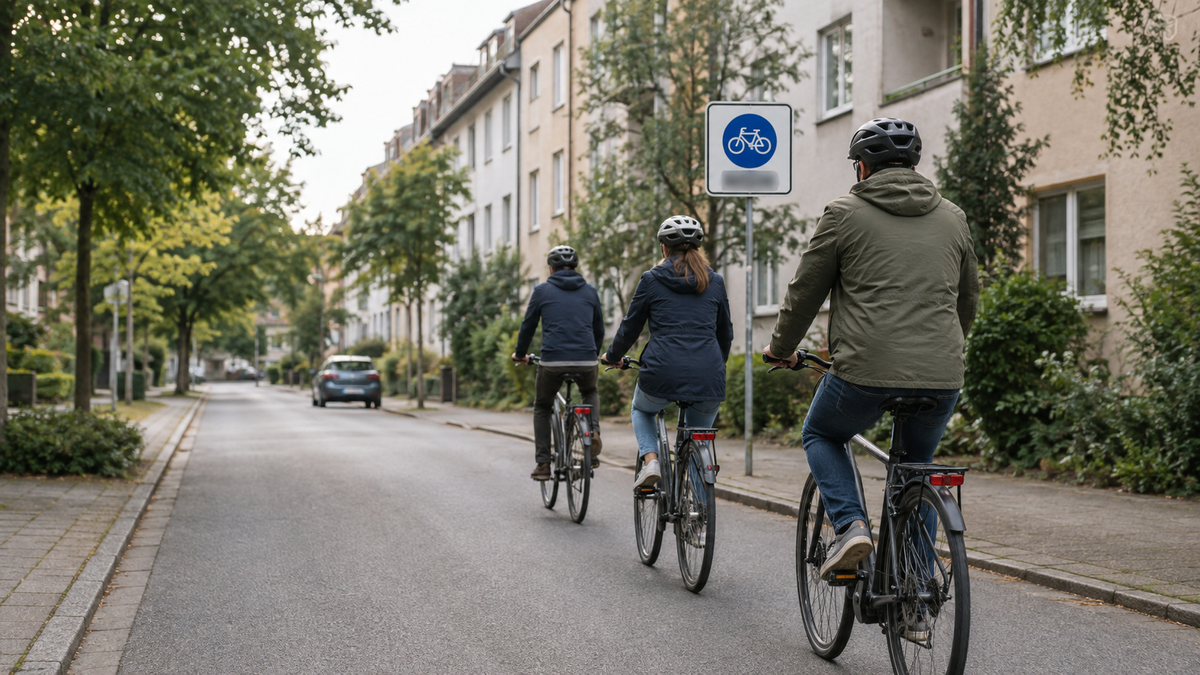
A bicycle zone comprises several interconnected streets and begins with sign 244.3 and ends with sign 244.4. Bicycle traffic and electric micro-vehicles are permitted within the zone; cars, motorcycles, and other vehicles require an additional sign. A maximum speed of 30 km/h applies to all traffic. Nevertheless, cyclists do not automatically have priority at every intersection.
Bicycle zone: the most important rules
- The zone begins at sign 244.3 and ends only at sign 244.4.
- Other vehicle traffic may enter if an additional sign permits it.
- A maximum speed of 30 km/h applies to everyone driving.
- Bicycle traffic must not be endangered or obstructed; motor vehicles must drive more slowly if necessary.
- Bicycles and e-scooters may ride side by side.
- Priority, turning, keeping to the right, and parking continue to be governed by the normal rules and the signs at the location.
How to read signs 244.3 and 244.4
Annex 2 of the German Road Traffic Regulations describes the entry sign as “Beginning of a bicycle zone.” The corresponding end sign cancels this zone rule. Within a neighborhood, the entry sign does not have to be repeated after every small intersection. Instead, the German Road Traffic Regulations require the symbol to be repeated on the road surface at regular intervals.
A single marking on the asphalt is not a reliable substitute for the entry signs. If you start in the middle of an unfamiliar zone, for example outside a residential building, check the next intersections and the local directional signs. Do not rely solely on a navigation app: construction sites and new traffic orders may have overtaken its map.
For your first trip, it is worth taking a short inspection ride around the edge of the neighborhood. This way, you can identify entrances, priority signs, and the end of the zone before planning a longer everyday route.
Are cars allowed in the bicycle zone?
Without permission, vehicle traffic other than bicycle traffic and electric micro-vehicles is not allowed. However, an additional sign such as “Residents excepted” or a symbol permitting certain motor vehicles is often displayed below the zone sign. Those vehicles may then enter. “Bicycle zone” therefore does not mean that you will never encounter a car there.
The zone’s protective rules apply to permitted motor vehicles. They must not endanger or obstruct cyclists and must reduce their speed further if 30 km/h would still be too fast for the specific encounter. Cyclists may ride side by side. However, this does not permit deliberately blocking traffic and does not cancel the general duty to exercise care and consideration.
30 km/h is a maximum, not a target speed
The 30 km/h limit applies to all traffic, including fast bicycles and pedelecs. With children, oncoming traffic in a confined space, open car doors, poor visibility, or wet paving, only a considerably lower speed may be safe. Although a pedelec only provides assistance up to 25 km/h, it can travel faster downhill; the zone limit still applies.

Do not confuse a bicycle zone with a traffic-calmed area. In a traffic-calmed area, walking speed applies and pedestrians may use the entire street. In a bicycle zone, by contrast, the normal use of the roadway applies, with the special status of bicycle traffic and a maximum speed of 30 km/h. Only the signs actually present determine the area.
Who has priority at intersections?
The bicycle zone sign does not grant general priority. Section 45(1i) of the German Road Traffic Regulations generally provides for “priority to the right” at intersections and junctions within the zone. If signs 205, 206, or other priority signs are present, they take precedence. A lowered curb, a property exit, or a farm track may also change the assessment.
Therefore, do not cross every side street at the same speed. Check the signs, slow down when visibility is obstructed, and expect traffic from the right. Within the zone, a cyclist may be required to yield to a permitted car. Conversely, a driver must respect your priority if you are approaching from the right or if a sign grants it.
Turning and road position
The obligation to keep to the right also applies in a bicycle zone. “As far to the right as possible” does not force you into the gutter or the door zone of parked cars. Maintain a suitable safety buffer for the situation, signal changes of direction in good time, and check traffic behind you before moving into position and before turning. The zone does not replace a shoulder check.
People riding side by side should communicate early before narrow sections. If traffic is actually being obstructed, riding one behind the other may be necessary; the express permission to ride side by side is not a free pass for avoidable obstruction. At the same time, permitted motor-vehicle traffic must be patient and must not force cyclists toward the edge by following too closely.
Parking remains regulated separately
Sign 244.3 does not impose a general parking ban. The normal stopping and parking rules, additional signs, and road markings apply. A car may legally park in a bicycle zone open to motor vehicles if nothing at the location prohibits it. However, a motor vehicle that is not permitted to enter may not drive through the zone merely for more convenient parking.
Bicycles should be parked so that sidewalks, entrances, emergency routes, and sight lines are not blocked. Poorly parked cargo bikes are particularly likely to obstruct visibility at intersection corners. The bicycle zone is intended to strengthen bicycle traffic; it does not remove the obligation to consider pedestrians or people using wheelchairs or strollers.
Distinguishing a bicycle zone from a cycle street
The rules are similar, but their spatial effect is different. A cycle street applies to a marked stretch of road between its beginning and end. A bicycle zone covers a network of several streets. The ADFC describes bicycle zones as larger interconnected areas governed by cycle-street rules.
For everyday orientation, this means that after turning within the zone, you generally remain in the zone until you pass an end sign. Nevertheless, additional rules may apply at individual locations. Construction signs, one-way streets, priority signs, or a prohibition applying to a particular direction do not become invisible because of the zone status.
A practical ride through the zone
- Read the additional signs at the entrance and expect possible permitted traffic.
- Adjust your speed to below 30 km/h according to visibility, the road surface, and encounters with other road users.
- At every intersection without signs, check for traffic from the right.
- Ride with a safe distance from doors, entrances, and pedestrians.
- Signal changes of direction and observe the normal turning requirements.
- Assume that the zone rules end only at sign 244.4.
Frequently asked questions
Do bicycles always have priority in a bicycle zone?
No. The signs at the location apply, and otherwise “priority to the right” generally applies. The zone protects bicycle traffic from danger and obstruction, but it does not replace the priority rules.
Can I ride a pedelec there?
A road-compliant pedelec with assistance up to 25 km/h is considered a bicycle. An S-pedelec, on the other hand, is a motor vehicle and requires appropriate permission to enter the zone.
Does the bicycle zone also apply to e-scooters?
Yes, Annex 2 expressly mentions electric micro-vehicles. They may also ride side by side, but like everyone else, their riders must show consideration.
Is a bicycle zone automatically car-free?
No. Additional signs may permit residents, specific types of vehicles, or other motor-vehicle traffic to enter. Read the entire combination of signs at the entrance.
As of: September 6, 2026. The current German Road Traffic Regulations and the specific signs at the location are authoritative.
Share:
Understanding a Bending Priority Road by Bicycle: Correctly Reading the Route and Hand Signals
Mandatory use of cycle paths: When the blue cycle path is truly compulsory