

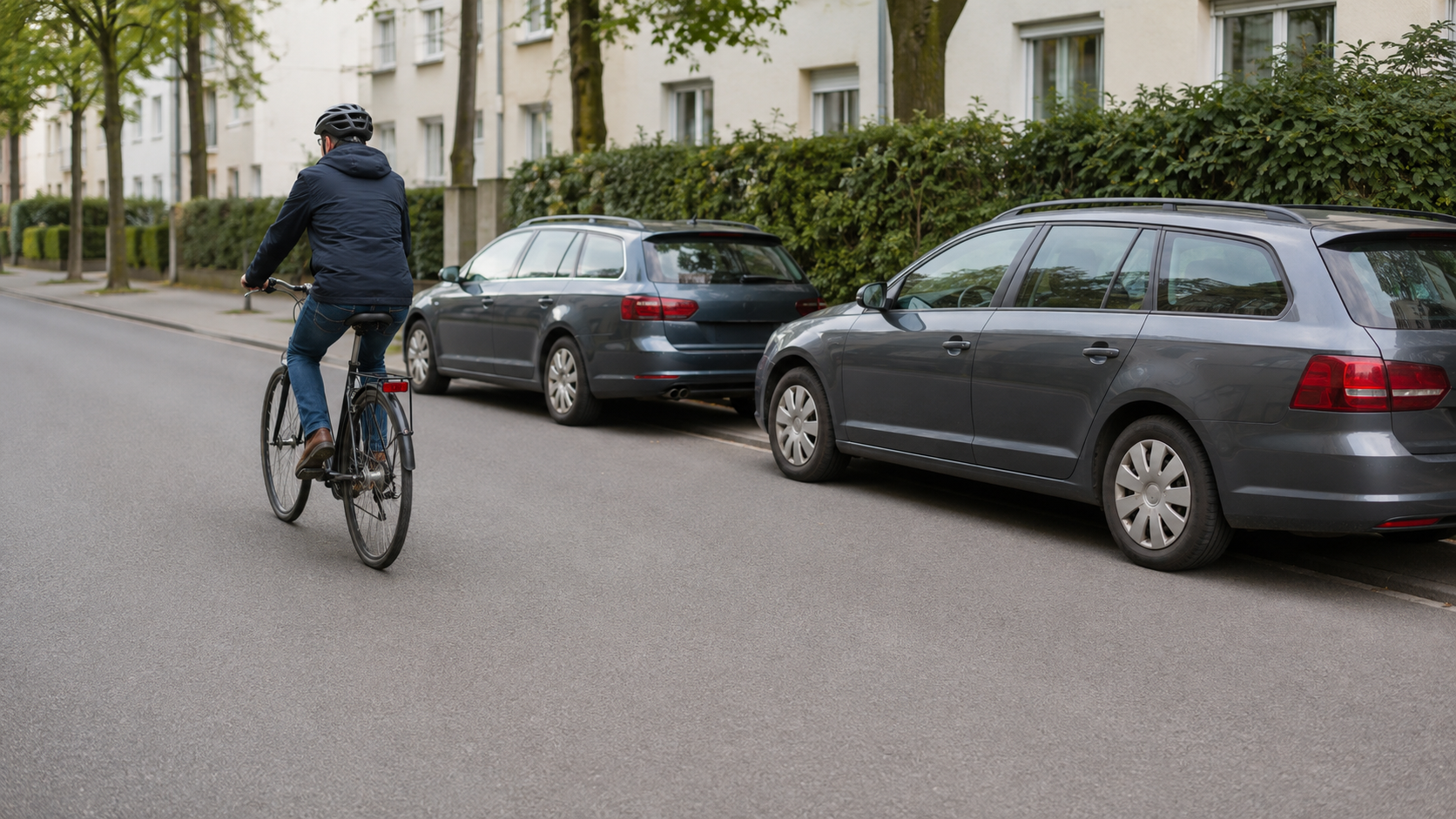
The keep-right rule requires road users to travel as far to the right as possible. It does not require riding in the gutter, over drain covers, or within the door zone of parked cars. The safe line depends on the edge of the road, obstacles, vehicle width, and traffic. Choosing your position in a clear and understandable way complies with the keep-right rule while also preserving your own reaction margin.
What “as far to the right as possible” really means
Section 2 (2) of the German Road Traffic Regulations (StVO) requires road users to travel as far to the right as possible, especially when facing oncoming traffic, when being overtaken, at hilltops, on bends, or where visibility is limited. However, “as far as possible” takes the specific circumstances into account. Broken glass, tram tracks, sunken gutters, snow, opened doors, or an uneven edge may require a larger safety margin.
The rule applies not only on wide main roads. You should generally also keep right on cycle paths, cycle lanes, advisory cycle lanes, and bicycle streets. On a narrow two-way cycle path, you still need to leave enough space from the edge, obstacles, and oncoming traffic. There is no rigid line that fits every situation.
Distance from the kerb and gutter
There is little room to manoeuvre directly beside the kerb. Pedals can touch the edge, drains may be lower, and dirt often collects along the side. The ADFC gives approximately 80 centimetres as a practical guide when there are no parked cars, measured from the end of the handlebars. This is not a figure prescribed by law, but a situation-dependent recommendation.
On a clean, wide, and clearly visible road, less space may be sufficient; gutters, crosswinds, or poor surfaces may require more. Do not check only the distance from your tyre: handlebars, panniers, and trailers make your vehicle wider. What matters is whether you can ride in a controlled manner and react to an obstacle.
Parked cars and the risk of dooring
A suddenly opened car door can block the entire area alongside a vehicle. The ADFC considers more than one metre, or approximately the width of a door, appropriate when passing parked cars. This figure is also a practical safety guideline, not a blanket statutory minimum that applies in every case.
Under Section 14 of the StVO, people getting into or out of vehicles must rule out endangering others. In everyday traffic, you should not rely on this blindly. Look for occupied seats, brake lights, running engines, taxi passengers, or people taking something out of the car. If a door is already open or loading is visibly taking place, leaving additional space is sensible.
Why leaving little space in the door zone also makes overtaking more difficult
If you ride directly beside parked cars, the remaining carriageway may appear wider to following motorists. This can encourage them to overtake within the same narrow lane. A clear, safe line makes it more apparent that a proper overtaking manoeuvre requires sufficient space or a complete lane change.

The statutory obligation for motorists to leave at least 1.5 metres when overtaking cyclists in built-up areas and two metres outside built-up areas is a separate rule. It does not require you to sacrifice your safety margin on the right. Conversely, you must not use the required overtaking distance to justify deliberately blocking traffic or swerving unexpectedly.
Advisory cycle lanes and cycle lanes
An advisory cycle lane is part of the carriageway and is marked by a broken line. If it runs directly beside parked cars, its right half may lie within the door zone. You do not have to press yourself against a painted line at the expense of your safety. After checking over your shoulder, continue further to the left in a clear line if the necessary safety distance requires it.
A cycle lane is separated by a solid line and is normally mandatory to use. Even there, an appropriate distance from parked vehicles remains important. If the marked area is objectively too narrow or blocked, the correct course of action becomes more difficult. Do not suddenly cross the line; slow down, observe, and choose a legally and practically safe transition.
Narrow roads and oncoming traffic
If the road is not wide enough for oncoming traffic, your bicycle, and a legal overtaking distance at the same time, the overtaking vehicle must wait. Ride predictably. A hurried swerve into a parking space may mean that you have to pull out dangerously again just a few metres later. A steady line is often better than constantly weaving in and out.
When a bus or lorry approaches, keep as far to the right as possible without giving up the safe area at the edge. Reduce your speed early and look for a suitable place to move aside only if it is actually passable. Pressure from a following vehicle does not turn a pavement or a dangerous gutter into a permitted riding area.
With a trailer or wide luggage
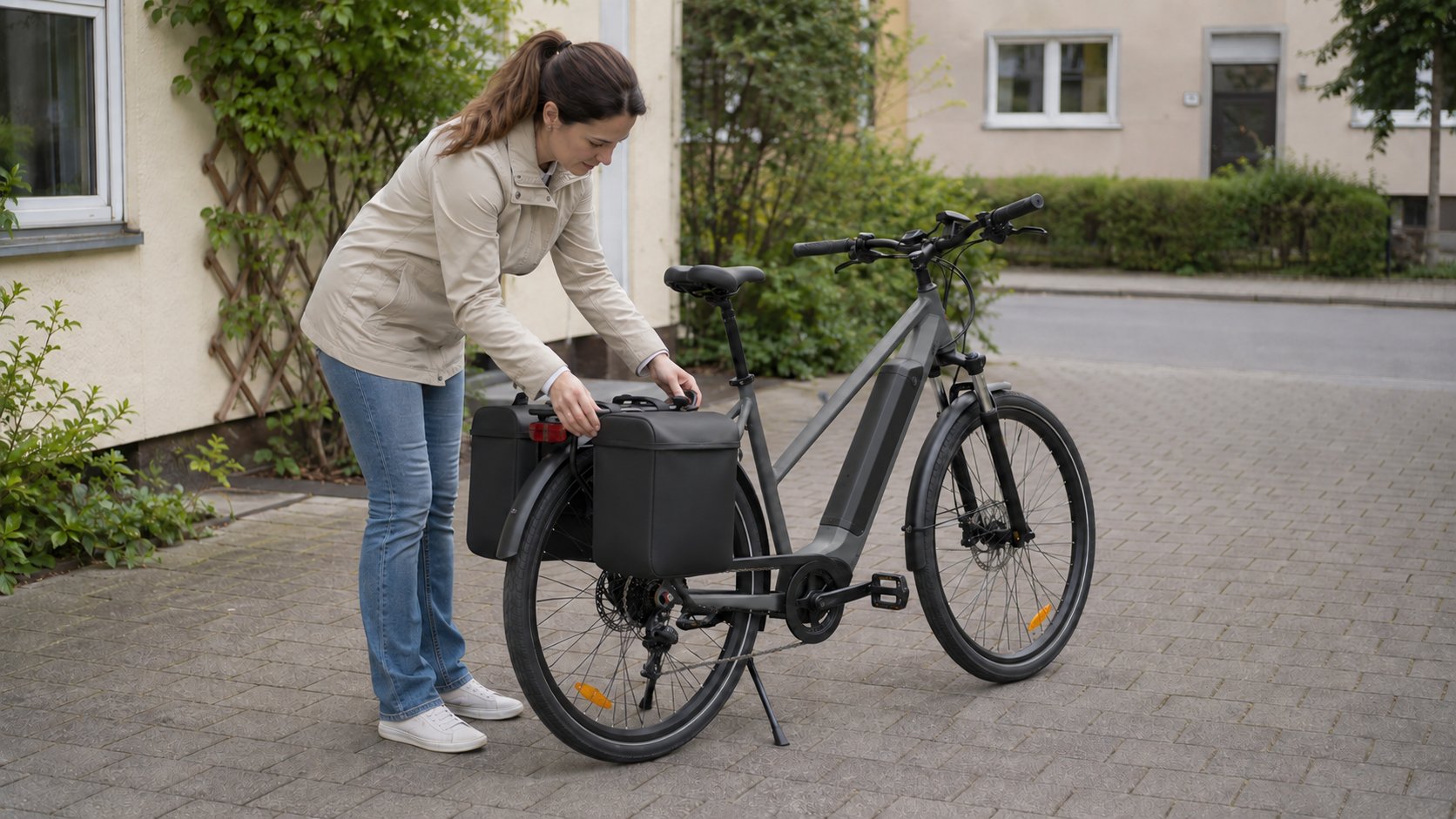
A trailer does not always follow exactly the line of the rear wheel. In bends, it cuts in, and luggage sticking out to the side can catch on bollards or parked cars. Plan your distance based on the widest part of the entire combination, not just the handlebars. Before your first everyday ride, practise slow starts, braking, and cornering in an area free of traffic.
On a pedelec, motor assistance does not change this basic rule. However, the higher system weight can affect braking distance and evasive manoeuvring. Do not therefore ride faster into a narrow door zone simply because starting off is easy.
When someone honks or pressures you from behind
Stay calm, hold your line, and avoid making a sudden evasive move. Look for a safe place where you can let a faster vehicle pass if this is possible without creating a hazard. Do not steer onto the pavement or stop in a door zone. Filming licence plates or conflicts with your smartphone while riding can further impair your attention.
If there is an immediate threat, immediate safety takes priority. Ride to a busy, safe place and contact the police if you are in danger. A later assessment requires the location, time, direction of travel, and an objective description; arguing in moving traffic will not resolve the lack of space.
Five-point check for your riding position
- Is there a gutter, edge, or dirty surface on the right?
- Could doors be opened or vehicles pulled out?
- Do luggage, a trailer, or crosswinds require additional space?
- Is your line recognisable early and free of sudden swerves?
- Can you brake and move aside without hitting the kerb or oncoming traffic?
Frequently asked questions
Do I have to ride directly at the right-hand edge of the road?
No. You should ride as far to the right as possible, while retaining the necessary safety margin from the edge, dirt, obstacles, and parked vehicles.
Is a one-metre distance from parked cars required by law?
The StVO does not specify a fixed distance for cyclists. The ADFC recommends at least approximately one metre as a practical guide. The specific situation may require more space.
May I leave an advisory cycle lane to the left?
An advisory cycle lane is part of the carriageway. If using it becomes dangerous because of parked cars or obstacles, a safe line further to the left may be necessary. Check the traffic behind you first.
Who is responsible for an opened car door?
People getting into or out of vehicles must rule out endangering others. Liability after an accident nevertheless depends on the specific circumstances and the available evidence and cannot be predicted as a blanket rule.
As of: 6 September 2026. This article provides general guidance and does not predict liability in any individual case.
Share:
Carrying Luggage on a Bicycle: Transport Loads Safely and Legally
Carrying Luggage on a Bicycle: Transport Loads Safely and Legally