

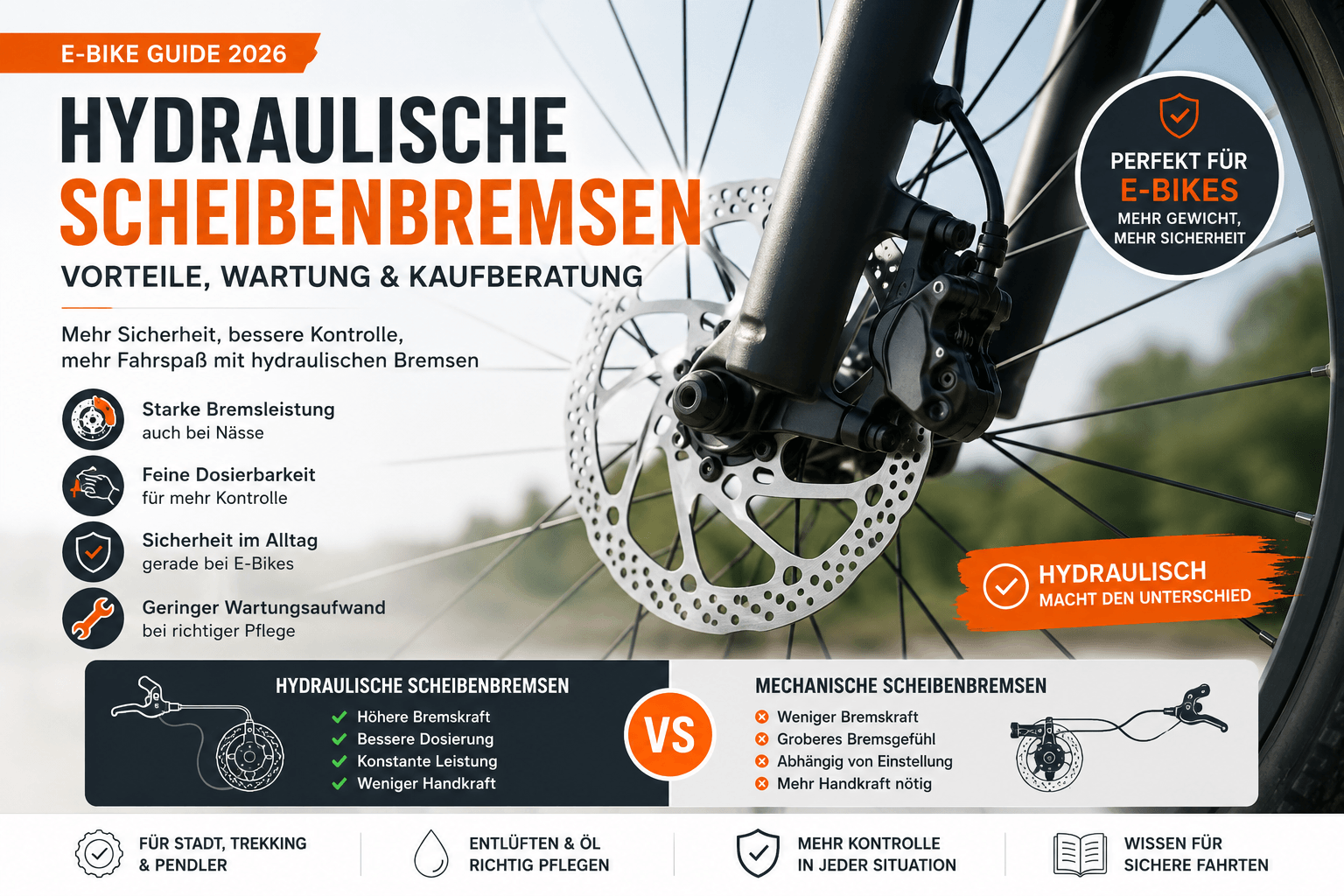
Hydraulic disc brakes on an e-bike: What they really offer in everyday use
When buying an e-bike, people often focus first on the battery, motor, and range. However, the brakes are at least as important. Especially on e-bikes with higher weight, for daily use, or in urban traffic, hydraulic disc brakes play an important role in control, modulation, and safety.
What are hydraulic disc brakes?
Hydraulic disc brakes use a closed braking system. When the brake lever is pulled, pressure is transmitted through brake fluid or mineral oil to the brake caliper. The brake pads then press against the brake disc. The result is consistent, easily controllable braking performance.
Hydraulic vs. mechanical disc brakes
Many users look for the difference between mechanical and hydraulic disc brakes. Both systems can brake reliably, but they differ in feel, maintenance, and braking force transmission.
| Criterion | Hydraulic disc brakes | Mechanical disc brakes |
|---|---|---|
| Braking power | Usually more powerful and consistent | Dependent on cable tension and adjustment |
| Modulation | Very smooth and controlled | Solid, but often less responsive |
| Maintenance | Less frequent adjustment, but bleeding may require technical expertise | Easier to understand, but cable tension must be checked more often |
| Everyday use in wet conditions | Strong in changing conditions | Good, but more dependent on adjustment and brake pads |
| Suitable for e-bikes | Very good for higher weight and daily use | Good for simple, lightweight, or budget-oriented bicycles |
Why hydraulic disc brakes are particularly useful on e-bikes
E-bikes are often heavier than conventional bicycles because of their battery, motor, and sturdier frames. They also have higher average speeds and are used more frequently for everyday journeys. That is precisely why e-bikes benefit greatly from brakes that respond precisely and reliably.
- More control with a heavier vehicle
- Better modulation in city traffic and stop-and-go riding
- Consistent braking performance in wet conditions and changing circumstances
- A more comfortable braking feel on longer rides
- Less hand force when braking in everyday use
Maintenance: What should you bear in mind with hydraulic brakes?
Hydraulic brakes are often considered low-maintenance in everyday use, but they are not maintenance-free. Brake pads, brake discs, and the system’s seal integrity should be checked regularly. If the brake lever feels spongy or braking power decreases, the brakes may need bleeding.
When should you bleed a hydraulic brake?
Many users search for bleeding hydraulic bicycle brakes when the brake no longer feels responsive. Typical signs include a soft bite point, reduced braking power, or a brake lever that has to be pulled unusually far.
- The brake lever feels spongy
- The braking force only kicks in very late
- After extended use, the bite point changes noticeably
- After transport or a repair, the brake feels unusual
- The brake was opened or a hose was replaced
Shimano, Magura & Co.: Why many people search for brands
Search queries often include terms such as Shimano hydraulic disc brake or Magura. This shows that many users want to know not only whether hydraulic brakes are good, but also whether specific braking systems are easy to maintain, readily available, and reliable.
However, the brand name is not the only decisive factor when buying an e-bike. What matters is how the braking system, vehicle weight, tyres, frame geometry, and intended use work together.
Which Cyseekin models particularly benefit from strong braking performance?
With e-bikes, it is not just about getting where you are going faster. Being able to stop in a controlled manner at any time is just as important. The role of the brakes varies depending on the model and how it is used.
Discover Cyseekin E-Bikes with Practical Everyday Equipment
Compare models for city riding, commuting, and practical everyday journeys directly in the official Cyseekin Shop.
View All Cyseekin E-Bikes →Related Content
FAQ – Hydraulic Disc Brakes on E-Bikes
Are hydraulic disc brakes better than mechanical ones?
For many e-bikes, yes, because they generally offer better modulation and stronger braking performance. Mechanical disc brakes can also be reliable, but their cable tension and adjustment need to be checked more frequently.
How often do hydraulic brakes need to be bled?
There is no fixed interval that applies to all bicycles. Bleeding is especially advisable when the bite point feels spongy or braking performance noticeably decreases.
Can you refill the oil in a hydraulic bicycle brake yourself?
Only with the appropriate fluid and the correct tools. If you are unsure, have the brake inspected by a specialist workshop, as using the wrong fluid or working improperly can impair braking performance.
Why do hydraulic disc brakes sometimes squeak?
Common causes include dirty brake discs, glazed brake pads, moisture, or a brake that is not properly aligned.
Are hydraulic disc brakes suitable for e-bikes?
Yes, especially for heavier e-bikes, city traffic, commuting, and frequent use. They help you control braking force more effectively and provide a safer riding experience.

Share:
E-Bike 25 km/h vs 45 km/h: Differences, Law & Buying Guide 2026
Buy an E-Bike – Best E-Bikes 2026 Comparison