

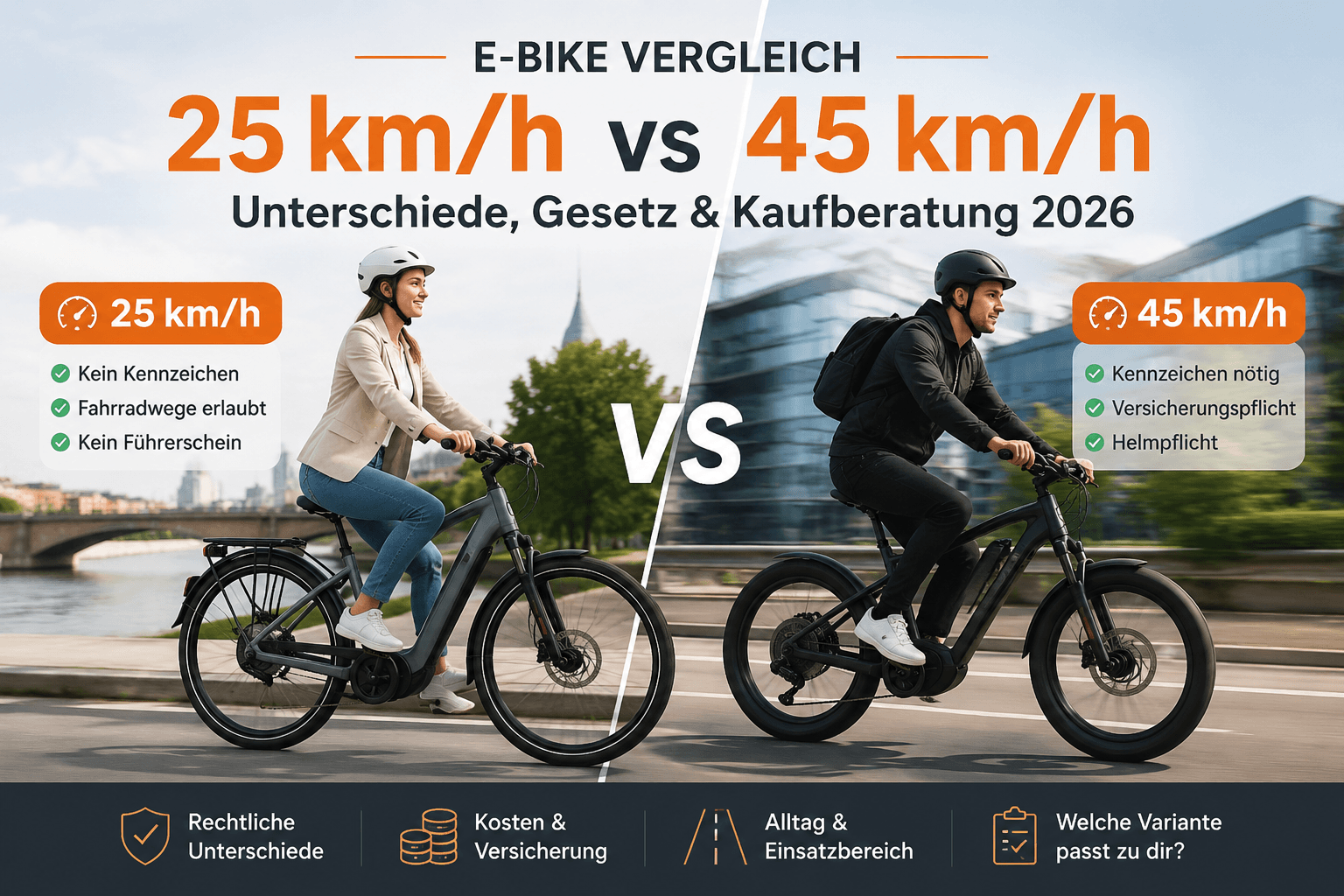
25 km/h vs 45 km/h e-bike – what is the difference?
In Germany, choosing between a 25 km/h pedelec and a 45 km/h S-Pedelec is decisive for everyday use, costs, insurance, and legal requirements.
Basic principle: 25 km/h vs 45 km/h
25 km/h e-bikes, i.e. classic pedelecs, provide assistance only while pedaling and up to 25 km/h. 45 km/h models, known as S-Pedelecs, offer significantly higher speeds but are no longer legally considered ordinary bicycles.
✔ Everyday use & urban traffic
✔ No insurance requirement for standard pedelecs
✔ Use of many cycle paths possible
✔ Faster commuting over longer distances
✖ Insurance required + license plate
✖ Classic cycle paths are generally not permitted
Legal differences in Germany
In Germany, 25 km/h pedelecs are generally treated like bicycles in everyday use. 45 km/h S-Pedelecs, on the other hand, belong to a different vehicle class and come with additional requirements.
- 25 km/h → bicycle-like use in everyday life
- 45 km/h → insurance and license plate required
- Helmet requirement for 45 km/h S-Pedelecs
- Cycle paths are generally not permitted for S-Pedelecs
Everyday use: Which speed makes sense?
On paper, 45 km/h sounds attractive. In everyday use, however, the better choice depends heavily on where and how you ride. For city journeys, shopping, and short commutes, a 25 km/h e-bike is often more practical and flexible.
| Criterion | 25 km/h | 45 km/h |
|---|---|---|
| Urban traffic | Very well suited | Often oversized |
| Commuting 10–25 km | Very good for regular journeys | Faster, but with more legal obligations |
| Costs | Lower running costs | Higher due to insurance, license plate, and maintenance |
| Flexibility | Very high in everyday use | Restricted by regulations and usage requirements |
| Cycle paths | Usable in many cases | Usually not permitted |
25 km/h: Why this class is more practical for everyday use for many people
A 25 km/h e-bike is fast enough for many everyday situations. Especially in cities, people rarely travel continuously at top speed. Traffic lights, intersections, cycle paths, pedestrian areas, and narrow streets mean that control and comfort are often more important than maximum speed.
Fewer legal hurdles, good flexibility, easier use in city traffic, and lower ongoing costs.
45 km/h: When an S-pedelec may be worthwhile
A 45 km/h S-pedelec may be a good option for longer commutes if the route is well suited to it. Those who regularly travel outside densely populated city centers may benefit from the higher speed.
For 45 km/h models, insurance, a license plate, helmet requirements, permitted routes, and additional maintenance costs should be carefully checked in advance.
Which Cyseekin e-bike is right for me?
Cyseekin focuses on practical 25 km/h e-bikes for city riding, commuting, shopping, and leisure. This makes the models particularly suitable for people looking for a practical e-bike for daily journeys.
The C20 is suitable for city riding, shopping, and commuting, with stable assistance and practical everyday usability.
The S10 is suited to relaxed rides, regular journeys, and classic city mobility.
The C10 is ideal for short distances, urban mobility, and people who prefer a folding e-bike.
FAQ – 25 km/h vs. 45 km/h e-bike
Is a 45 km/h e-bike legal in Germany?
Yes, but only as an S-pedelec with insurance, a license plate, and a helmet requirement. Other rules also apply than for conventional 25 km/h pedelecs.
Which e-bike is better for everyday use?
For city traffic, shopping, and daily journeys, 25 km/h e-bikes are often the more practical choice because they can be used more flexibly and with fewer complications.
Can I use bike paths with a 45 km/h e-bike?
In most cases, no. S-pedelecs generally may not use conventional bike paths.
Which is cheaper to maintain?
25 km/h e-bikes are generally cheaper to maintain because they do not require insurance or a license plate as S-pedelecs do.
Why does Cyseekin focus on 25 km/h e-bikes?
25 km/h e-bikes are particularly well suited to city riding, commuting, shopping, and everyday use. They provide electric assistance while remaining straightforward for daily use.
Choose the right e-bike now
Compare 25 km/h models for everyday use, city riding, and commuting.
Discover models →
Share:
E-Bike City: The Best City E-Bikes for Everyday Use, Commuting & Urban Life 2026
Hydraulic or Mechanical Disc Brakes? The E-Bike Brake Guide