

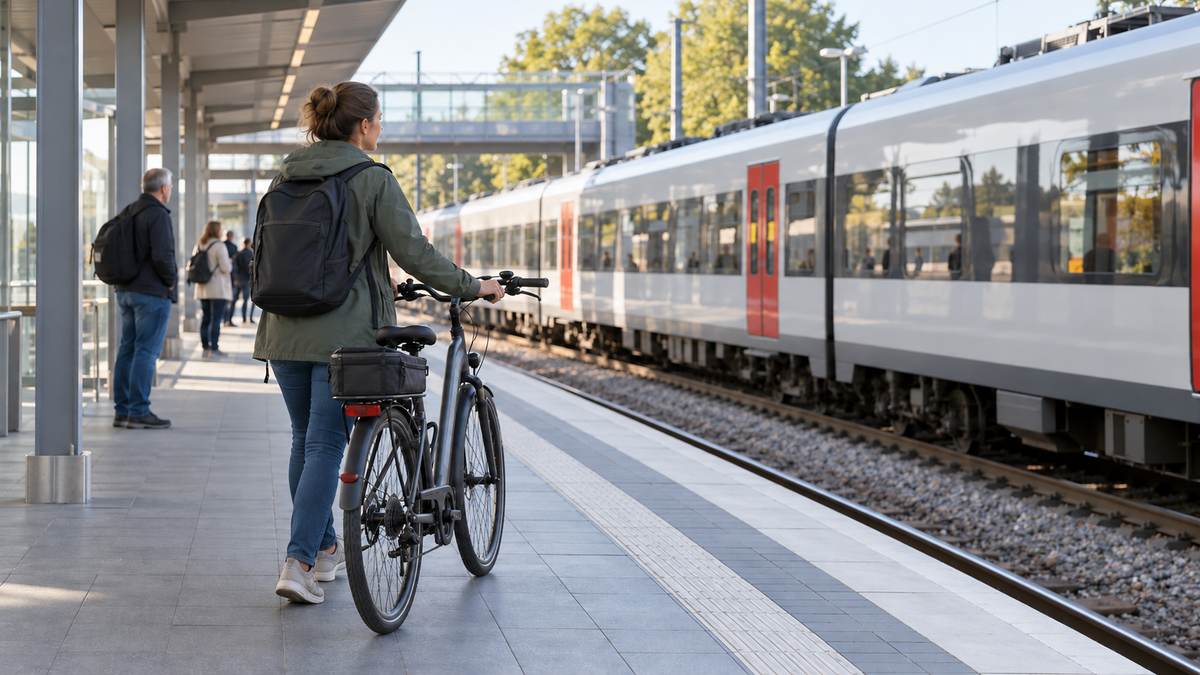
Bicycle transport with the Deutschlandticket is not regulated uniformly nationwide. Within its applicable fare area, the Deutschlandticket entitles you to travel on local public transport, but it does not automatically let you bring your bicycle free of charge. Whether you need an additional bicycle ticket, when bicycle transport is not permitted, and whether e-bikes are allowed depends on the relevant transport network, fare, and operator. So check not only your connection, but also the rules for every fare area along your route. This guide takes you through six steps, from planning your trip to the platform, and helps you plan a reliable alternative.
This article is for general guidance. Fare conditions, restricted hours, and vehicle rules may change or differ for individual lines. On the day of travel, the published conditions of the responsible transport operator or network, as well as on-site operational instructions, take precedence.
Why the Deutschlandticket alone is not enough
According to official information from Deutsche Bahn, bicycle transport is not included in the price of the Deutschlandticket. Instead, the rules of the Deutschlandtarif, the relevant state fare, transport network, or operator apply to your specific journey. You may be able to take your bicycle free of charge at certain times on one route, need a bicycle ticket on another, and face restricted hours in a different network.
Even a valid bicycle ticket is not a reservation or a guarantee that you can bring your bike. Multi-purpose areas have limited space, and train staff and transport operators may restrict bicycle transport for safety or capacity reasons. So plan not only around the fare rules, but also allow extra time.
Six steps to finding the right connection
Step 1: Plan your entire journey
Note your origin, destination, travel date, and preferred departure time. Then check each leg: regional express, regional train, S-Bahn, U-Bahn, tram, and bus services may be subject to different rules. If your journey crosses several transport network boundaries, it is not enough to read only the conditions at your departure station. What matters is which fares and operators apply to every leg.
Use the bicycle carriage option in the journey planner if available. It helps you choose suitable connections, but does not replace checking the current conditions of carriage. Make a separate note of the operator, line number, and transfers.
Step 2: Classify the vehicle correctly
Note what you are taking: a standard bicycle, a standard pedelec, a cargo bike, a bicycle with a trailer, a tandem, a folding bike, or an S-pedelec. Operators may treat these vehicles differently. Many fare rules treat a standard pedelec like a bicycle for carriage, but this does not mean it is guaranteed nationwide. Different rules or exclusions may apply to S-pedelecs, particularly wide vehicles, trailers, or cargo bikes.
Therefore, check the definitions in the conditions of carriage. Also look for requirements regarding dimensions, batteries, securely attached parts, and designated parking spaces. This step concerns carriage on the mode of transport only and does not replace checking the vehicle’s legal classification under road traffic law.
Step 3: Check ticket requirements for every section
Search the website or app of the relevant transport network for “bicycle carriage,” “bicycle ticket,” and “conditions of carriage.” Clarify three points: Is carriage free on your route? If not, which bicycle ticket applies? Does that ticket cover all sections, or do you need an additional ticket for another fare zone?
The VBB area is a good example of why a regional check is necessary: the network expressly points out that the Deutschlandticket does not automatically include bicycle carriage and that a suitable fare may be required for bicycles. Other regions may have different arrangements. So do not apply a VBB rule to a trip in another federal state.
Step 4: Check restriction periods and exceptions
Some transport services restrict bicycle carriage during peak hours, on certain lines, or on specific vehicle types. Check the times for your outward and return journeys separately. A connection in the morning may be permitted, while the return journey falls within a regional restriction period. Also check how working days are defined, public holidays, and special rules during construction work or major events.
If the published rule is unclear, ask the operator in advance and specify the line, time, and vehicle type. A general statement such as “bicycles are allowed” does not tell you whether your pedelec can be carried on that specific trip.
Step 5: Plan capacity and boarding realistically
If possible, choose a service outside peak hours and avoid tight connections. You can identify the multipurpose area from the carriage formation display or pictograms. Position yourself so that you do not obstruct other passengers or delay the train by rushing.
Buying a bicycle ticket does not reserve a space for your bike. If the area is full, you may not be able to take your bike, even with valid tickets. You should especially note an earlier or later service as a backup plan during weekend travel, holidays, good weather, or events.
Step 6: Check again on the day of travel
Shortly before departure, check for construction work, replacement services, train cancellations, and last-minute changes to the train type. Replacement buses for rail services can often carry bicycles only in limited numbers or not at all; the operator’s information is authoritative. Download the relevant fare information or take a screenshot with the date in case you have no data connection while travelling. A screenshot documents your preparation, but does not guarantee carriage if there is no space.
Decision table for planning your trip
| Check | If confirmed | If unclear or not met |
|---|---|---|
| Is carriage free on all sections of the journey? | Note the rule and the period it applies. | Find the right bicycle ticket for each fare zone. |
| Is your type of bicycle permitted? | Check the size and parking rules. | Contact the operator with your bicycle type and route. |
| Is your journey outside a restricted travel time? | Confirm the outbound and return journeys separately. | Change the departure time or connection. |
| Is there a suitable multipurpose area? | Find the boarding area in advance. | Plan an alternative connection without a guaranteed place. |
| Do you have a backup plan in case the service is full? | Note down extra time and the next available service. | Allow more time for your journey or choose a different route. |
Quick checklist before heading to the platform
- Your Deutschlandticket and, if needed, bicycle ticket are valid and ready to hand.
- All fare zones, operators, and restricted travel times for the outbound and return journeys have been checked.
- Your pedelec or other type of bicycle is permitted under the current conditions.
- Loose bags and accessories are secured; you can push and hold the bike in a controlled manner.
- Multipurpose area, transfer routes, and a backup connection for later are known.
Walk your bicycle along the platform, keep emergency exits and door areas clear, and follow staff instructions. If necessary and safe, remove your luggage before boarding. If there is a conflict over space, do not argue or block access; use the alternative you have prepared.
Frequently asked questions about taking a bicycle on public transport with the Deutschlandticket
Is a bicycle included for free with the Deutschlandticket?
No, not nationwide. According to Deutsche Bahn, bicycle transport is not included in the price of the Deutschlandticket. Free bicycle transport may be available regionally, but the conditions of the relevant fare and operator apply.
Does a bicycle ticket guarantee that you can bring your bike?
No. A bicycle ticket covers fare eligibility, but generally does not reserve a space on local public transport. Capacity, safety, and operational requirements remain decisive.
Can a pedelec be taken on board like a bicycle?
Check the conditions of carriage. Standard pedelecs are often treated like bicycles, while different rules may apply to S-pedelecs or particularly large vehicles. The designation alone does not guarantee that you can bring it on board.
What applies when traveling through multiple transport networks?
Check every affected fare zone and operator. A bicycle ticket may be limited to a specific region; another option may cover multiple sections. The applicable area and conditions of the ticket you actually choose are what matter.
Can a folded folding bike count as luggage?
This depends on the operator’s luggage and packaging rules. Check whether and how the bike must be folded, secured, or packed. This does not mean there is a blanket nationwide guarantee.
What should you do if the train is full?
Follow staff instructions and do not block doors or emergency exits. Take the next suitable service or your planned alternative route. Having a ticket does not change the current capacity limit.
Conclusion: Check the fare first, then your bicycle and capacity
Taking a bicycle on public transport with the Deutschlandticket requires more than a valid personal ticket. Check the entire route, regional fare rules, your specific type of bicycle, any restricted hours, and realistic capacity. Check the information again on the day of travel and have an alternative ready. This helps you avoid preventable problems without promising that you can bring your bike, since that ultimately depends on current conditions and the situation on site.
Share:
Floor pump or mini pump for your bike: Which is right for home and on the go?
E-bike inspection: How often is it advisable, and what is checked?