

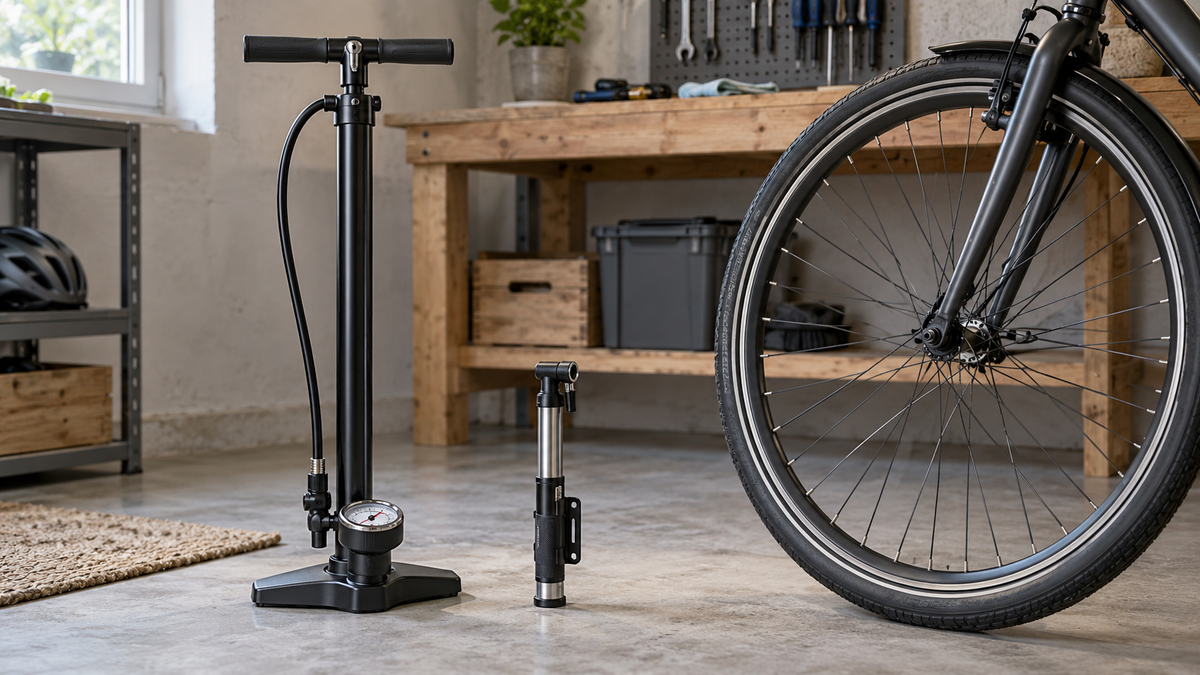
Floor pump or mini pump for your bike? The answer depends less on the highest possible pressure rating than on how you'll use it. At home, a stable base, fast airflow, and an easy-to-read pressure gauge matter. On the go, compact size, weight, a secure valve connection, and practical pumping performance are more important. For most everyday and e-bike riders, the ideal solution isn't one pump or the other, but a clear division of roles.
This comparison shows how to assess both types of pump. It doesn't replace a pressure recommendation: the permitted range is printed on the tire, while the right riding pressure also depends on the tire, total weight, terrain, and load.
Floor pump or mini pump: a quick comparison
| Criterion | Floor pump | Mini pump |
|---|---|---|
| Main use | Regular checks at home | Puncture repairs and topping up on the go |
| Pumping speed | Usually more air per stroke and less effort | Depending on its size, more strokes and longer pumping time |
| Pressure checks | Often with a large pressure gauge | Often without a gauge or with a compact one |
| Portability | For a workshop, basement, or garage | For a bag, mount, or luggage |
| Strain on the valve | The hose can usually be attached steadily | A flexible hose makes it easier to pump straight |
| Best suited for | Regular checks | Portable backup |
Clear recommendation: If you're buying just one pump for home use and plan to check your tires regularly, choose a floor pump with a compatible pump head and an easy-to-read gauge. If the pump is only for taking on rides, choose a mini pump that really suits your valve, tire volume, and storage space. If you ride regularly, you're usually better equipped with both tools.
Why a mini pump doesn't fully replace a floor pump
A good mini pump can get a tire back on the road after a puncture. However, its smaller cylinder often means you need considerably more strokes. This makes regular pressure checks more difficult, especially with wider tires. A floor pump, by contrast, stands on the ground, is operated with both hands, and can be connected to the valve more steadily.
Conversely, even the best floor pump is no help at the roadside. A portable pump therefore shouldn't be judged in the same category as a workshop tool. It's a backup that must be small enough to actually take along, but powerful enough to reinflate your tire after a repair.
1. Check the valve head first
Compatibility comes before pressure, materials, and accessories. Check which valve is fitted to your bike and whether the pump head can securely grip it without an improvised adapter. Common names include the Schrader or car valve, the Sclaverand or Presta valve, and the Dunlop valve. Our overview of bicycle valves can help you identify yours.
A convertible multi-valve head is handy if different bikes in your household use different valves. What matters is not the number of advertised standards, but a secure, easy-to-use connection. On a mini pump, an extendable hose can reduce sideways forces on the valve by making your hand movements less direct. Even so, the head should be attached straight and released without force.
2. Don’t confuse air volume with pressure
A high maximum pressure alone says little about how comfortable a pump is to use on your bike. Wide city, trekking, or e-bike tires need comparatively more air for each pressure adjustment. A larger cylinder with a higher volume per stroke is therefore convenient. Narrow tires with higher operating pressures benefit more from a design that reaches the required pressure without excessive effort.
So don’t just ask, “How many bar can the pump deliver?” More important questions are: How many strokes are realistic, how hard does the final part of pumping become, and is the scale easy to read in the range relevant to you? An impressive upper limit is of little use if you ride your tire well below it and the gauge is hard to read at that point.
3. A pressure gauge is most useful at home
You can only judge tire pressure roughly with your thumb. A floor pump with a pressure gauge helps you set it consistently, provided the scale is large enough and clearly covers the range you need. This helps you spot changes early: if a tire needs pumping up much more often than before, check the cause rather than simply topping it up again and again.
A pressure gauge is a useful extra on a mini pump, but it is not automatically the most important feature. A compact, sturdy pump without a gauge may be a better emergency tool than a larger model that stays at home because of its weight or impractical shape. After you get home, you can check and adjust the pressure with a floor pump.
4. Hose, handle, and stability determine ease of use
For a floor pump
The foot should stand steadily on level ground, the handle should accommodate both hands, and the hose should reach the valve without tension. Check whether the pump head locks securely and releases easily. A long hose alone is no proof of quality; above all, it must suit the pump’s storage position and the valves on your bikes.
For a mini pump
Make sure the pump sits securely in your hand and is easy to control even with wet hands. A short, flexible hose can make it easier to connect. A very small pump saves space, but often requires more strokes. A slightly longer frame or mini pump often works faster, but needs a suitable mount or more room in your luggage.
5. Realistically test size and mounting
Measure not just the pump, but also the storage space you plan to use. A saddlebag must also fit an inner tube or repair kit, tire levers, and, if needed, a wrench. For a frame mount, check that the pump and bottle cage fit together, nothing interferes with the crank or suspension, and the pump locks securely in place.
After installation, take a short test ride on uneven asphalt. If the pump rattles, the mount comes loose, or you can remove it without tools, adjust the attachment. If you regularly leave your bike parked in public, a pump that’s easy to remove and carry in a bag is usually a better choice than one left visibly attached to the bike.
Which pump is right for each use?
Everyday use and commuting on a city bike or e-bike
For home use, a sturdy floor pump with a pressure gauge and a head that fits your valve is recommended. On the go, a robust mini pump with a flexible connection is often enough. Whether it’s a city bike or an e-bike, tire limits, load, and manufacturer specifications remain decisive. The motor is not a separate factor when choosing a pump.
Weekend rides and cycling tours
For longer rides, make sure your mini pump is not just compact, but also practical. At home, use it to inflate a partially deflated tire once. This lets you check before your trip whether the valve connection, number of strokes, and handling are acceptable. If you’re traveling with others, a slightly larger pump may make sense, as long as it fits all the valves you use.
Wide tires with high air volume
Choose a pump that moves more air with each stroke. An extremely compact high-pressure pump may be technically suitable, but can take unnecessarily long to inflate a high-volume tire. For a floor pump, a clearly legible scale in the pressure range you actually use is more important than the highest possible maximum reading.
Narrow tires with higher pressure
The key is for the pump to reach the approved range in a controlled way without requiring excessive effort. Pay particular attention to how securely it fits on a narrow valve stem. Don’t buy based on the advertised maximum pressure alone; ease of use and a suitable scale remain crucial.
Floor and Mini Pump Buying Checklist
- Valve: Does the head fit directly and form a tight seal?
- Tire type: Do you mainly need high volume or higher pressure?
- Pressure gauge: Is the relevant range easy to read?
- Connection: Can you operate the head straight on without applying much sideways force?
- Ergonomics: Are the handle, base, and stroke practical for you?
- Transport: Does the mini pump fit in your bag or holder with the rest of your puncture repair kit?
- Practical test: Have you tried the model on your own bike before your first ride?
- Replacement parts: Can the seals, hose, or pump head be replaced if needed?
Avoiding common bad purchases
A common bad purchase is a pump that looks impressive on paper but is awkward to use with your own valve. Another impractical choice is a tiny emergency pump for a high-volume tire if it has never been tested in realistic conditions. With floor pumps, a hard-to-read gauge can mean that you barely use it.
Also, don’t buy a mini pump without a secure transport plan. A model that rattles around loose in your backpack or gets removed because of the noise won’t be there when you next get a flat. The best choice is a pump that fits your bike, is easy to use, and stays where you intend to keep it.
FAQ: Floor pump or mini pump for your bike
Is a mini pump enough for home use?
Technically, it may be sufficient if it works with your valve and covers the required pressure range. For regular checks, a floor pump is usually faster and more stable, and has an easier-to-read pressure gauge.
Does every bicycle pump need a pressure gauge?
No. A basic, reliable mini pump can be a good choice for mobile puncture repairs. For repeatable pressure adjustments at home, however, an easy-to-read pressure gauge is helpful.
Is a higher bar rating automatically better?
No. The pump needs to reach the approved pressure range for your tire. Beyond that, air volume, effort required, gauge, and connection matter more than the highest possible maximum rating.
Which mini pump is suitable for an e-bike?
There is no specific category of pump required just for e-bikes. What matters is the valve, tire volume, approved pressure range, and available storage space. Test the pump on your actual bike before adding it to your puncture repair kit.
Conclusion: Two tools, two clear roles
A floor pump is the better choice for regular pressure checks at home. A mini pump is a portable backup for your puncture repair kit. If you ride often, you don’t have to choose between the two: choose a floor pump based on its valve head, stability, and easy-to-read gauge, and a mini pump based on compatibility, actual pumping time, and secure transport. Test both on your own tire before relying on them.

Share:
Taking a bicycle on the Deutschlandticket: Check the ticket, blackout periods, and e-bike rules
E-bike inspection: How often is it advisable, and what is checked?