

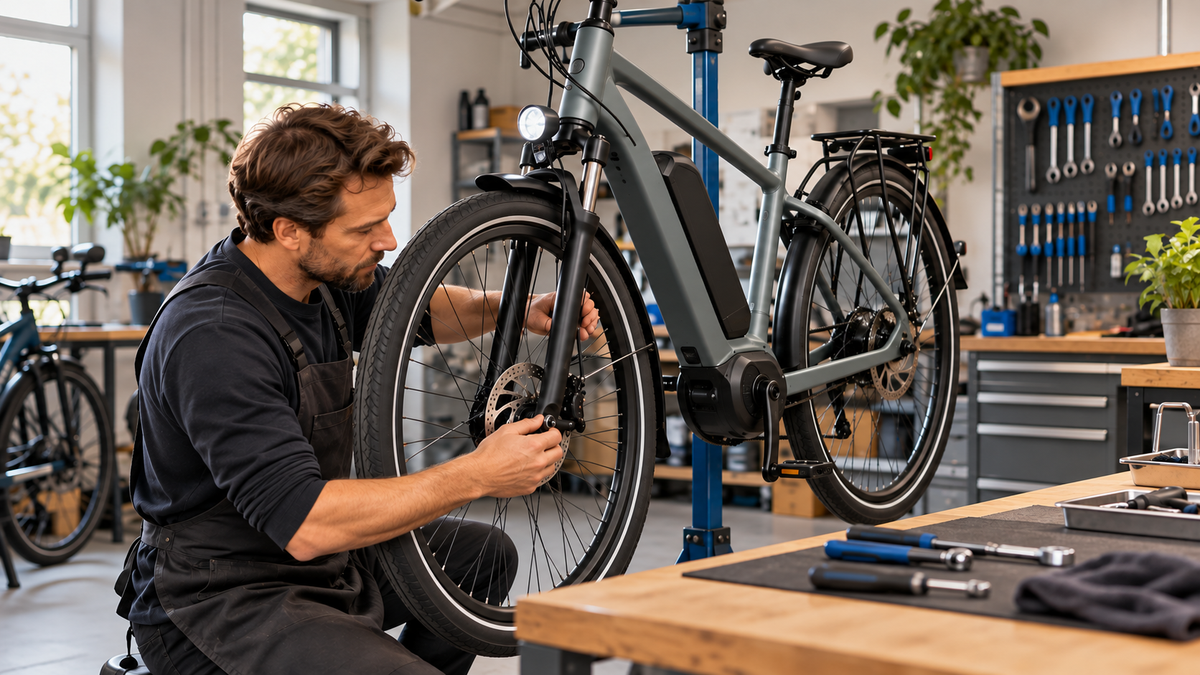
How often an e-bike should be inspected can’t be answered with a single mileage or time interval. The key factors are your bike’s and drive system’s manuals, the manufacturer’s requirements, how you actually use the bike and any specific issues. A city e-bike ridden every day in the rain and loaded with luggage may need attention sooner than a bike that is rarely ridden, even if they are the same age.
An inspection involves more than a quick look before a ride. It combines mechanical checks and functional tests, as well as—if the system allows—a professional diagnosis of the electrical components. This guide explains when to book an appointment, what you can check yourself beforehand and what questions to ask the workshop.
The short answer: the manual, how you ride and the bike’s condition are what matter
Start with the owner’s manual and service documents for your specific model. They may specify an initial inspection, regular maintenance intervals or special checks. If the information is unclear, ask the dealer or manufacturer instead of using a figure you found online for a different bike.
| Situation | Recommended course of action | Why |
|---|---|---|
| New or recently assembled e-bike | Schedule the initial inspection specified in the manual or handover documents | Assembly, fasteners and settings are checked again after initial use |
| Regular everyday use without any issues | Follow the manufacturer’s service interval and document the workshop’s recommendation | Wear does not progress at the same rate on every bike |
| Frequent rain, dirt, salt, heavy loads or long distances | Coordinate an earlier inspection with the workshop | Use and environment can accelerate maintenance needs |
| Fall, hard impact, play, crack, weak brakes or system failure | Don’t wait until the next routine interval | A specific safety or functional issue needs prompt attention |
| Long period out of use | Carry out a visual and functional check before putting it back into use; if in doubt, arrange a professional inspection | Tire pressure, corrosion, the battery and moving parts may have changed |
Why there is no universal e-bike inspection interval
E-bikes differ in frame, brakes, gearing, motor position, battery, display, software and maximum permitted weight. Maintenance schedules and diagnostic options also depend on the system. A blanket rule such as “every 1,000 kilometers” may therefore be too late or unnecessarily early.
Mileage alone does not reflect the level of stress. Frequent stops and starts in city traffic, daily loads, riding on rough surfaces, winter use, and exposure to rain and dirt put different demands on components than leisurely weekend rides on dry paths. Time, storage conditions, and unusual bike behavior are also important.
Bosch eBike Systems recommends an initial inspection at a specialist dealer for e-bikes with its system after approximately four weeks or 300 kilometers ridden, followed by regular comprehensive service checks. This is a Bosch-specific example, not a general guideline for Cyseekin or other drive systems. The relevant documentation applies to your bike.
Distinguishing between an initial inspection and regular maintenance
The initial check after the first rides
An initial check is intended to assess whether the delivered and assembled bike is still correctly adjusted after the first period of use. The exact scope should be clarified in advance with the seller or specialist workshop. It may include fasteners, wheels, brakes, gears, bearing points, and secure battery mounting. This does not mean that every screw should simply be tightened more.
Bring the handover documents and the exact model name. If you partly assembled the e-bike yourself, note which steps you carried out. Don’t assume that a workshop can automatically identify every model-specific assembly detail without being asked.
Regular service based on actual use
After the initial check, the schedule for subsequent checks depends on the manufacturer’s specifications, the bike’s documented condition, and how it is used. After an inspection, ask which parts should be monitored and when the next check is recommended. A clear recommendation is more useful than a sticker with no reference to mileage, date, or scope of work.
Don’t schedule an appointment on the morning of a trip. Workshops can be busy in spring and before typical holiday periods. For commuter bikes used year-round, an appointment before the wet and dark season can be practical, provided it fits the maintenance schedule. However, the calendar is no substitute for an immediate check if a problem arises.
What can be checked during an e-bike inspection
The scope is not the same everywhere. When booking an appointment, ask which services are included and which work is only carried out after consultation. A clear order confirmation helps protect both parties from misunderstandings.
- Frame and attachments: visible damage, fasteners, handlebars, stem, saddle, kickstand, fenders, and luggage rack.
- Wheels and tires: condition, fit, tire pressure, axles, spokes, rims, and free rotation.
- Brake system: function, pad condition, lines or cables, brake discs or braking surfaces, and a clear pressure point.
- Drive and gears: chain or belt, sprockets, chainring, shifting function, cranks, and pedals in accordance with the manufacturer’s specifications.
- Lighting and electrical system: front and rear lights, cables, display, controls, and externally accessible plug and contact areas.
- E-bike system: fault memory, diagnostic report, software version, or system test only with approved tools and personnel trained for the specific system.
- Final check: documented functional test; a test ride only by authorized personnel and under safe conditions.
An inspection does not automatically mean that the battery is opened or its remaining capacity is determined precisely. Batteries and motors are sealed systems. The specialist workshop must explain whether a capacity measurement or electronic diagnosis is possible and included for the specific system.
What you can check yourself - and where the limit lies
Simple checks before every ride are still worthwhile: tire pressure and visible tire damage, both brakes, lights, secure battery fit, and any loose or unusual components. This pre-ride check does not replace an inspection, but it can reveal a defect early.
For a stationary brake check, see the guide “Checking bicycle brakes”. Do not open the battery, motor, or sealed electronics. Unknown error codes, damaged contacts, persistent system failures, or unusual heat should be referred to the manufacturer’s support team or a qualified specialist workshop.
There are also clear mechanical limits. Cracks, deformation, perceptible bearing play, a weak brake, or a battery that is not securely locked cannot be “confirmed” by a short test ride. The e-bike must remain stationary until the cause has been determined.
These signs call for an earlier appointment
- The brake lever feels noticeably different, braking performance decreases, or metallic noises occur.
- The handlebars, wheel, crank, pedal, saddle, or rack have play or shift position.
- A tire repeatedly loses air or shows bulges, cracks, or exposed casing.
- The chain skips, the gears work unreliably, or the drive makes a knocking noise under load.
- Assistance, the display, or the lights repeatedly fail or show an unknown error.
- The battery casing, mount, or contacts are damaged, deformed, unusually warm, damp, or corroded.
- The e-bike has been involved in a fall, hard impact, deep water, or transport damage.
These points do not prove a specific cause. They show that a fixed maintenance date alone is not enough. Describe the incident and the behavior as accurately as possible instead of presuming a diagnosis.
How to prepare for your workshop appointment
- Identify the model: Identify the bike, drive system, battery, and charger clearly; share serial numbers only through designated private channels.
- Gather documents: Have the proof of purchase, owner's manual, previous service receipts, and any error messages ready.
- Describe the issue: Note when it occurred, the weather, assistance level, noise, display indication, and how often it happens. A short video may be helpful if recorded without riding in a risky manner.
- Clarify scope and costs: Ask what is included in the inspection price, which spare parts are charged extra, and whether they will check with you before carrying out additional work.
- Confirm system expertise: Make sure the workshop can diagnose the specific drive system and is authorized to perform approved updates.
- Agree on drop-off requirements: Check whether you should bring the battery, keys, charger, or accessories. Do not ship a lithium-ion battery without prior approval.
For Cyseekin e-bikes, the current service and repair page advises contacting Cyseekin Support first and confirming the appointment, availability, scope of service, and costs with the relevant workshop. This process information does not replace the model manual or individual repair authorization.
Don’t confuse inspections, repairs, and warranties
An inspection checks and documents the bike’s condition. A repair fixes a specific fault; worn parts or additional work may require a separate service request. Warranty terms, statutory consumer rights, and voluntary service offerings are also separate matters.
Whether specific maintenance is required under a voluntary warranty depends on the provider’s current terms. This should not be taken to mean that all e-bikes are subject to a general legal inspection requirement. Keep your receipts, and if you need to make a warranty claim, get written agreement before paying for any work. This article is not legal advice.
Frequently asked questions about e-bike inspections
Is an annual e-bike inspection always enough?
Not necessarily. An annual routine may suit some types of use, but it is not a universal standard. The manual, mileage, load, weather, time in storage, and any issues determine whether the bike should be checked sooner or differently.
Does Bosch’s recommendation of four weeks or 300 kilometers apply to every e-bike?
No. Bosch gives this figure as a recommended initial inspection interval for e-bikes with its system. Don’t apply it to a different model without checking its manufacturer’s documentation.
Can I do the entire inspection myself?
You can carry out visual and functional checks, as well as maintenance tasks that are expressly approved. However, system diagnostics, work on safety-critical components, and repairs to sealed electronics require the appropriate qualifications, tools, and manufacturer information.
What should be included on the workshop receipt?
Useful details include the date, mileage, identified model, scope of work requested, checks performed, measurement or diagnostic results, parts replaced, and recommendations. Check the receipt as soon as you pick up the bike, and ask for any unclear abbreviations to be explained.
In conclusion: Don’t rely on the calendar alone
The right answer to “E-bike inspection - how often?” is: follow the requirements for your specific bike, taking its use and condition into account. Schedule the recommended initial check, document regular maintenance, and respond to warning signs immediately. This makes an inspection a clear, traceable safety decision rather than a one-size-fits-all appointment unrelated to your e-bike.

Share:
Floor pump or mini pump for your bike: Which is right for home and on the go?
Snow-covered bike path: When the mandatory-use requirement no longer applies