

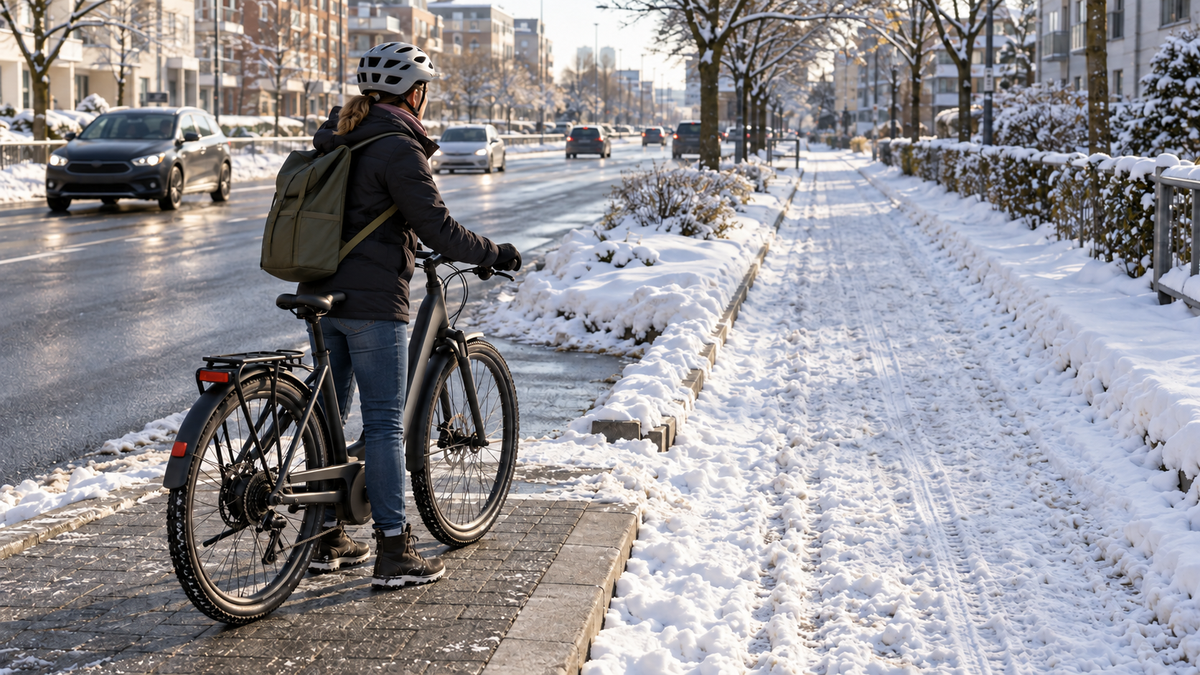
A snow-covered bike path may no longer be mandatory to use, but not simply because of a thin layer of snow. The key question is whether the path marked by sign 237, 240, or 241 is still objectively usable under the specific conditions. Deep snow, continuous ice, snowbanks pushed onto the path, or such a severe narrowing that the bicycle can no longer be controlled all weigh against usability. However, the assessment depends on the individual circumstances. This guide takes you through a cautious decision-making process, but it is not a substitute for individual legal advice.
This guidance applies to bicycles and standard pedelecs, which are treated as bicycles under traffic regulations. S-pedelecs are generally subject to different traffic rules and are not covered by this article.
When are cyclists required to use a bike path?
Under Section 2, subsection 4 of the German Road Traffic Regulations (StVO), cyclists generally have to use a bike path in their direction of travel only when this is required by one of the three blue traffic signs:
- Sign 237: bike path;
- Sign 240: shared sidewalk and bike path;
- Sign 241: separate bike path and sidewalk.
If there is no such sign, a right-hand bike path without signage is often an option, not an obligation. By contrast, a left-hand bike path without one of the signs listed above may be used only if a standalone supplementary sign reading “Cyclists permitted” allows it. So first check the sign, the direction of travel, and the route. Snow does not change the meaning of the sign, but it may mean that using the path as directed is no longer possible or reasonable on that particular section.
Snow alone does not automatically remove the obligation
An uncomfortable, slower, or occasionally wet ride is not automatically enough. A lightly snow-covered bike path that is still easy to see and can be ridden under control may remain mandatory to use. The situation may be different if the surface is hard to make out over a significant distance, the front wheel drifts in the snow, braking and steering are barely possible, or a snowbank effectively blocks the path.
The ADFC describes bike paths that have not been cleared or gritted in winter as a typical case in which the obligation to use them may no longer apply. This is not a blanket exemption for every winter hazard. What matters is the specific condition, the length of the affected section, and whether a careful cyclist can still use the path safely and under control. The police, an insurer, or a court may assess a later individual case differently.
Decision table for a snow-covered cycle path
| Observation | Assessment | Cautious action |
|---|---|---|
| No sign 237, 240, or 241 in your direction of travel | No obligation to use the path based solely on the path itself | Follow the regular road rules; do not use a sidewalk as a substitute. |
| Blue sign, path cleared and safe to ride on under control | The obligation to use the path generally remains in force | Adjust your speed and following distance for wetness, cold, and isolated slippery spots. |
| Thin or patchy layer of snow, surface still visible | Not automatically unusable | Continue only if you can maintain safe control of steering and braking. |
| Continuous ice, deep snow, a snowbank, or a substantial narrowing | The path may be objectively unusable | Stop, check traffic, and move onto the road cautiously if necessary. |
| The road is also not safe to reach or ride on | Legal permission is no guarantee of safety | Dismount, choose another route, or end your ride. |
The decision in five steps
1. Stop before the hazardous section
Do not make the decision while performing an unstable evasive maneuver. Slow down early and stop in a safe place with a clear view. Also check for traffic behind you. A sudden swerve from the cycle path onto the road can be more dangerous than the snow itself.
2. Match the sign to the actual path
Determine which part of the path is designated for bicycle traffic. With sign 241, the cycle path obligation applies to the separated cycle path, not the adjacent sidewalk. With sign 240, pedestrians and cyclists share the path. You must not endanger or impede pedestrians; reduce your speed significantly when necessary.
3. Assess usability along the entire route, not just in one spot
Look beyond the individual tire track, if it is safe to do so. A short section that can be passed cautiously should be assessed differently from a longer sheet of ice or a completely snowed-in path. Important warning signs include limited steering control, hidden edges, snowdrifts lying across the path, repeated skidding, and a width that no longer allows a controlled line.
4. Only move onto the road when it is safe to do so
If an obligatory bike path is objectively unusable, the roadway may be used as a regular traffic area. Watch the traffic, signal your move in good time, and merge only when there is enough space. This does not give you right of way when merging. On the roadway, ride predictably and keep a safe distance from the edge, snow deposits, and parked vehicles. When the obstruction ends and the signposted requirement still applies, move back only at a point you can reach safely - not with a sudden swerve or by going over an unsuitable high curb.
5. If in doubt, choose the safer option
Being allowed to use the roadway does not mean you have to continue riding in a risky situation. If ruts, ice, or heavy traffic make it impossible to continue under control, dismount. Push your bike on a permitted surface, take another route, or postpone your trip. Safety is not a question of proving what happened after the fact.
Why the sidewalk is not an alternative route
Snow on a bike path does not automatically allow cyclists to use a regular sidewalk. This also applies when the sidewalk appears to have been cleared. Exceptions apply in particular to children under Section 2(5) of the StVO and their accompanying person as regulated there, or when an additional sign explicitly permits cycling. Where a sign says “Sidewalk - Cyclists permitted,” take particular care; pedestrians must not be endangered or obstructed.
Without such authorization, your only option is to walk your bike. Once you dismount and push your bicycle, you are a pedestrian. Make sure not to block the sidewalk with your bike.
What you can document on site
Documenting a dangerous situation does not make it legal or safe. However, it can help you describe the actual conditions later or report them to the responsible authority.
- Take photos only while stationary and without endangering yourself or others.
- Take an overview photo showing the traffic signs and route, as well as a close-up of the surface.
- Note the location, direction of travel, date, and approximate time.
- Record whether the bike path was blocked at a single point or over a longer stretch.
- Report the stretch through the municipal defect-reporting portal or to the responsible road authority, if such a channel is available.
Do not use your smartphone while riding. Taking a photo from the saddle can create an additional risk.
Quick winter check before setting off
- check weather and ice warnings for your specific route;
- prepare a cleared alternative route;
- check the lights, tires, brakes and battery fit;
- allow more time and plan a point at which to turn back;
- avoid sudden steering or braking on unfamiliar or obscured surfaces;
Even a mechanically sound bike can lose traction on ice. A check-up is therefore no substitute for deciding to avoid a route.
Frequently asked questions about snow-covered cycle paths
Does the obligation to use the cycle path end as soon as there is a thin layer of snow?
Not automatically. What matters is whether the path is still identifiable and can be ridden on in a controlled manner despite the snow. The German Road Traffic Regulations do not specify a general snow depth threshold.
Can I always ride on the road when it snows?
No. If there is no sign making cycle-path use mandatory, the general rules for riding on the road apply. If a cycle path is signposted, you may use the road only when the path is objectively unusable in the specific circumstances. You must change over safely.
Can I ride on the cleared sidewalk instead?
Generally, no. A sidewalk is not an automatic alternative route. Cycling is permitted only if explicitly allowed or under a legal exception. You can still dismount and push your bike.
What should I bear in mind on a shared pedestrian and cycle path?
At sign 240, pedestrians and cyclists share the path. Pedestrians are entitled not to be endangered or obstructed. If snow narrows the passage, you may therefore need to ride very slowly, wait or dismount.
Does a photo prove that I was allowed to ride on the road?
A photo can document the conditions, but it does not decide the legal question on its own. The viewing angle, length of the obstruction, direction of travel and timing remain relevant. The final assessment can only be made on a case-by-case basis.
Bottom line: Check the sign, assess whether the path is usable, and put safety first
On a snow-covered cycle path, the decision starts with signs 237, 240 or 241. If use is mandatory, that generally remains the case even when the path is merely inconvenient. If the cycle path is objectively unusable because of snow, ice or a blockage, you may move onto the road. This does not make the sidewalk an alternative route. Stop before changing lanes, merge in a controlled manner, and end your ride if neither the cycle path nor the road can be used safely.
Share:
Floor pump or mini pump for your bike: Which is right for home and on the go?
E-bike inspection: How often is it advisable, and what is checked?