

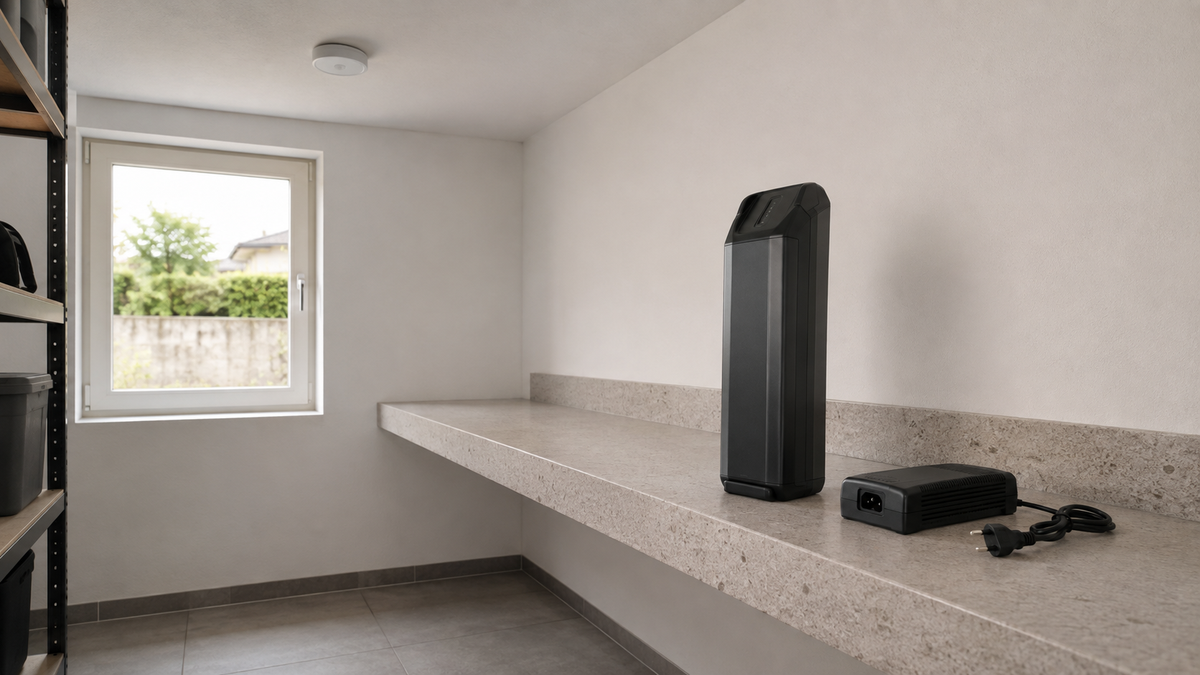
If an e-bike is left unused for several weeks or months, the battery should neither remain fully charged on the charger nor be forgotten in a cold garage while empty. Good storage combines three factors: the appropriate charge level, a dry, moderate temperature, and a safe location. The battery’s specific operating manual always takes priority.
First, find the manufacturer’s specifications
Identify the battery and charger using the bicycle’s documentation, not just by their external appearance. Look there for the storage range, permitted temperature, recommended charge level, inspection interval, and removal instructions. A permanently installed battery may require different steps from a removable model.
Use only a charger approved by the manufacturer for this battery. Similar connectors are not proof of compatibility. A replacement battery must also match the system in terms of voltage, communication, housing, and approval. This article therefore does not specify any supposedly universal charging time or connector combination.
What charge level is suitable for longer-term storage?
The Verbraucherzentrale recommends a charge level of 30 to 60 percent for longer periods of non-use. The ADFC recommends around 30 to 70 percent and explicitly points out that manufacturer recommendations may differ. The sensible guidance is therefore “partially charged according to the instructions,” not one single figure for every battery.
A permanently very high charge level and deep discharge put stress on lithium-ion batteries. Set the target range shortly before storing the battery and then disconnect the charger. Do not leave the battery connected to the mains for months just to maintain a particular level. If the system has a special storage mode, follow the original instructions.
Temperature: dry and free from extremes
As a general guide, the Verbraucherzentrale specifies 10 to 20 °C and a dry room. The ADFC recommends a cool area of 10 to 15 °C for longer-term storage. These ranges point in the same direction: avoid frost, proximity to heating, direct sunlight, and a heated-up car.
A garage is suitable only if it stays dry and complies with the temperatures specified in the instructions. A damp basement can promote corrosion on contacts and the housing. In the home, the battery must not be placed in an escape or emergency route; the Berlin Fire Department also points this out for lithium-ion batteries.
Set up the storage location properly
- Choose a stable, level, and dry surface where the battery cannot fall.
- Keep it away from paper, textiles, fuel, paint, and other easily flammable materials.
- Avoid direct sunlight, radiators, stoves, and major temperature fluctuations.
- Protect the contacts according to the manufacturer’s instructions without short-circuiting them or wrapping them in damp, airtight material.
- Keep escape routes and doors clear; children and pets must not be able to reach the battery.
- Ensure that a working smoke alarm is located near the storage or charging area.
An arbitrary metal box does not automatically become a safe battery box. The wrong containers can trap heat or gases and make a reaction more difficult to detect. Use only a solution specified by the battery manufacturer or a qualified fire-safety adviser for the particular purpose.

Consider storage and charging separately
A good storage location is not automatically a good charging location. Charging also requires a suitable outlet, the approved charger, and an environment free from moisture and extreme temperatures. The Verbraucherzentrale recommends a non-flammable surface such as stone, keeping the battery away from flammable materials, and, if possible, having a smoke alarm nearby. Do not charge for long periods unattended and, if possible, do not charge overnight in living areas.
Remove the battery or leave it in the bicycle?
If the manufacturer states that the battery is removable, taking it out usually makes dry, temperature-stable storage easier. Switch off the system, remove the key and battery according to the instructions, and avoid applying force to the lock or contacts. Hold a heavy battery with both hands and place it on a clear surface.
With a permanently installed battery, keep the bicycle in a suitable location. Do not cover the battery or bicycle with damp tarpaulins, and do not place it next to a heat source. Check whether alarm, tracking, or additional modules consume energy during the break; follow the instructions for the respective system.
Check the battery during the storage period
Self-discharge and the energy consumption of the electronics vary. Check the charge level at the interval specified by the manufacturer. If there is no clear information, ask the dealer or system provider instead of inventing a fixed monthly schedule. Recharge to the recommended storage level only when necessary and within the permitted temperature range.
During each inspection, check for deformation, cracks, severe dents, corrosion, liquid, unusual odors, or heat. Do not open the housing. A battery is not a component to be repaired with adhesive tape, third-party cells, or a universal power supply.
After a fall or visible damage
A dropped battery may be damaged internally even if there is little visible damage on the outside. Stop using and charging it, and have it inspected by a dealer or service center according to the manufacturer’s instructions. A swollen housing, severe dents, persistent heating, or leaking substances are not normal signs of aging.
If a battery becomes hot or starts hissing, steaming, or smoking, do not treat it like an ordinary stored item. Get people to safety. In the event of fire or smoke, leave the room, close the door only if this is possible without delay or risk, warn others, and call 112. Do not touch a battery that is already reacting or carry it through smoke-filled areas.
Before the first ride after the break
First bring a cold battery to the charging and operating temperature permitted by the manufacturer. Check the housing, locking mechanism, and clean, dry contacts. Insert it without force and charge it only with the approved device in a safe environment. If an error message remains or the battery becomes unusually hot, stop.
Plan the first ride to be short and close to a safe return option. Test whether the display, assistance, and locking mechanism work reliably. After a long period of non-use, also check the tires, brakes, lights, and fasteners; a well-maintained battery does not automatically make the rest of the bicycle roadworthy.
Frequently asked questions
At what percentage should I store my e-bike battery?
General sources specify around 30 to 60 or 30 to 70 percent. The range in your battery’s operating manual is authoritative.
Can the battery stay in the garage during winter?
Only if the garage is dry, the manufacturer’s specified range is maintained, and the location is fire-safe. An unheated garage with frost or high humidity is unsuitable.
Should the battery remain connected to the charger during storage?
Normally, set the recommended storage level and then disconnect the charger. Follow different product-specific instructions if your system has a designated storage mode.
What should I do with a swollen battery?
Do not continue charging, using, or opening it. Keep a safe distance and contact the dealer or manufacturer; if there is heat, steam, smoke, or fire, get people to safety and call 112.
As of September 6, 2026. The values are general guidelines. The current instructions and safety information for the specific battery and charging system are authoritative.

Share:
Riding a bicycle without using your hands: What Section 23 of the German Road Traffic Regulations prohibits
Retrofitting bicycle turn signals: What the German Road Traffic Licensing Regulations permit