

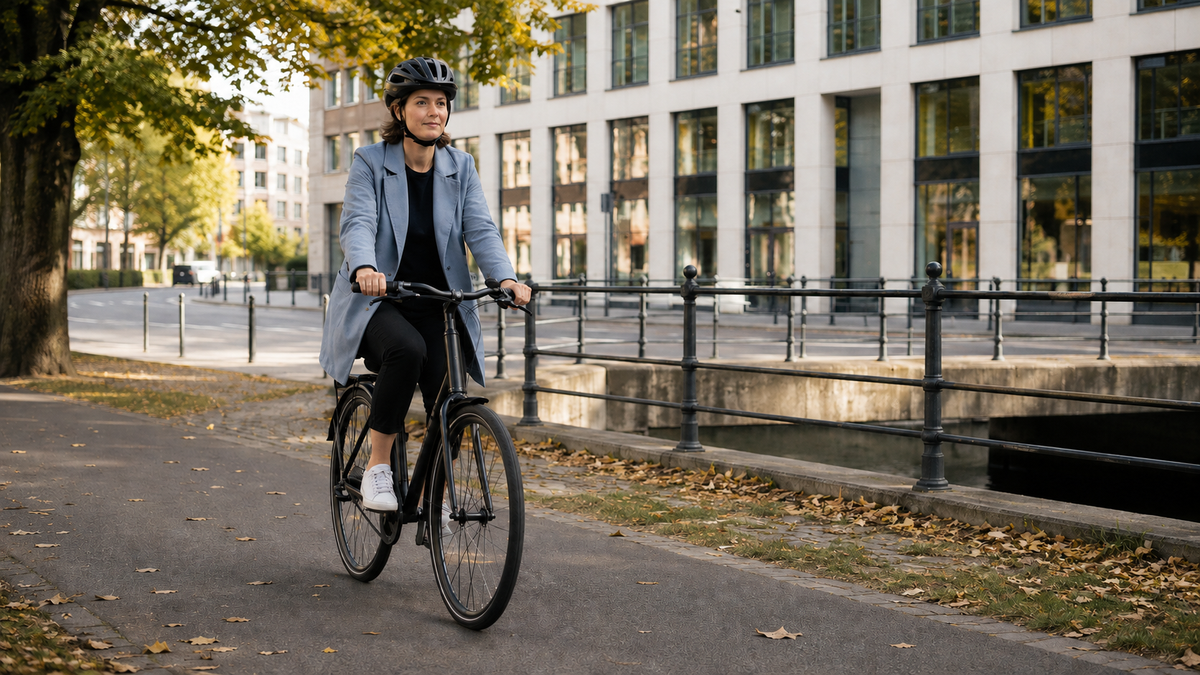
Riding a bicycle without holding the handlebars is not permitted in Germany. Section 23 (3) of the German Road Traffic Regulations (StVO) does not provide a special exception for empty roads, experienced riders, or pedelecs. The practical distinction nevertheless needs explaining: a brief hand signal when turning is not the same as deliberately continuing to ride with both hands off the handlebars.
The wording of Section 23 StVO
Section 23 (3) StVO sets out three duties for people riding bicycles and motorcycles: they may not attach themselves to vehicles, ride without holding the handlebars, or remove their feet from the pedals or footrests unless road conditions require it. Regarding the ban on riding without holding the handlebars, the subsection specifies no speed or location limit.
This applies just as much to an ordinary bicycle as to a pedelec, which is legally treated as a bicycle. A quiet cycle path, a downhill stretch, or a short distance does not make the action permissible. A violation may be penalized; no fixed amount is stated here deliberately, because the current fine schedule at the time of the incident must be checked.
Your feet must also generally remain on the pedals. The wording of the law permits removing them only when road conditions require it. Balance exercises, freestyle riding, or coasting with your feet raised therefore do not belong in public traffic areas.
Riding without hands and one-handed riding are not the same
The wording prohibits riding without holding the handlebars. It does not contain an equivalent blanket ban on every one-handed movement. Nevertheless, riding one-handed is not automatically safe or always appropriate. Under Section 23 (1), the rider remains responsible for having an unobstructed view and hearing, as well as for the roadworthiness of the bicycle, its load, and its occupants.
One hand on the handlebars must provide genuine control. On cobblestones, in crosswinds, with a heavy load, a trailer, or an unfamiliar bicycle, briefly taking one hand off can already be risky. If you cannot steer and brake steadily, stop. Riding experience is not a license for a situation in which you do not have the bicycle under control.
Hand signals when turning
Section 9 (1) StVO requires a turn to be announced in good time and clearly. On a bicycle, this is usually done with a clear hand signal. Keep your other hand on the handlebars; then return the signaling hand in good time so that you can operate the turn and brakes safely.
A hand signal is therefore not an invitation to continue riding without holding the handlebars. Observe the traffic, position yourself correctly, and watch for oncoming traffic and people crossing the road. If the surface, load, or your balance does not permit a safe hand signal, reduce your speed and resolve the situation without a risky movement—if necessary, by stopping and walking the bicycle.

Common reasons are not exceptions
Closing a jacket, cleaning glasses, adjusting a glove, opening a bottle, or tightening a backpack strap: all these tasks may require both hands. The safe solution is not to let the bicycle “ride itself” for a moment. Find a clear spot outside the lane, brake in a controlled manner, place both feet securely on the ground, and complete the task while stationary.
The same applies to navigation and smartphones. The section on device use addresses the additional rules of Section 23 (1a). For the question at hand, it is enough to say this: a device does not justify riding without holding the handlebars or looking away for an extended period. If more than a brief, controlled glance is needed, stop.
Do not try to save luggage or cargo while riding
If a bag slips or a strap comes loose, do not reach for it with both hands while riding. Brake without making any sudden steering movement and stop away from traffic. Section 23 (1) requires the load and vehicle to comply with regulations and not compromise road safety.
Before setting off, close bags, secure loose ends, and check that the lights and reflectors are unobstructed. A short test ride in an open area will show whether the load affects steering. If the load has to be held in place repeatedly during the journey, it is not secured properly.
Technical problem: stop instead of continuing to balance
A misaligned handlebar, loose grip, flapping cable, or unusual steering movement should not be investigated while coasting. Stop and get off. If a defect significantly compromises road safety and cannot be fixed immediately, Section 23 (2) requires the vehicle to be removed from traffic by the shortest route; bicycles may then be walked.
Electronic assistance does not stabilize the bicycle either. The additional weight and acceleration of a pedelec can make corrections more demanding. Switch off the drive system before checking anything and work only according to the instructions. In the event of steering, brake, or frame defects, leave the work to a specialist workshop.
How to stop without creating a new risk
- Look ahead and place both hands on the brakes.
- Reduce your speed steadily without swerving abruptly.
- Choose a firm, sufficiently wide spot outside the active traffic lane.
- Come to a complete stop, put both feet down, and get off if necessary.
- Only then adjust clothing, navigation, luggage, or technical equipment.
- Check over your shoulder and assess your surroundings before setting off again.
Do not stop in the middle of a bend, on an obstructed crest, or directly behind a narrow section. If no safe spot is available, continue in a controlled manner with both hands on the handlebars until you reach a suitable place. Missing a turn is less dangerous than making a hurried correction without holding the handlebars.
What you can prepare before riding
- Check the route and the first turn before setting off.
- Adjust your jacket, helmet strap, and gloves while stationary.
- Store your bottle so that you only use it at a safe stop.
- Shorten luggage straps and keep loose ends away from the bicycle and drive system.
- Have the brake levers and grips adjusted so that they are safely within reach.
- Practice handling a new bicycle in an area free of traffic—with your hands on the handlebars.
Good preparation removes the apparent reasons for riding without holding the handlebars. This is particularly helpful when commuting, when time pressure can encourage spontaneous adjustments. It is better to plan a short stop than to ride, search, and organize at the same time.
Frequently asked questions
Is riding a bicycle without holding the handlebars a criminal offense?
It is prohibited under Section 23 (3) StVO and may be treated as a regulatory offense. The current official schedule is decisive for any specific penalty.
Is one-handed cycling permitted?
Section 23 (3) expressly prohibits riding without holding the handlebars, but does not generally prohibit every one-handed movement. However, you must be able to control the bicycle safely at all times; if you cannot, stop.
May I take one hand off the handlebars to give a hand signal?
A timely, clear hand signal announces a turn. The other hand remains on the handlebars, and the signaling hand is returned in good time for controlled steering and braking.
May I ride without holding the handlebars to close my jacket?
No. Stop in a clear place outside the traffic lane, put both feet down, and adjust your clothing while stationary.
As of September 6, 2026. The current StVO and the specific traffic situation are decisive; this article does not replace legal advice.
Share:
Storing an E-Bike Battery: Charge Level, Temperature, and Fire Safety
Retrofitting bicycle turn signals: What the German Road Traffic Licensing Regulations permit