

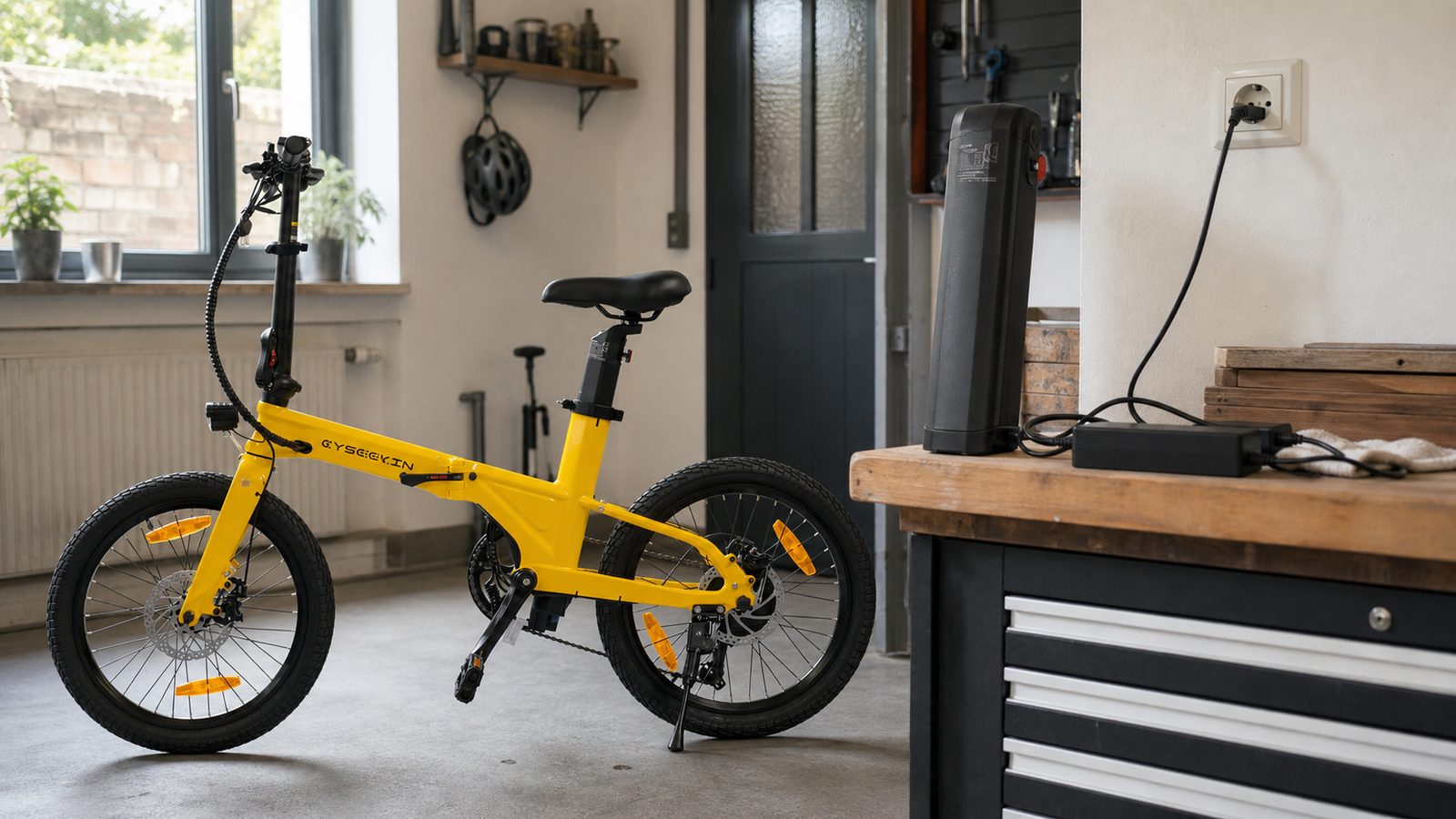
Practical calculation · As of 4 August 2026
A full charge of the 345.6-Wh battery in the Cyseekin C10 costs around 14 cents in my example calculation, including the assumed charging losses. Depending on the range actually achieved, this results in electricity costs of around 14 to 35 cents per 100 kilometres.
I did not want to settle for the usual answer of “around 15 cents.” That is why I explain openly here which assumptions lie behind it and how you can adjust the amount to your own electricity tariff.
For the C10, the pure electricity costs are very low. The greater uncertainty is not the electricity price but the actual range: headwinds, temperature, tyre pressure, rider weight, hills, and assistance level significantly affect consumption.
I calculate using these three figures
345.6 Wh corresponds to 0.3456 kWh of stored energy. To account for losses, I use 0.3974 kWh from the socket. The actual loss depends, among other things, on the charger, state of charge, and temperature; 15 percent is deliberately used here only as a transparent modelling assumption.
0.3456 kWh × 1.15 × €0.349/kWh = €0.1387
Rounded: around €0.14 per full charge
Your own calculator: Battery capacity in Wh ÷ 1,000 × charging-loss factor × electricity price in €/kWh. For a partial charge, multiply the result by the charged proportion afterwards.
How much does the e-bike cost per 100 kilometres?
Cyseekin states a maximum range of up to 100 km for the C10. I would not use this maximum figure uncritically as an everyday value. That is why I am showing four scenarios using the same charging-cost assumption of 14 cents.
| Actual range per charge | Charges for 100 km | Electricity costs per 100 km | Classification |
|---|---|---|---|
| 40 km | 2,50 | approx. €0.35 | High assistance, cold weather, hills, or a heavy load |
| 60 km | 1,67 | approx. €0.23 | Realistic calculation example for mixed everyday use |
| 80 km | 1,25 | approx. €0.18 | Favorable conditions and moderate assistance |
| 100 km | 1,00 | approx. €0.14 | Manufacturer's maximum figure, not achievable on every ride |
Even in the cautious 40-km scenario, the electricity costs alone remain below 40 cents per 100 km. In practice, tires, brake pads, the chain, servicing, and, in the long term, the battery contribute significantly more to running costs than electricity.

How high are the annual electricity costs?
For an annual distance of 2,500 km, the following approximate figures result using the same 14-cent charging rate. I have deliberately rounded the figures so that the table is understood as a planning aid rather than an apparently exact consumption measurement.
| Range per charge | Full charges for 2,500 km | Electricity costs per year |
|---|---|---|
| 40 km | approx. 63 | approx. €8.75 |
| 60 km | approx. 42 | approx. €5.83 |
| 80 km | approx. 31 | approx. €4.38 |
| 100 km | 25 | approx. €3.50 |
Why charging time says little about the cost
The C10 is specified as requiring 4 to 5 hours to charge. However, a longer charging time does not automatically mean a more expensive charge. What matters is how many kilowatt-hours actually flow from the power outlet. A lower-powered charger may take longer while still transferring approximately the same amount of energy.
How to charge an e-bike battery properly
- Use the right charger: I use only the supplied or expressly approved charger.
- Charge in a dry, temperature-protected place: A very cold battery must first adjust to room temperature.
- Take damage seriously: I do not continue charging a battery that looks unusual, is deformed, or is damaged.
- Not every ride requires 100 percent: A partial charge is often sufficient for short everyday trips; before longer tours, I deliberately charge the battery fully.
- Check first when you're out and about: I check with my employer, hotel, or restaurant whether and where charging is permitted.
How much does a larger 500- or 750-Wh battery cost?
The formula remains the same. At 34.9 ct/kWh and 15 percent charging loss, the calculated cost is around 20 cents for 500 Wh and around 30 cents for 750 Wh. This is a capacity comparison, not a range comparison: A heavier bike or a more powerful motor can consume the additional energy more quickly.
FAQ about e-bike charging costs
How much does a full e-bike charge cost?
It depends on battery capacity, electricity rate, and charging losses. For the C10’s 345.6-Wh battery, using 34.9 ct/kWh and 15 percent loss, I arrive at around 14 cents.
How much does an e-bike cost per kilometer?
Based on electricity costs alone, the C10 comes to around 0.14 to 0.35 cents per kilometer in my scenarios. Maintenance, wear, and battery aging are not included.
Can I charge my e-bike for free while on the go?
Some employers, hotels, restaurants, or ADFC charging points allow charging. I ask beforehand and use the appropriate charger; car fast-charging stations are not intended for this purpose.
How long does the C10 battery take to charge?
The current C10 product page states 4 to 5 hours. The exact time depends on the remaining charge level and charging conditions.
How do I calculate my own electricity costs?
Divide the watt-hours by 1,000, multiply by your charging-loss factor, and then multiply by your electricity price in euros per kWh.
Putting the C10 and other models into perspective
If you want to check the 345.6-Wh figure, charging time, and range information directly for the model, you can find all the technical specifications on the C10 page. The model overview also provides a comparison with the C20 and S10.
C10 technical specifications Compare the C10, C20, and S10Sources and calculation date
- Federal Network Agency: Modeled electricity price for new customers in January 2026
- Cyseekin C10: Battery, charging time, and range information
- ADFC Dortmund: Information and typical costs when charging on the go
Editorial note: The 15 percent charging loss is an explicitly stated model assumption, not a measurement taken from the specific charger. Electricity rates and real-world ranges vary.

Share:
Transporting an E-Bike in a Car: Remove the Battery? 7 Safety Checks
Which Cyseekin e-bike is right for me? Choosing the C10, S10, and C20 correctly