

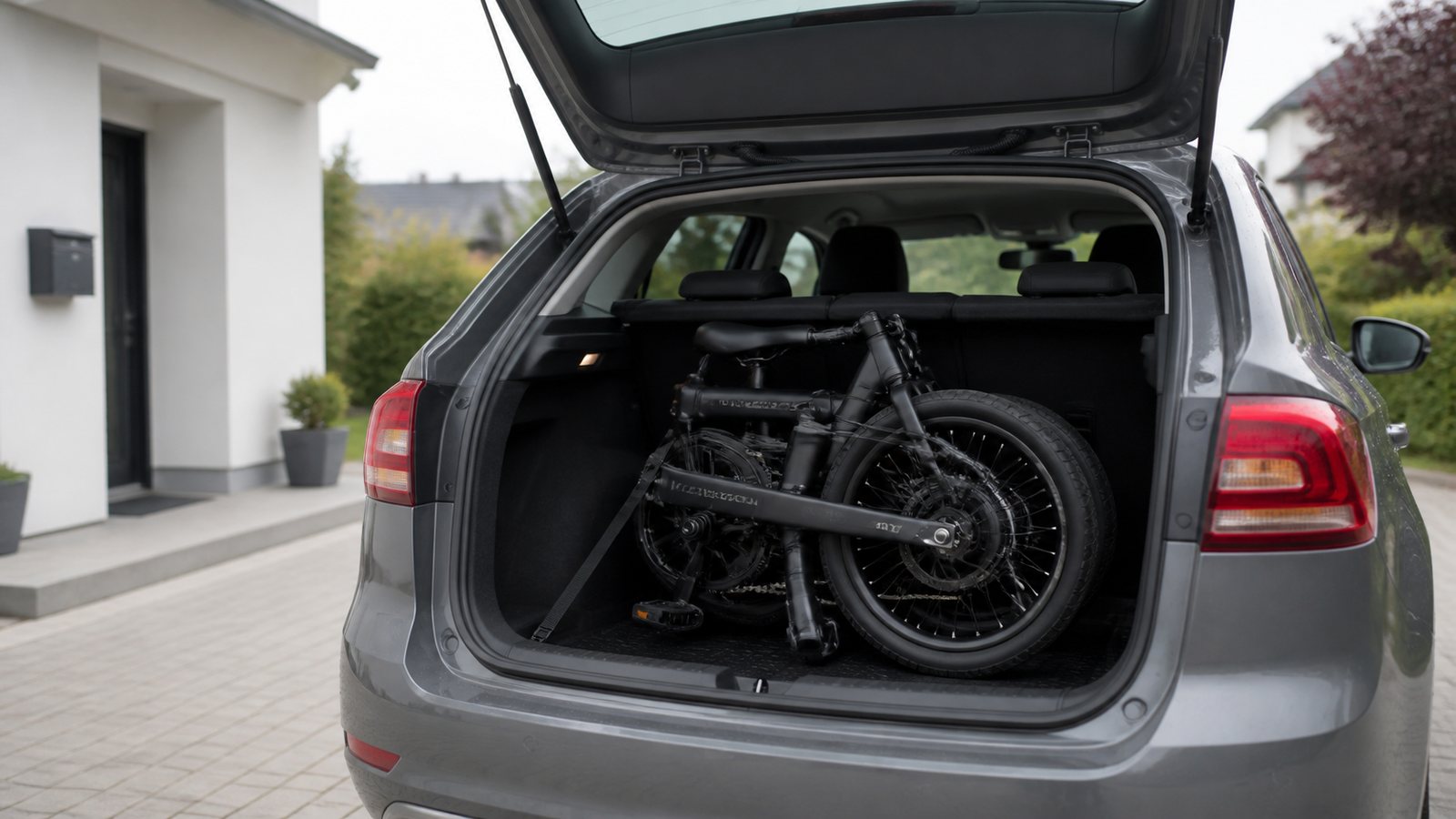
Practical check
In the trunk, the e-bike should be positioned so that it cannot slide or damage any components. On an external or rear carrier, I first check the carrier load and tow-ball load, remove the battery and any loose accessories, and secure the bike according to the carrier manufacturer’s instructions. The battery travels protected and dry, not loose inside the vehicle.
Trunk or bike carrier: Which one is suitable for my e-bike?
The right solution depends less on the “e-bike” label than on the weight, dimensions, whether the battery can be removed, and the approvals for the car and carrier. That is why I measure everything before the trip instead of relying on a product photo.
In the trunk
- Check beforehand
- Folded or packed dimensions, tie-down points, protection of the contacts
- Advantage
- The bike remains protected from headwind and rain
- Drawback
- It must not slide without being secured
Rear carrier
- Check beforehand
- Tow-ball load, carrier payload, weight per rail
- Advantage
- Heavy bikes do not have to be lifted onto the roof
- Drawback
- The total weight and attachment must be strictly observed
Roof carrier
- Check beforehand
- Roof load, system approval, overall height
- Advantage
- The trunk remains accessible
- Drawback
- Greater lifting height and increased vehicle height
ADAC generally considers rear carriers the more practical solution for heavy bikes or frequent use. However, the values in the vehicle, tow hitch, and carrier instructions remain decisive. There is no blanket load capacity for “all e-bikes.”

My 7-point checklist before setting off
Add up the actual weights
I record the weights of the bike and carrier, as well as the individual model of each bike when transporting several bikes. I then compare the total with the tow-ball load and the carrier’s payload. The lowest permissible value always applies.
Remove the battery when transporting the bike externally
ADAC and ADFC recommend removing a removable battery from the outside of the car during transport. If it cannot be removed, follow the manufacturer’s instructions for the specific bike and carrier.
Store the battery safely in the car
I protect the contacts, prevent sliding, and choose a cool, dry place away from direct sunlight. The battery must not lie loose on the seat or trunk floor.
Remove loose parts
I remove bags, baskets, the pump, water bottle, and other accessories. I also take a removable display into the car as instructed by the manufacturer.
Secure the frame and wheels
I secure the frame at the designated mounting point and secure both wheels with the carrier straps. Cables and brake lines are not mounting points.
Do without covers
A closed cover increases the surface area exposed to the wind. The battery and loose electronics go in the vehicle, protected; for the bike, follow the manufacturer's instructions.
Check after a few kilometers
After the first short stretch, I check the straps, loops, and locks again. Before traveling abroad, I also check the current regulations in the destination country.
What does this mean for the folding Cyseekin C10?
According to the current product page, the Cyseekin C10 weighs 18.6 kg, has a removable, lockable battery, and measures 815 × 400 × 690 mm when folded. These are helpful planning figures, but not yet a guarantee that it will fit in the trunk: I would measure the cargo area's narrowest point and allow additional space for padding and tie-downs.
Anyone wanting to compare several compact models can find the current dimensions and weights in the Cyseekin folding e-bike collection. For transport, the specific product page matters more than a general model category.
Short packing list
- Keys for the battery and frame lock
- Suitable padding for the frame and contacts
- Straps and loops specified by the carrier manufacturer
- User manuals for the car, carrier, and e-bike
- for trips abroad: the currently required warning panel or additional marking
- Charger – packed dry and secured against sliding
FAQ about transporting an e-bike by car
Does the e-bike battery always have to be removed during transport?
For a removable battery on a roof rack or rear carrier, ADAC and ADFC recommend removing it. In the trunk, this depends on the manufacturer's instructions and on securely fastening the bike. A non-removable battery must not be removed without authorization.
Can a folding e-bike be transported lying down in the trunk?
Only if the manufacturer does not prohibit this and the bike, battery, and components are protected against slipping, pressure, and damage. In particular, the display, brake levers, gears, cables, and battery contacts must not be subjected to stress.
Can I put a protective cover over the e-bike on the rear carrier?
ADAC advises against using protective covers during transport because they significantly increase the surface area exposed to wind. For rain protection, the manufacturer's instructions for the bike and carrier are authoritative.
How fast can I drive with a bicycle carrier?
I follow the lowest permitted limit stated in the vehicle and carrier manuals and in the applicable traffic regulations. ADAC recommends a maximum speed of 120 km/h when transporting bicycles; this is a recommendation and does not replace a different manufacturer limit.
What rules apply abroad?
That depends on the country you are traveling to. Warning panels, repeated license plates, and requirements for protruding loads vary. I check the rules shortly before departure with a current official source.
Before the trip: Measure rather than guess
Check the specific folded dimensions, bike weight, and whether the battery can be removed on the product page. Then compare these values with your vehicle and carrier system.
View C10 specifications Compare folding e-bikesSources and status
- ADAC: Transporting bicycles correctly—with roof or rear carrier, updated on 03/20/2026, accessed on 05/08/2026.
- ADFC: Battery care and use, accessed on 05/08/2026.
- Bosch eBike Systems: Transporting the eBike, accessed on 05/08/2026. The information applies to Bosch systems and is cited here only as an example from a manufacturer.
- Cyseekin: C10 product page, current information on weight, folded dimensions, and battery, accessed on 05/08/2026.
Editorial note: The information is based on the publications linked above and the current C10 product data; no independent riding or crash test was conducted. Before every ride, check the operating manuals for your specific e-bike, vehicle, and carrier. This article does not replace manufacturer approval or legal advice.
Share:
What tire pressure should you use for an e-bike? How to find the right pressure
What does charging an e-bike really cost? My C10 calculation for 100 km