

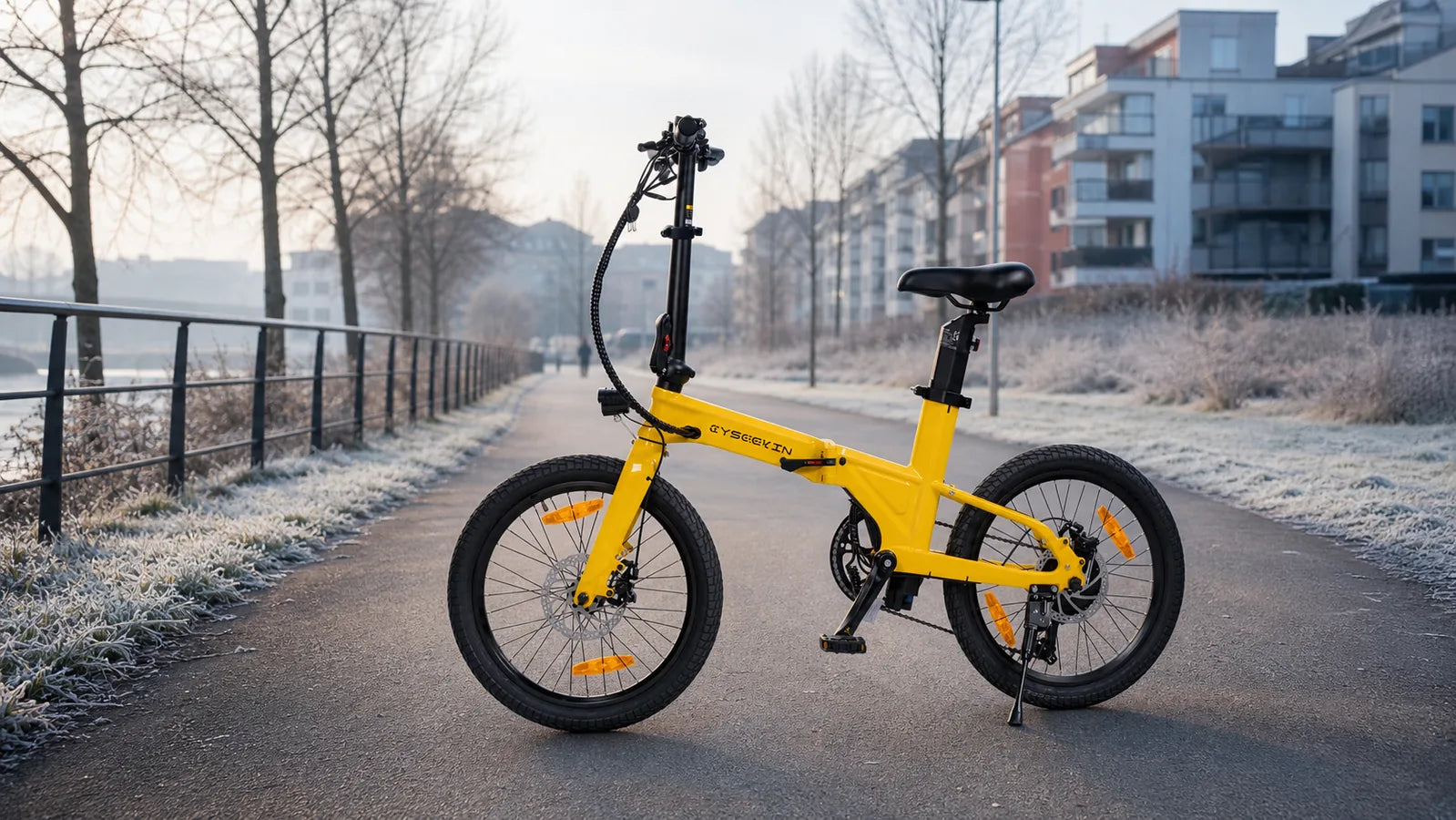
In short: In winter, the usable power of an e-bike battery may temporarily decrease. How much this affects the range depends not only on the temperature, but also on the route, headwinds, tire pressure, load, and assistance level. For reliable planning, sufficient reserve therefore matters more than a blanket percentage.
Quick overview
- Cold can temporarily reduce the available battery power while riding.
- A warm, dry storage location and inserting the battery shortly before departure help in freezing conditions.
- The maximum stated range is not a promise for winter use; your route should be planned with a reserve.
- During longer periods of inactivity, following the manufacturer's instructions, maintaining a medium state of charge, and carrying out regular checks are crucial.
Range specifications are determined under defined conditions. Everyday conditions are usually different: low temperatures, wet roads, frequent starts, and additional headwinds often occur at the same time. That is precisely why the question “How much shorter is the range in winter?” cannot be answered with a single reliable percentage.
Why cold affects range
The ADFC points out that cold can cause a temporary loss of capacity in lithium-ion batteries. This does not automatically mean that the battery has been permanently damaged. During a cold ride, however, less usable energy may be available than in milder temperatures.

What the C10 data means for winter
According to the current product page, the C10 has a removable lithium-ion battery with 36 V, 9.6 Ah, or 345.6 Wh. The removable battery can be stored and charged separately from the bicycle in a dry place. The product page lists three assistance levels and explicitly states that factors including temperature, weight, headwind, gradients, tire pressure, and riding style affect the range.
| C10 specification | Official figure | Practical winter assessment |
|---|---|---|
| Battery | 36 V / 9.6 Ah / 345.6 Wh, removable | Store in a dry place as specified in the user manual; if temperatures are below freezing, install it shortly before the ride. |
| Maximum range | Up to 100 km, depending on conditions | Do not use this as a fixed winter distance. Plan a reserve for the outbound trip, return trip, and detours. |
| Range test | 25°C, 60 kg load, 15–20 km/h, flat paved route | A winter day usually differs significantly from these test conditions. |
| Assistance | Three levels | On flat sections, select a suitably lower level when sufficient reserve is needed. |
| Tires | 20 × 2.125 inches | Check the pressure regularly and keep it within the tire or manufacturer's specified range. |
How to plan your personal winter range
A small ride log is the most reliable approach. It does not replace a technical range test, but it reflects your own route better than a general average value. Three to five comparable rides are usually enough to establish a cautious reserve for everyday use.
| Take notes | Example | Why it helps |
|---|---|---|
| Temperature | 4°C | Compare cold-weather and milder rides on the same route. |
| Route | 18 km, urban traffic | Assess distance, stop-and-go traffic, and elevation profile. |
| Assistance | Predominantly level 2 | Understand the impact of the selected motor assistance level. |
| Remaining charge | After the outbound and return trips | Set a personal safety reserve. |
Seven points before a cold-weather ride
- Store the battery in a dry, temperature-controlled place: Do not leave it unnecessarily long in a cold garage when temperatures are below freezing.
- Use only the associated charger: The charging instructions in the C10 operating manual take precedence.
- Insert the battery shortly before departure: The ADFC recommends this approach for winter rides.
- Check the tire pressure: Do not intentionally ride with extremely soft tires; the permitted range remains decisive.
- Do not plan the route down to the last bar: Take the return trip, detours, and longer stops into account.
- Choose the appropriate assistance level: Use high assistance selectively instead of keeping it on during every flat stretch.
- Check for moisture after riding: Keep the battery, charging socket, and contacts dry; allow a battery that has become very cold to reach the permitted charging temperature before charging it.
Storing the battery for several weeks
For longer breaks, the Verbraucherzentrale recommends a charge level of 30 to 60 percent and dry storage at 10 to 20 °C. The ADFC gives a general guideline of 30 to 70 percent and also emphasizes that the operating instructions for the respective model take precedence. The charge level should be checked regularly so that the battery does not remain completely discharged for an extended period.
Mechanical damage is not a matter of optimizing range: A battery with severe dents, a swollen casing, or unusual heat generation must not be used further or opened yourself. In this case, the official customer service or a qualified service center is the right next step.
FAQ about e-bike range in winter
How much range does an e-bike lose in winter?
There is no single percentage that applies to every e-bike. Temperature, battery condition, route, wind, tire pressure, load, and assistance level all have an impact at the same time. Therefore, plan with a personal reserve rather than applying a blanket reduction.
Should an e-bike battery be brought indoors during winter?
In freezing conditions, a dry, temperature-controlled storage location is advisable. The ADFC recommends storing the battery in a warm place and only inserting it shortly before riding. Also follow the operating instructions for the respective model.
Can a chilled battery be charged immediately?
Only charge in dry conditions, using the associated charger, and within the temperature limits specified in the user manual. A battery that has become severely chilled should first adjust to an allowable temperature before charging.
Does the Cyseekin C10 always achieve 100 km in winter?
No. “Up to 100 km” is a maximum range specification. The C10 manual describes the comparison test at 25°C, with a 60 kg load, at 15–20 km/h, and on a flat, paved route. Winter conditions may differ significantly.
Does a battery cover protect against the cold?
ADFC mentions a suitable neoprene cover as a possible aid against cooling. However, it must fit the battery and must not obstruct any connections or designated areas; the manufacturer's instructions take precedence.
How should an e-bike battery be stored over the winter?
For longer breaks, Verbraucherzentrale recommends a charge level of 30 to 60 percent and dry storage at 10 to 20°C. Check the charge level regularly and follow any differing model-specific instructions.
Compare the technical specifications before your ride
Range, battery, and weight should always match your actual use. Current variants, availability, and technical specifications are listed directly on the model and overview pages.
Sources and test conditions
- Cyseekin C10 product page: Current information on the battery, range, assistance levels, tires, and influencing factors.
- Cyseekin C10 user manual: Range test conditions, charging process, and technical specifications.
- ADFC: Battery care and use: Cold temperatures, charging, winter use, storage, and damaged batteries.
- Verbraucherzentrale: Batteries for electric cars, pedelecs, and more: Storage during extended periods of non-use and how to handle damage.
As of August 26, 2026. The manufacturer's instructions and the user manual for the specific battery and charger take precedence.
Share:
E-bike with trailer: Does the hitch really fit my bike?
E-bike chain worn out? Here’s how to detect wear in time