

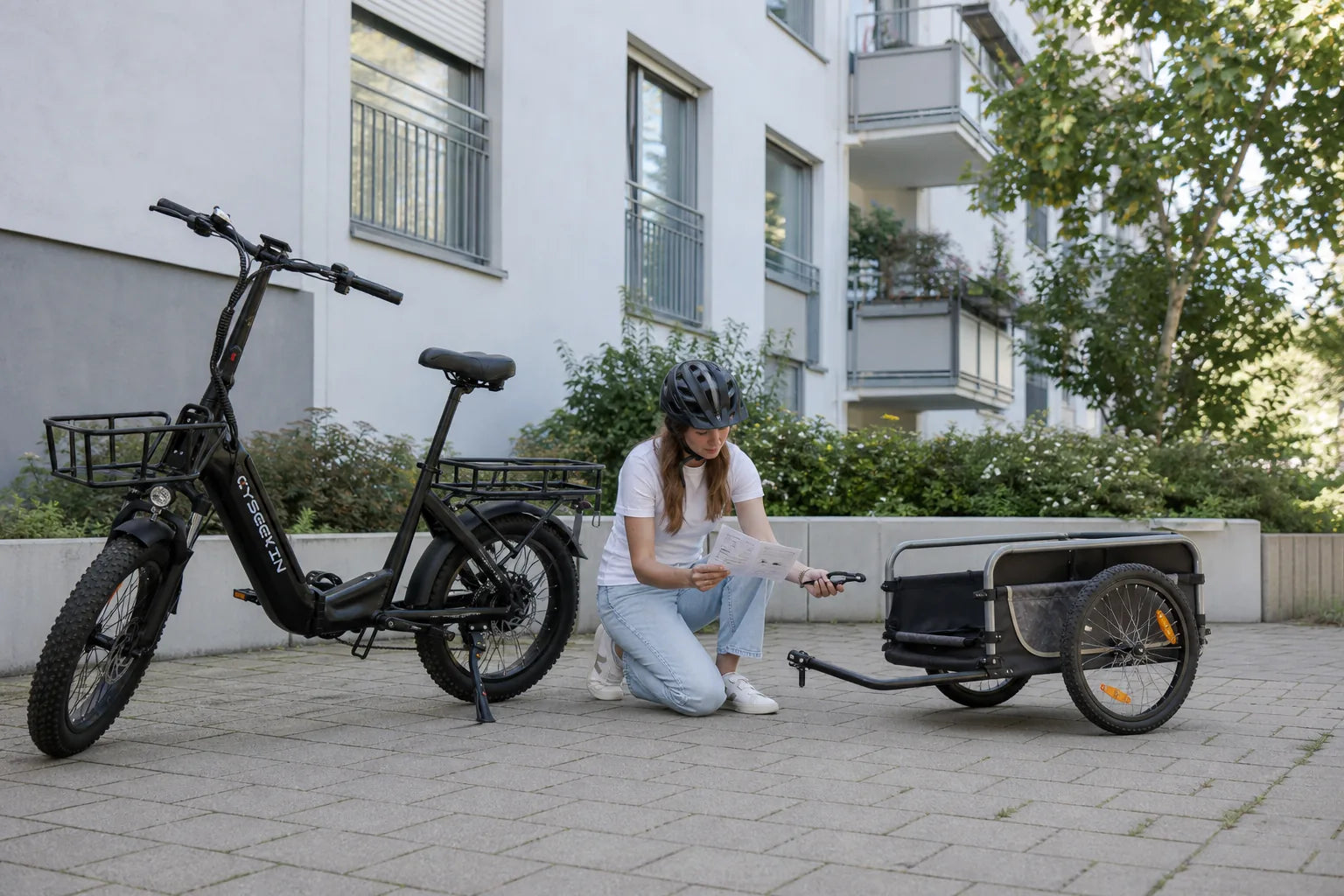
The e-bike’s maximum payload alone is not sufficient proof. Before purchasing, you must also check the trailer type, permitted weight, brakes, clearance around the kickstand and derailleur, and the planned route.
Three checks before ordering any parts
Six steps to a reliable compatibility check
- Determine the intended use.
Is it for shopping, luggage, a dog, or children? Trailers are designed for a specific purpose, a specific load, and a specific restraint system. - Check approval for the e-bike.
The appropriate manual and the bicycle manufacturer must permit trailer use for the model, frame, and mounting point. For Cyseekin, this question should be sent to Support before installation, together with photos of the model and axle. - Read the trailer manual.
The permitted load, hitch type, safety strap, tire pressure, and maintenance intervals depend on the specific trailer. - Identify the rear axle clearly.
Solid axles with nuts, quick-release skewers, and thru-axles look similar but require different hitch plates or adapters. With thru-axles, length, thread pitch, and head shape also matter. - Check clearance and condition.
The hitch and drawbar must not touch the kickstand, derailleur, brake, spokes, or frame. Tires, brakes, and fastenings must be in perfect condition. - Practice without a load and test the route.
The ADFC recommends riding without a child first to become familiar with the turning circle, braking distance, and width. Narrow passages, stairs, access barriers, and high curbs should be avoided in advance.

Why the axle type determines the adapter
In its current compatibility check, Thule distinguishes three basic types: solid axle, quick-release skewer, and thru-axle. This classification helps identify the design, but it replaces neither approval from the e-bike manufacturer nor the instructions for your own trailer.
| Axle type | Typical feature | Clarify before installation |
|---|---|---|
| Solid axle | The wheel is held on both sides by nuts. | Axle diameter, thread, usable thread length, space for the hitch plate, and kickstand. |
| Quick-release skewer | Thin skewer through a hollow axle, usually with a lever. | Approved longer quick-release skewer, flat contact surface, and sufficient clearance from the dropout. |
| Thru-axle | Thick axle screwed through the frame and hub. | Diameter, overall length, thread pitch, and head geometry; use only an exactly matching replacement. |
| Rear-wheel hub motor | Motor cable and often a bolted axle on the rear wheel. | Manufacturer approval, the correct adapter, cable protection, a torque arm, and sufficient clear contact surface. Do not modify anything yourself. |
Current user questions particularly often concern missing hitches on used trailers, incorrect adapters for internally geared hubs, and conflicts with the kickstand. These exact points should be photographed before purchase and checked with both manufacturers.
Maximum load is not the same as towing capacity
Values stated on product pages refer to the bike's permissible load. This does not automatically indicate how much trailer weight may be towed. Trailer use requires separate approval and compliance with the trailer manufacturer's limits.
This also applies to the Cyseekin C20: The current product page lists a maximum load of 150 kg and hydraulic disc brakes. These specifications describe the e-bike but do not constitute a guarantee for a specific hitch or towing capacity.
- The rider, luggage, and accessories count toward the e-bike's load.
- The trailer's own weight and load are assessed according to its instructions.
- Hills, descents, and frequent starts increase the strain on the brakes and drivetrain.
- The lowest permitted limit within the entire combination is decisive.
Child trailers: Check the technical requirements and legal situation together
In Germany, Section 21 of the German Road Traffic Regulations (StVO) permits up to two children to be carried behind bicycles in trailers designed for this purpose. The riders must be at least 16 years old; the children must generally be under seven years old. This age limit does not apply to a child with a disability.
The ADFC also points out that child trailers must not be used behind S-Pedelecs. It is therefore decisive whether the vehicle is legally classified as a bicycle or Pedelec up to 25 km/h, or as a faster motor vehicle.
Regardless of the legal situation, the trailer’s manual, restraint system, permitted child weight, and manufacturer’s specifications apply. Before the first ride, practise the width, cornering behavior, and braking distance without a child.
How the trailer changes the ride
| Situation | What changes | Practical decision |
|---|---|---|
| Starting and climbing | More weight requires more power and a suitable assistance level. | Set off gently, shift early, and do not test an unfamiliar incline fully loaded for the first time. |
| Braking and downhill sections | Braking distance and thermal load may increase. | Reduce speed, increase your following distance, and plan long, steep descents only with a suitable combination. |
| Corners and curbs | The trailer tracks further inside and may be lifted on one side. | Take a wide, steady line; avoid high edges and rapid changes of direction. |
| Narrow passages and parking | The bike-and-trailer combination is wider and needs more space. | Check the route beforehand and use the trailer’s parking brake when loading or unloading. |
FAQ: E-bike, trailer, and hitch
Can every e-bike tow a bicycle trailer?
No. The e-bike manufacturer must approve trailer use for the specific model and intended attachment point. In addition, the hitch, axle, adapter, and trailer instructions must be compatible.
Does a maximum load of 150 kg mean that a trailer is permitted?
No. The maximum load describes the permissible load on the bicycle and is not automatically a permitted trailer load. Trailer use requires separate approval as well as compliance with the trailer manufacturer's limits.
Which adapter fits an e-bike with a rear-wheel motor?
This cannot be determined solely from the term rear-wheel motor. The axle diameter, thread, length, motor cable, torque arm, and frame clearance must be checked. Use only a solution confirmed by the bicycle and trailer manufacturers.
Can the coupling rest against the kickstand or brake?
No. The coupling and drawbar must be positioned freely and must not interfere with the kickstand, brake, gears, spokes, motor cable, or frame. If there is a conflict, another approved solution or a different towing bicycle is required.
Can a child trailer be used behind an S-Pedelec?
According to the ADFC's current classification, transporting children in a trailer behind an S-Pedelec is not permitted. Therefore, check the vehicle class in advance; a pedelec with a top speed of 25 km/h is treated differently under the law.
What information does Cyseekin need for a compatibility question?
The model, order number, photos of both sides of the rear axle, the axle marking, the kickstand, and the desired coupling, as well as the trailer manufacturer and model, are helpful. A written response should be awaited before purchasing parts.
Sources and Test Bench
Legal and compatibility information was reviewed on August 22, 2026. The current manuals and approvals from the bicycle and trailer manufacturers remain authoritative.
- ADFC – Transporting Children in Bicycle Trailers and Safe Riding Practices
- ADFC – Pedelecs, S-Pedelecs, and Trailers
- Federal Ministry of Justice – Section 21 of the German Road Traffic Regulations (StVO): Passenger Transport
- Federal Ministry of Justice – Section 63a of the German Road Traffic Licensing Regulations (StVZO): Bicycles and Bicycle Trailers
- Thule – Axle Types and Adapters for Bicycle Trailers
- Cyseekin – Model Manuals and C20 – Current Product Information
Share:
E-bike disc brake squeaking: Identify the causes and take safe action
E-bike range in winter: How to plan your battery and reserve