

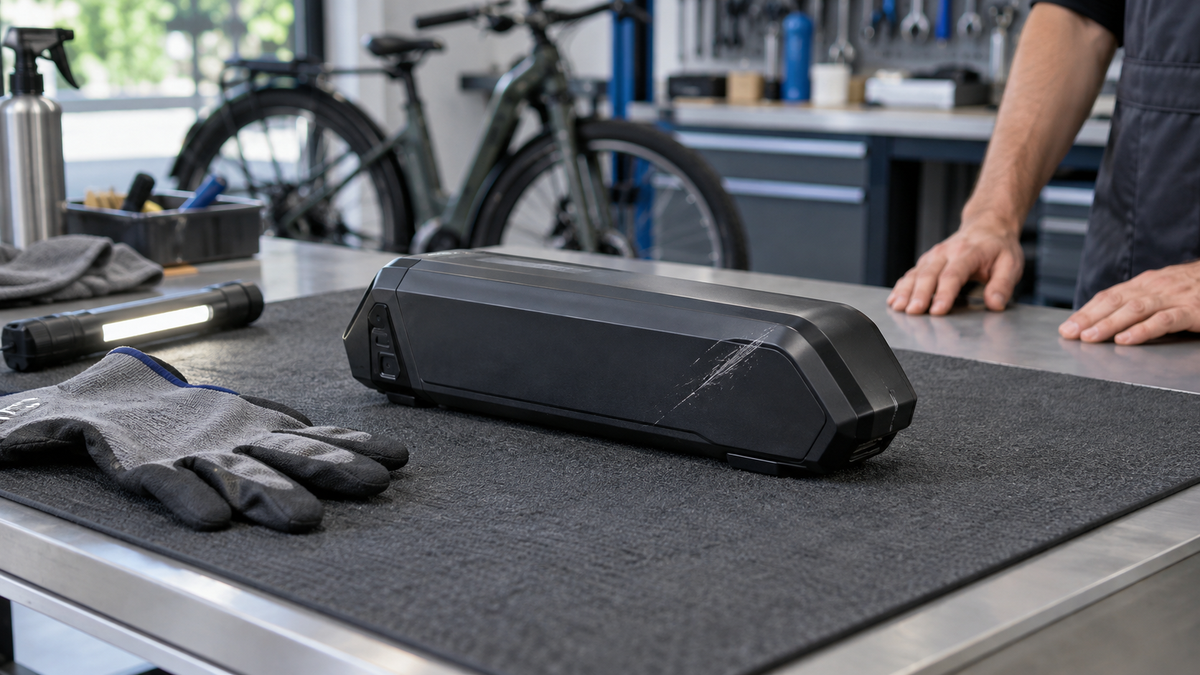
If your e-bike battery has been dropped, do not charge it or insert it into the bicycle as a test. Keep it away from ignition sources and only check from a safe distance for cracks, severe dents, deformation, swelling, fluid, unusual heat, odor, hissing, vapor, or smoke. If there is heat, vapor, smoke, or a risk of fire, leave the area, warn others, and call 112. If the battery shows no acute warning signs, document the fall and have it assessed by the dealer or a suitable specialist before using it again. Do not open or test the casing yourself.
E-bike battery dropped: first steps
First, stop any planned ride and keep the charger and bicycle switched off. An unremarkable display, normal LEDs, or a small external scratch do not prove that the cells, connections, and battery management system inside are undamaged. Even a brief functional test cannot reliably answer this question.
- Make sure that children and pets cannot access the battery.
- Do not touch or move it if it is hot, hissing, steaming, or smoking. If the situation escalates, leave the area and call the fire department.
- If the battery is cool and shows no acute warning signs, leave it switched off and separate from the charger and bicycle. Avoid further impacts, moisture, and flammable materials.
- Record the height of the fall, the surface, the side of impact, and the time. Photograph the battery from several angles without shaking, pressing, or opening it.
- Contact the dealer, manufacturer’s support team, or a qualified specialist before charging or using the battery again.
The Verbraucherzentrale identifies heating and escaping vapor after a fall as urgent warning signs and otherwise recommends having the battery inspected by a dealer. If it is not possible to act safely, your own safety takes priority over the battery.
Which warning signs mean stop immediately?
The severity of damage cannot be determined solely by the sound of the impact. The ADAC points out that the height of the fall and the hardness of the surface play a role, and that internal damage can be difficult for non-experts to detect. Therefore, use the following overview as a stop list, not as a clearance test.
| Observation | What it may mean | Safe response |
|---|---|---|
| Smoke, vapor, hissing, flames, or rapid heating | Acute reaction in the battery; risk of fire and smoke inhalation | Keep your distance, leave the area, warn others, and call 112 |
| Swelling, liquid, or unusual odor | Possible internal defect | Do not touch, charge, or insert it; secure the area and request professional assistance |
| Crack, severe dent, deformation, or damaged contacts | The casing, seal, or internal components may be impaired | Do not continue using it; have it assessed professionally |
| Fall from a greater height or onto stone, concrete, or metal | Increased risk of damage even without obvious external marks | Do not attempt to charge or ride; document what happened and have it inspected |
| Only a superficial scratch is visible | No reliable evidence for or against internal damage | Do not clear it for use yourself; obtain the manufacturer's instructions and a professional assessment |
What you may check without a functional test
Perform only an external visual inspection
If the battery remains cold, dry, and still, you may inspect the closed casing, locking areas, and externally visible contacts from a safe position. Use good lighting. Do not press a dent back into place or try to snap a shifted cover back into position. Do not hold your face over the battery or deliberately smell near openings.
Next, open the appropriate user manual for your exact model. A manual may show the intended removal, locking mechanism, and normal casing shape. However, after a hard impact, it does not replace a professional assessment and does not constitute blanket approval for charging.
These self-tests are not a safe diagnosis
- Insert the battery and switch on the display “just to take a quick look”
- Connect the charger and observe the temperature or LEDs
- Open the casing, loosen screws, or access cells and fuses
- Bridge contacts, test with an unsuitable measuring device, or use third-party adapters
- Shake, bend, or “straighten” the battery by pressing on dents
ADAC expressly advises against attempting repairs yourself. A battery contains a great deal of energy; opening it incorrectly or working on the cells can impair safety functions and create a fire hazard. Even a normal display after insertion would only indicate that it is operating, not rule out hidden impact damage.
How to coordinate an expert assessment, Cyseekin support, and insurance
Document the incident completely
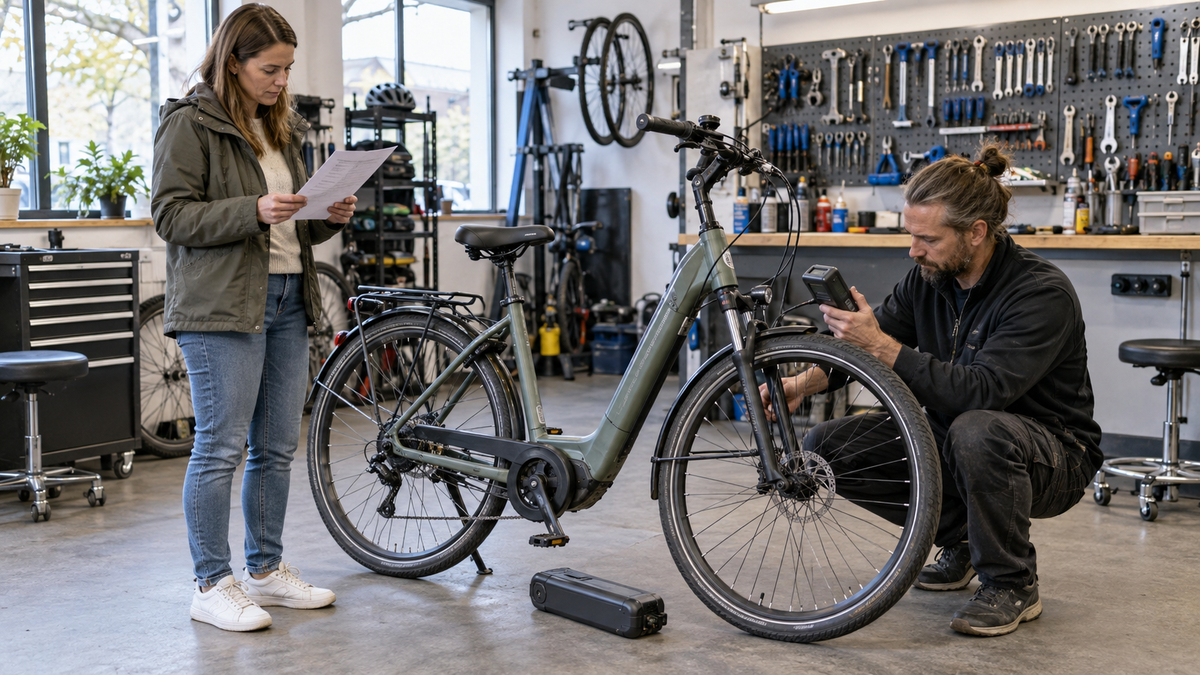
For a Cyseekin e-bike, contact Cyseekin Support first. State the model, order reference, date of the incident, approximate drop height, surface, side of impact, and all changes. Attach clear photos of the intact battery, visible contacts, and mount. Provide serial numbers only through the designated private support channel.
The published service and repair page asks customers to contact Cyseekin before visiting a workshop. Appointments, the scope of the inspection, and costs must be agreed with the respective workshop. Do not send in a battery or another part without being asked; damaged lithium-ion batteries may be subject to special transport regulations.
Ask in writing how the battery should be handled until it is handed over, which specialist facility can accept it, and whether the mount, lock, or electrical connections on the bike also need to be inspected. Do not dispose of a suspect battery in household waste or transport it without specific instructions.
Assess warranty and insurance separately
A fall proves neither a manufacturing defect nor an automatically insured loss. The current Cyseekin warranty terms list damage caused by falls, collisions, impacts, and unauthorized disassembly among the exclusions. Whether a warranty, statutory consumer rights, or insurance applies in an individual case must be assessed based on the cause, contract, and evidence; this article does not promise coverage of costs.
For an insurance inquiry, keep the proof of purchase, photos, the time, location, circumstances, and written diagnosis. Describe only what you observed and avoid speculation about the cause. Have any repair, disposal, or replacement purchase confirmed before changing any facts or evidence.
Conclusion: have it checked before charging it again
If the e-bike battery has been dropped, an immediate charging or riding test is the wrong shortcut. In the event of heat, steam, smoke, hissing, swelling, or leaking fluid: keep your distance, protect people, and call 112 in an acute emergency. Even if the battery remains outwardly calm, document the incident anyway and have it professionally assessed before using it again.
Open the instructions for your exact model now, take photos without tampering with the battery, and send the support team a complete account. Do not use or charge the battery again until the responsible specialist has clearly assessed it and told you what to do next.
Share:
Buying a Used E-Bike: Check the Battery, Test Ride and Documents
Packing list for a 3-day bike tour: pack light for two nights away