

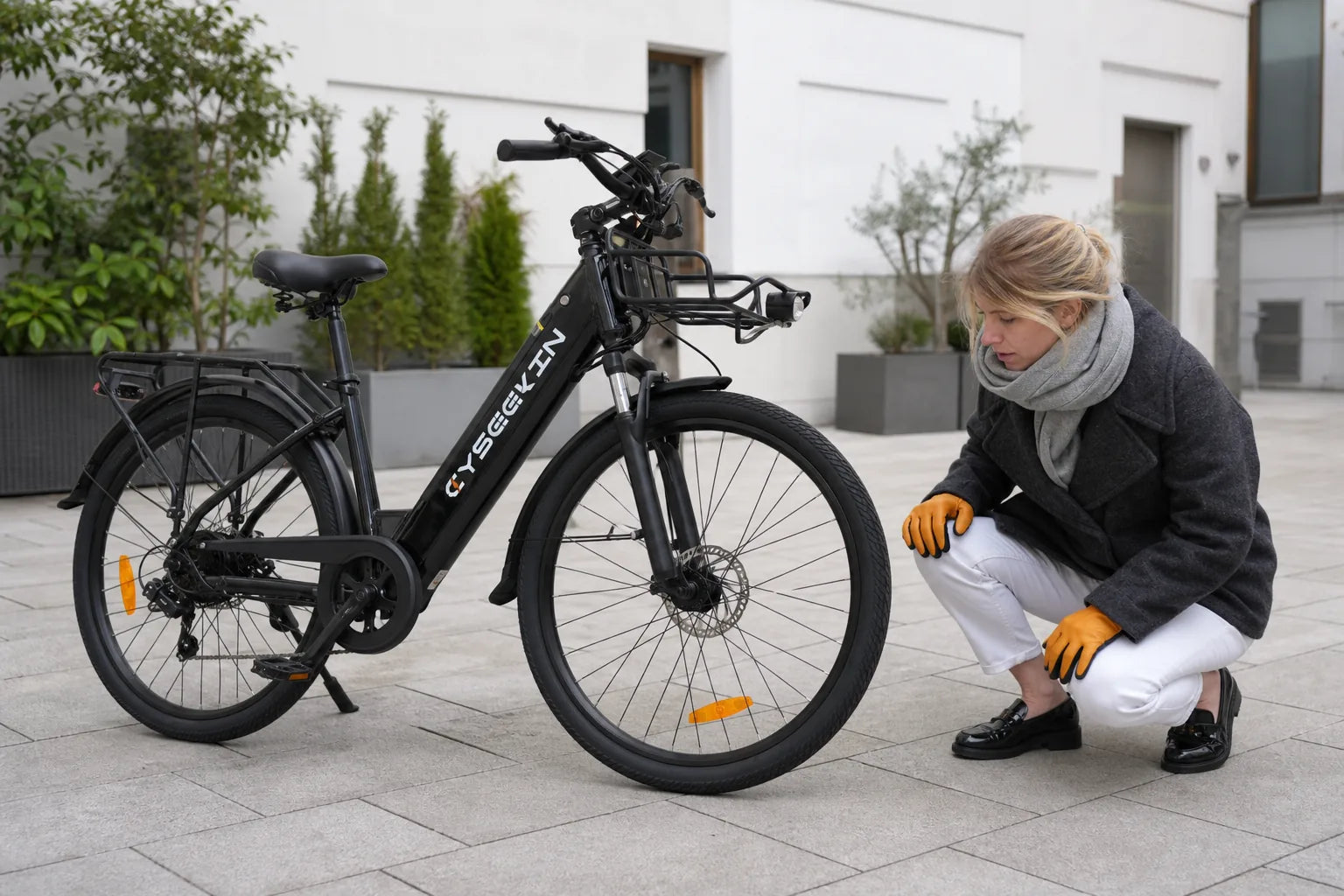
If the noise persists when dry, the brake rubs continuously, or braking performance decreases, you should stop experimenting. Possible causes include contamination, glazed or worn pads, incorrect alignment, or a damaged component.
Three signals for an initial assessment
What the noise reveals together with the braking feel
The noise alone is not enough for a diagnosis. More important is the combination of when it occurs, wheel rotation, lever feel, and braking performance.
| Observation | Possible interpretation | Next safe step |
|---|---|---|
| Brief squeaking after rain, normal braking performance | Moisture or superficial road dirt | Carefully check on a safe surface, allow it to dry, and monitor it. If it persists, have it investigated further. |
| Squeaking even when the brake is dry | Contaminated or glazed pads, dirty disc, incomplete bedding-in | Do not use lubricants or household products; follow the manufacturer's instructions or have a workshop inspect it. |
| Rhythmic rubbing while the wheel is spinning freely | Caliper not centered, rotor dirty or deformed, foreign object | Switch off the bike, carry out a visual inspection, and if you lack experience, do not try to realign anything yourself. |
| Reduced braking power, an unusually soft lever, a leak, or visible damage | Safety-relevant defect or severe contamination | Do not continue riding. Contact a specialist workshop or Cyseekin Support. |

What can be safely checked without disassembly
- Switch off the e-bike and park it securely. Do not work on an activated drive unit, and avoid contact with a hot brake disc.
- Look at the rotor—do not touch it. Are there traces of oil, a foreign object, discoloration, cracks, or visible deformation?
- Check the brake pad and caliper. Visible wear, misaligned parts, or an unusual gap should be inspected by a qualified professional.
- Compare the lever feel. Has the bite point changed noticeably, or can the lever be pulled unusually far?
- Observe wheel rotation. Continuous rubbing should be assessed differently from a noise that occurs only when braking.
Shimano expressly warns against allowing oil or grease to get onto the rotor and pads. Chain, maintenance, and corrosion-protection sprays also have no place on the friction surface. Follow the brake manufacturer's instructions for cleaning; for example, SRAM specifies isopropyl alcohol for its systems. Such guidance should not be applied to every system without verification.
These quick “solutions” can make the problem worse
- No WD-40, chain oil, or multipurpose spray: Lubricants reduce friction and can permanently contaminate the pads.
- Do not heat the pads on suspicion: An open flame or oven is not a safe general repair method.
- Do not sand down the rotor and pads indiscriminately: Material removal and an uneven surface can worsen braking behavior and create warranty issues.
- Do not “repair” them by prolonged braking downhill: Bedding-in procedures depend on the manufacturer and should be carried out on a safe, level route.
- Do not take a test ride if braking performance is weak: Noise is annoying; insufficient deceleration is a safety issue.
New pads and rotors need to be bedded in correctly
New or freshly replaced components do not always reach their intended friction surface immediately. Correct bedding-in can improve braking power, noise behavior, and service life. However, the precise sequence of speed, brake pressure, and repetitions depends on the installed brake system.
If you are not sure which pads and rotor are installed, do not follow just any online guide. The relevant sources are the appropriate Cyseekin user manual and the component manufacturer's specifications.
Mechanical or hydraulic: the noise often sounds similar
According to the latest product information, the C10 and S10 use mechanical disc brakes, while the C20 uses hydraulic disc brakes. For mechanical systems, the cable, housing, and cable tension must also be checked. For hydraulic systems, the hose, bite point, and possible leaks are relevant.
However, the brake system name is not the deciding factor for the initial assessment; braking performance is: squeaking with unchanged deceleration can initially be monitored, while reduced braking power, damage, or leakage requires professional inspection.
For the C10 and S10, the Cyseekin brake cable guide explains how to handle the mechanical cable for each model. It does not replace a diagnosis of contaminated pads or damaged components.
FAQ: E-Bike Disc Brake Squeaking
Is squeaking after rain normal?
Moisture and road dirt can temporarily cause noise. What matters is whether braking performance remains normal and the noise disappears after drying. If it persists in dry conditions or braking performance decreases, the brake must be inspected.
Can I use WD-40 on a squeaky disc brake?
No. WD-40, chain oil, and other lubricants must not get onto the rotor or brake pads. They can contaminate the friction surfaces and significantly reduce braking performance.
Can I continue riding with squeaky brakes?
Noise alone is not enough to confirm that the bike is safe to use. If braking performance has changed, the lever feels spongy, damage is visible, or fluid has leaked, the bike must not be ridden further. If braking performance is unchanged, the cause should still be checked promptly.
Why do new brake pads squeak?
New pads and rotors often need to be bedded in according to the manufacturer's instructions. Incomplete bedding-in, contamination, or incorrect alignment can cause noise. The exact procedure depends on the installed system.
Do hydraulic brakes squeak less than mechanical ones?
Not necessarily. Both systems can develop noise in wet conditions, due to contamination, glazed pads, or improper alignment. The difference lies more in operation and maintenance than in any guarantee against squeaking.
Where can I have a Cyseekin brake inspected?
First, contact Cyseekin Support via the service page and provide the model, purchase details, and symptoms. The team can coordinate repairs, required parts, and a suitable service process. Safety-related work should be carried out by a qualified bicycle workshop.
Sources and Test Bench
Product and safety information was reviewed on August 21, 2026. The specific brake may vary depending on the model or production status; the manual and component labeling take precedence.
Share:
Charging the e-bike battery: What is the correct sequence for the C10?
E-bike with trailer: Does the hitch really fit my bike?