

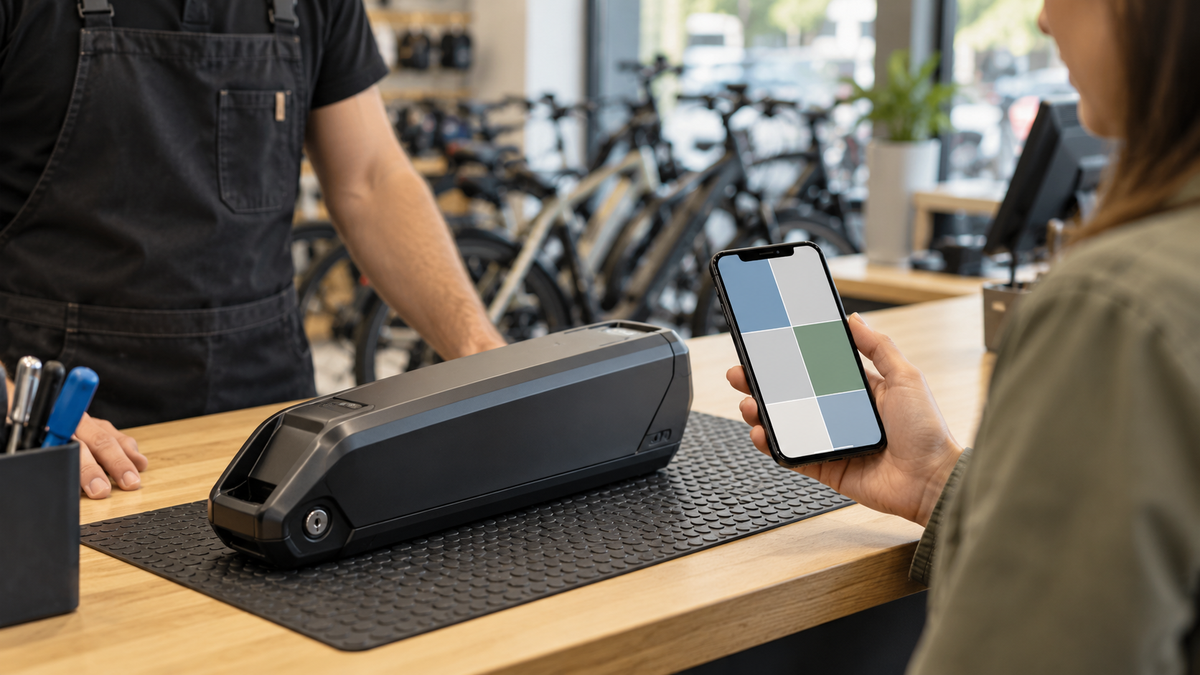
The EU battery passport for e-bikes will become relevant from February 18, 2027 for batteries for light means of transport that are newly placed on the market or put into service. These typically include e-bike drive batteries if they meet the legal definition of an LV battery. Buyers should be able to access certain model information via a QR code.
Important: The passport does not automatically make all battery data public and is neither a health certificate nor a promise about range, warranty, or safety. Article 77 does not impose a blanket retrofitting requirement for old batteries.
What applies from February 18, 2027?
Article 77 of the EU Batteries Regulation 2023/1542 requires an electronic battery passport from this date for every LV battery, every industrial battery with more than 2 kWh, and every electric vehicle battery that is placed on the market or put into service. The passport can be accessed via the unique identifier in the QR code provided for in Article 13.
For e-bikes, the LV battery category is decisive. The current consolidated version defines it in Article 3(1)(11) as a sealed battery weighing up to 25 kg that specifically provides power for the propulsion of wheeled vehicles using motor power or a combination of motor and human power, and that is not an electric vehicle battery. A typical e-bike drive battery therefore generally falls into this category; the classification of a specific product depends on the product in question.
The cutoff date does not impose a blanket retrofitting requirement for every battery already in use. The rule applies to batteries placed on the market or put into service from February 18, 2027. A battery purchased in 2025 therefore does not have to receive a passport later solely because of the date. For stock held in storage or a replacement battery purchased later, the purchase date is not necessarily the same as the legal date on which it was placed on the market. If in doubt, ask the supplier and check the specific battery.
What information can buyers see publicly?
Annex XIII separates information according to access rights. Model information is publicly accessible insofar as it applies to the relevant battery category. This may include material composition and cell chemistry, critical raw materials, information on carbon footprint and recycled content, rated capacity in Ah, voltages, original performance, expected cycle life including the reference test, warranty period, EU declaration of conformity, and guidance on handling waste batteries.
This information can make models easier to compare. However, it does not automatically answer how far a specific e-bike can travel on a single charge. Actual range depends, among other things, on the assistance level, route, temperature, tires, load, and riding style. A stated number of cycles is also an estimate based on a reference test, not a guaranteed remaining service life for each individual battery.
What remains access-restricted?
| Access level | Examples | What buyers should take away |
|---|---|---|
| General public | Model-specific data such as chemistry, rated capacity, voltage, expected cycles, warranty period, and declaration of conformity | This level should be freely accessible through the passport, insofar as the information is applicable. |
| People with a legitimate interest | Detailed composition, sources of spare parts, disassembly instructions, and, for an individual battery, its state of health, status, cycles, and certain usage data | This data is not automatically part of the public QR-code view. Access and use are subject to the specified rights. |
| Notified bodies, market surveillance authorities, and the European Commission | Test reports demonstrating compliance with the Regulation | Consumers cannot infer from the visible QR code that all inspection documents are publicly available. |
The state of health is particularly important. Annex XIII classifies this information as data for the individual battery that is accessible only to people with a legitimate interest. A publicly scannable passport therefore does not have to show the current state of health to every visitor. Charge cycles, accidents, temperature history, and state of charge are also not automatically public consumer data.
What the battery passport does not prove
- No automatic condition assessment: The presence of a QR code does not prove that a used battery still has its original capacity today.
- No range guarantee: Ah, Wh, or cycle figures do not replace realistic trip planning for the specific e-bike.
- No additional warranty: The publicly stated warranty period documents information but does not automatically extend the contract, statutory rights, or warranty terms.
- Not a safety assessment: A passport and conformity information do not replace a visual inspection, manufacturer instructions, recall checks, or a professional assessment of a damaged battery.
If there are cracks, deformation, unusual heating, an odor, or the battery has been dropped, it should not continue to be used just because its passport appears to be in order. Follow the manufacturer’s instructions and have any questionable batteries professionally inspected. For periods when the battery is not in use, our guide Storing an e-bike battery covers temperature, charge level, and suitable storage location separately.
Brief timeline for e-bike buyers
- Until February 17, 2027: When purchasing, continue to keep the receipt, battery identification, manufacturer documentation, warranty terms, and compatibility information. A missing passport before the cutoff date is not automatically a defect.
- From February 18, 2027: For an affected LV battery newly placed on the market or put into service, check the QR code and that it is uniquely linked to the battery.
- For a replacement or used purchase: Don’t ask only about the e-bike’s year of manufacture. What matters is the identity, origin, and legal status of the specific battery.
- Before a purchase close to the cutoff date: Check the current EU text and its implementation again. Technical details and access procedures may be further specified before the start date.
Purchase checklist from 2027
- Is there a QR code on the battery in question, and is it clearly legible?
- Does it lead to a battery passport with a unique identifier rather than just a general advertising page?
- Do the manufacturer, model, chemistry, rated capacity, and voltage match the battery and the e-bike on offer?
- Are the public details accessible free of charge, and do they appear complete and consistent?
- Do the warranty period in the passport, the purchase documents, and the specific warranty terms match?
- For a used battery: Is there also a verifiable condition assessment? The public passport alone is not enough.
- Keep the receipt, serial or battery ID, and link to the passport together.
The German Federal Network Agency describes the Digital Product Passport in general as a basis for standardized data exchange along the value chain. For consumers, this can make information about origin, materials and repairs easier to trace. But this is only useful if the passport matches the actual product and the information is interpreted correctly.
Frequently asked questions about the EU Battery Passport for e-bikes
Does my old e-bike battery need to be retrofitted in 2027?
Not across the board. Article 77 applies the requirement to affected batteries placed on the market or put into service from February 18, 2027. It does not establish a general private retrofit requirement for every battery purchased earlier.
Does the QR code show the battery’s current state of health?
Not necessarily in the public view. Under Annex XIII, the battery’s state of health is among the data subject to access restrictions. So when buying used, ask for a verifiable diagnosis and do not rely on the QR code alone.
Can I compare range using the Battery Passport?
You can compare technical model specifications. The passport does not guarantee real-world range, because the e-bike, assistance level, temperature, route, weight and riding style have a major impact on the result.
Does the Battery Passport replace receipts and warranty documents?
No. Keep your receipt, specific warranty terms, battery identification and service records separately. The passport documents required information, but does not replace individual proof of purchase or an assessment of damage.
Conclusion: greater transparency, but not an all-round certificate
The EU Battery Passport is intended to make e-bike batteries more traceable from February 18, 2027. For buyers, clear identification and public model information are especially useful. However, condition, usage and test data remain partly restricted. So treat the passport as a structured source of information, not as an automatic statement about health, range, warranty or safety.
As of: 21.10.2026. This article provides general consumer information and is not legal advice. Check the applicable version and the specific access rules again if you are buying shortly before or after February 18, 2027.

Share:
Beanie under a bike helmet: How to ensure your helmet fits properly in winter
E-bike fall check: Check the lights, brakes, tires, and battery in 15 minutes