

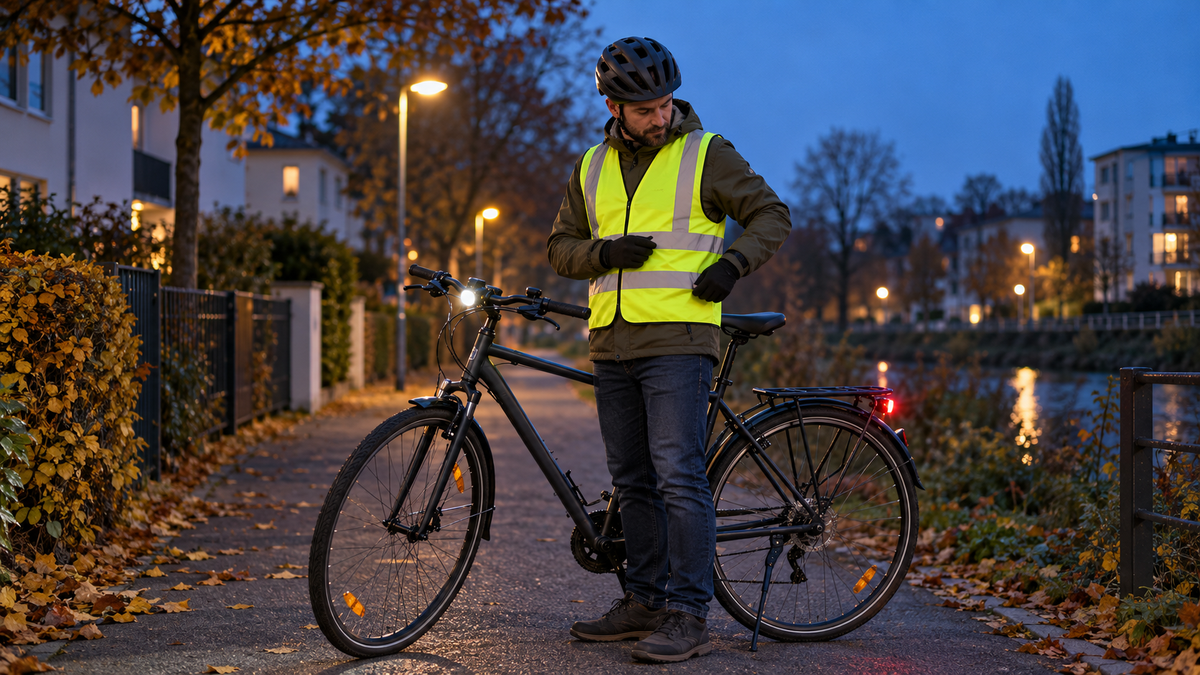
High-visibility vests are not generally required when cycling in Germany. If you're searching for “high-visibility vest bicycle required Germany,” it's important to distinguish between two things: Section 53a of the StVZO requires certain motor vehicles to carry a high-visibility vest, but ordinary bicycles are not on that list. For bicycles, Section 67 of the StVZO instead sets out the required lighting and reflectors. A well-fitting high-visibility vest can improve visibility, but it does not replace a headlight, rear light, or the required reflectors.
Is a high-visibility vest required when cycling in Germany?
In Germany, riders of ordinary bicycles are not generally required to wear a high-visibility vest while riding. The frequently cited high-visibility vest rule in Section 53a of the StVZO concerns carrying a high-visibility vest in certain motor vehicles. These include passenger cars, trucks, truck tractors and tractor-trailer units, as well as buses. Bicycles are not included.
Under Section 63a(2) of the StVZO, a pedelec is classified as a bicycle if it meets the criteria specified there, including a maximum continuous rated power of 0.25 kW and assistance that cuts out no later than at 25 km/h or when pedaling stops.
This does not mean that being easily visible is unimportant. Specific equipment requirements apply to the bicycle itself. Section 67 of the German Road Traffic Licensing Regulations (StVZO) requires, among other things, approved lighting equipment: a white light and a white reflector at the front, a red light and a red reflector at the rear, as well as the required side reflectors and pedal reflectors. Our article on bicycle lighting under the StVZO summarizes the details and permitted options.
This classification refers to the general rules in Germany and is not legal advice for specific professional activities, events, or workplace requirements. Additional rules may apply in those cases.
High-visibility vest and mandatory equipment: the crucial difference
| Equipment | Legal status for a regular bicycle | Practical benefits |
|---|---|---|
| Front light and rear light | Lighting equipment required under § 67 StVZO; detachable lights must be fitted at dusk, in darkness, or whenever visibility conditions require them. | Lights the road and makes the bicycle visible from the front and rear. |
| Reflectors on the bicycle and pedals | Part of the required equipment in the prescribed configurations. | Reflects incoming light and supplements active lighting. |
| High-visibility vest or reflective clothing | No general requirement to wear one for ordinary cyclists. | Can help you be seen by adding a large reflective surface. |
| Reflective band on an arm or leg | Optional addition to clothing. | Moving reflective points can stand out in the dark, but they don’t replace bicycle lights. |
For autumn rides, the ADFC emphasizes that reflectors on the bicycle are mandatory, while reflective elements on clothing can be useful. Bright and reflective clothing can help you be seen sooner in rain, fog, or against the light. The priority remains the same: First, the bicycle must be properly equipped and in working order; clothing is an additional layer.
When a high-visibility vest can be useful on a bicycle
A vest can be especially practical when you want to quickly add visibility to a dark everyday jacket. You can put it on without changing your entire outfit. Typical situations include commuting at dusk, riding in fog or rain, and taking routes along poorly lit roads. An outer layer that stands out can also be helpful if you break down at the roadside.
However, its benefits depend on the specific situation. Reflective material only works when light hits it and it isn’t covered by a backpack, scarf, or luggage. Fluorescent colors can stand out in daylight; in the dark, what matters is how well they reflect light from headlights. A vest doesn’t automatically make a confusing intersection, an insufficient passing distance, or risky riding safe.
So don’t plan your ride around the vest. In poor visibility, reduce your speed, leave yourself a safety margin, and expect that others may overlook you despite your conspicuous clothing. On seasonal commutes, also account for the earlier darkness on both the outbound and return journeys.
How to choose a high-visibility vest for cycling
Check the fit before the color
The vest should fit over the jacket you actually wear without pulling tightly at the shoulders or stomach. At the same time, it should not be so loose that parts flap in the wind or come close to moving components. Try the vest on in your usual riding position and move your arms and upper body. A backpack can cover the back panel; reflective details on a bag or backpack cover can provide a useful addition in that case.
Keep reflective areas visible
Check the front and back, as well as side visibility. A small reflective logo is not the same as wide, unobstructed reflective areas. Fasten the vest if that is necessary for it to fit correctly. Dirt, rain covers, and outer layers of clothing can reduce its effectiveness. Follow the care instructions, as harsh washing or heavy wear can damage reflective surfaces.
How to interpret standards information
Section 53a of the StVZO specifies certain standards for the high-visibility vests required under that provision, including EN ISO 20471. However, this does not create a general standards or wearing requirement for private cyclists. If you choose a vest as highly visible additional clothing, you can compare its labeling, manufacturer’s information, size, and intended use. A standards label alone does not prove that the vest fits you well or remains clearly visible while cycling.
What a high-visibility vest does not replace
The vest is no substitute for the required lighting. Section 67 of the German Road Traffic Licensing Regulations (StVZO) requires lighting equipment to be operational, correctly fitted, and unobstructed. At dusk, in the dark, or whenever visibility conditions require it, removable headlights and lights must be fitted to the bicycle. This also applies when the jacket or vest is highly reflective.
- No substitute for lights: Switch on the front and rear lights before riding and check that they work.
- No substitute for reflectors: Keep required reflectors clean, complete, and unobstructed.
- No guarantee of visibility: Keep riding defensively and expect others to make mistakes.
- Not a free pass for additional lights: Additional lights must not dazzle other road users; bicycles are subject to approval regulations.
30-second visibility check before setting off
- Switch on the front and rear lights and check them from a few steps away.
- Check the white and red reflectors, as well as the pedal and side reflectors, for dirt or obstructions.
- Fasten your high-visibility vest or reflective clothing over your current jacket, and watch out for loose parts.
- Position your backpack and luggage so they do not block the bicycle lights or reflectors.
- Allow more time in fog, rain, or darkness, and adjust your riding to the visibility conditions.
Frequently asked questions about high-visibility vests for cycling
Do I have to wear a high-visibility vest when cycling in Germany?
There is no general requirement for ordinary cyclists to wear a high-visibility vest. § 53a StVZO requires certain motor vehicles to carry one. Separate occupational or organizational rules may impose additional requirements.
Is a high-visibility vest enough if my bicycle lights are broken?
No. A high-visibility vest does not replace the bicycle lights and reflectors required under § 67 StVZO. If the required lights are not working, fix the problem before riding.
Is yellow better than orange?
The sources cited do not support a general ranking. Make sure there are sufficiently visible areas, reflective elements, a good fit, and that you follow the manufacturer’s instructions. It also matters whether the vest remains visible with the clothes you actually wear.
Do I need a high-visibility vest even if I’m wearing a bright jacket?
Not necessarily. Bright clothing and reflective details can already improve visibility. Check the complete combination of bicycle lights, required reflectors, clothing, and luggage instead of assessing just one item of clothing.
Conclusion: voluntary addition, not a substitute
A high-visibility vest is not generally required when cycling in Germany. It can be a simple addition in the dark, at dusk, and in bad weather, provided it fits well and is not covered. However, the legal and practical foundation remains a bicycle equipped for safe road use, with functioning lights and the required reflectors.
So check the technical equipment first, add clothing afterward, and finally adjust your speed and route to the visibility conditions. This order prevents a high-visibility vest from creating a false sense of complete protection.
Share:
EU Battery Passport 2027 for E-Bikes: What Buyers Really Need to Know
E-bike fall check: Check the lights, brakes, tires, and battery in 15 minutes