

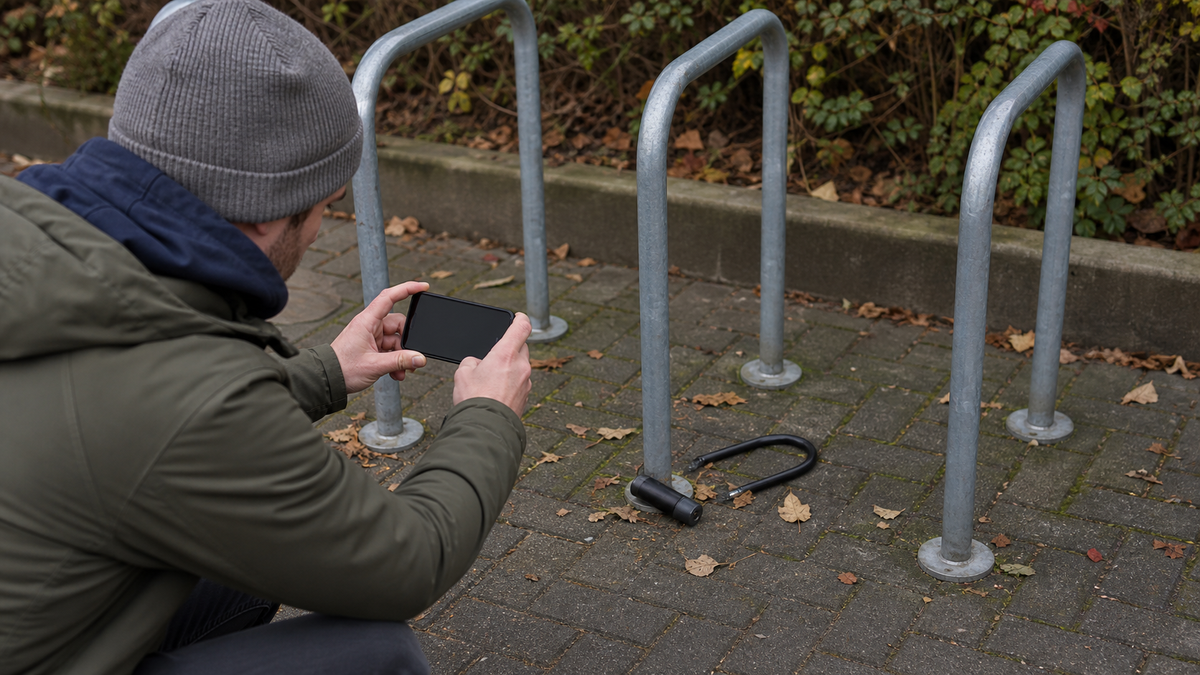
Where your bicycle stood just moments ago, there is now only a cut lock. What matters now is following a calm sequence: check, document, file a report, and notify your insurer within the deadline. Good documentation increases the chances that the police and insurer can clearly identify the bicycle. Even so, there is no guarantee that it will be recovered or that you will receive compensation.
First minutes: Do not unnecessarily alter the crime scene
First check whether the bicycle may have been moved, towed away, or relocated by an authorized person. Ask the property management, station staff, or event organizer without disturbing any evidence at the parking location. If lock fragments or other objects are there, photograph their position before touching anything. In the event of immediate danger, violence, or an ongoing theft, call 110.
Note the time, exact location, and period during which the bicycle was last known to be safe. Photograph the bike rack, lock fragments, surroundings, and any possible cameras. Ask witnesses for their contact details, but do not confront anyone. You should not publish private video recordings yourself; share the information with the police so that evidence preservation and data protection are handled correctly.
These bicycle details help with the search
The most important detail is an individual frame number. Depending on the bicycle, it can be found in different places and should be documented before a theft occurs. Add the manufacturer, model, color, frame size, purchase date, and distinctive features such as scratches, accessories, or replaced components. An up-to-date photo from both sides makes identification easier.
The Police Crime Prevention recommends recording this information in a bicycle passport. The former bicycle passport app is no longer available; a paper passport or your own securely stored documentation serves the same purpose. Do not keep receipts only in a bag attached to the bicycle.
File a complete theft report
A bicycle theft should be reported promptly. You can go to your local police station. For non-urgent cases, the police forces of the federal states also offer the official online police reporting portal. There, you select the federal state where the incident occurred and are directed to the appropriate form. Not every complex case is suitable for a purely online report.
Submit only facts that you actually know. Provide the time period, location, frame number, description, proof of purchase, and photos. Mention the type of lock, any existing coding, and, if applicable, a tracking function. Upload screenshots in unaltered form. Do not present suspicions about a particular person as facts in the report.

Ask for the case reference number or file number and, if needed, written confirmation. The insurer often needs this information. Submit additional information, such as a sales listing discovered later, under the same case instead of filing several separate reports.
E-bike: Secure keys, battery, and digital accounts
For an e-bike, also document the battery and key numbers, if available, as well as the charger and system documents. If the battery was not on the stolen bicycle, mention this in the report and to the insurer. A missing battery may be relevant to the value and description. Do not freely publish complete serial or key numbers online.
Change the password for a connected customer account if you suspect unauthorized access, and revoke active sessions according to the provider’s instructions. Do not remove the bicycle from the account too soon if this could cause you to lose location data, proof of ownership, or a locking function. First save screenshots and ask the manufacturer or police about the appropriate procedure.
GPS tracking: Observe, do not intervene yourself
If a tracker shows a location, take screenshots showing the time and inform the police. Do not go there alone, enter private property, or confront anyone. A location may be inaccurate, delayed, or already outdated. Even if you can see the bicycle, you may not forcibly take it from someone else’s possession.
Activate a sound or locking mode only if the instructions provide for it and doing so will not interfere with an ongoing police operation. Do not share access credentials publicly. Location histories may contain personal information and should be shared with the responsible authorities, not on social media.
Notify your insurer as quickly as possible
Whether and when an insurer pays depends on the policy. Home contents insurance may cover bicycle theft under certain conditions; specialized bicycle insurance may cover different locations, times, types of damage, or wear-related cases. The consumer advice center therefore recommends carefully comparing the scope of coverage, exclusions, and compensation limits.
Report the claim within the deadline specified in the policy. Commonly required documents include the case reference number, proof of purchase, frame number, photos, proof of ownership, and information about how the bicycle was secured. Submit truthful information and keep the originals. If a document is missing, ask the insurer which alternative it will accept instead of estimating values or recreating a receipt.
The cut lock may be important as evidence or in photographs. Do not dispose of it until the police and insurer no longer need it. If the bicycle was stolen from a basement, garage, or shared room, also document the door, access, and visible signs of forced entry. A blanket statement such as “a basement is always insured” would be incorrect; policy conditions vary.
Online searches with clear limits
Search for distinctive features on common sales platforms and in local found-property listings. Use saved searches so that you do not have to check manually all the time. If you find a possible listing, save the URL, profile name, images, price, description, and time as a screenshot. Do not negotiate a buyback or arrange a meeting alone.
Inform the police, quoting your case reference number. A similar bicycle is not yet proof, especially with common models. Public accusations can implicate uninvolved people and make an investigation more difficult. In a search post, share only necessary features and one image, not your full address, key number, or non-public investigation information.
Contact the lost-and-found office and local authorities
Ask the municipal lost-and-found office and, if applicable, the transport operator. Found bicycles are not always visible online immediately. Follow up after a few days and have the frame number and case reference number ready. If the bicycle was taken from a rental-bike station or train station, the operator may also have its own reporting process.
If your bicycle is found, inform the police and insurer. If you have already received compensation, ownership may have passed to the insurer under the policy terms, or repayment rules may apply. Do not simply start using the bicycle again without reporting the recovery and having its condition checked.
What you can prepare for next time
- Store the frame number, manufacturer details, and distinctive features separately from the bicycle
- Take up-to-date photos of the bicycle, lock, and accessories
- Save the proof of purchase, invoice, and, if applicable, proof of coding digitally
- Read the insurance terms for location, time, lock requirements, and reporting deadlines
- Protect the tracker account with a strong password and current recovery address
- Lock the bicycle to a fixed object; choose a lock and location appropriate to the risk
This preparation will not prevent theft, but it will shorten the time needed to find the relevant information. Clear documentation is particularly helpful when model names are similar or the bicycle has been modified. Update the documentation after replacing the frame, wheels, or battery.
Frequently asked questions
Is an online report enough?
For a non-urgent, clear case, the online police portal may be suitable. In the event of danger, violence, an ongoing crime, or complex evidence, contact the police directly; in an emergency, call 110.
What should I do if the frame number is missing?
File a report anyway. Look for the receipt, dealer documents, old photos, or service records. The dealer may still have the information, but may not have stored it or be able to release it in every case.
Does home contents insurance always pay?
No. Coverage, location, security requirements, excess, and compensation limits depend on the policy. Check the terms and ask the insurer in writing.
Can I buy a listing I have found myself?
This is risky and could endanger evidence or your safety. Document the listing and forward it to the police. Do not arrange a confrontation or take matters into your own hands.
Conclusion
After a bicycle theft, first secure information about the crime scene, time window, and bicycle details. Then file a report, obtain the case reference number, and notify the insurer within the deadline. Pass on tracker or sales-listing discoveries to the police without intervening yourself. The more complete your frame number, photos, and receipts are, the more clearly your bicycle can be identified.
As of September 6, 2026. This article describes a general procedure and does not replace police instructions or a review of your insurance policy.
Share:
Green arrow for bicycles: Turn right safely and legally at a red light
Bike path in the wrong direction: Avoiding accident risks at intersections