

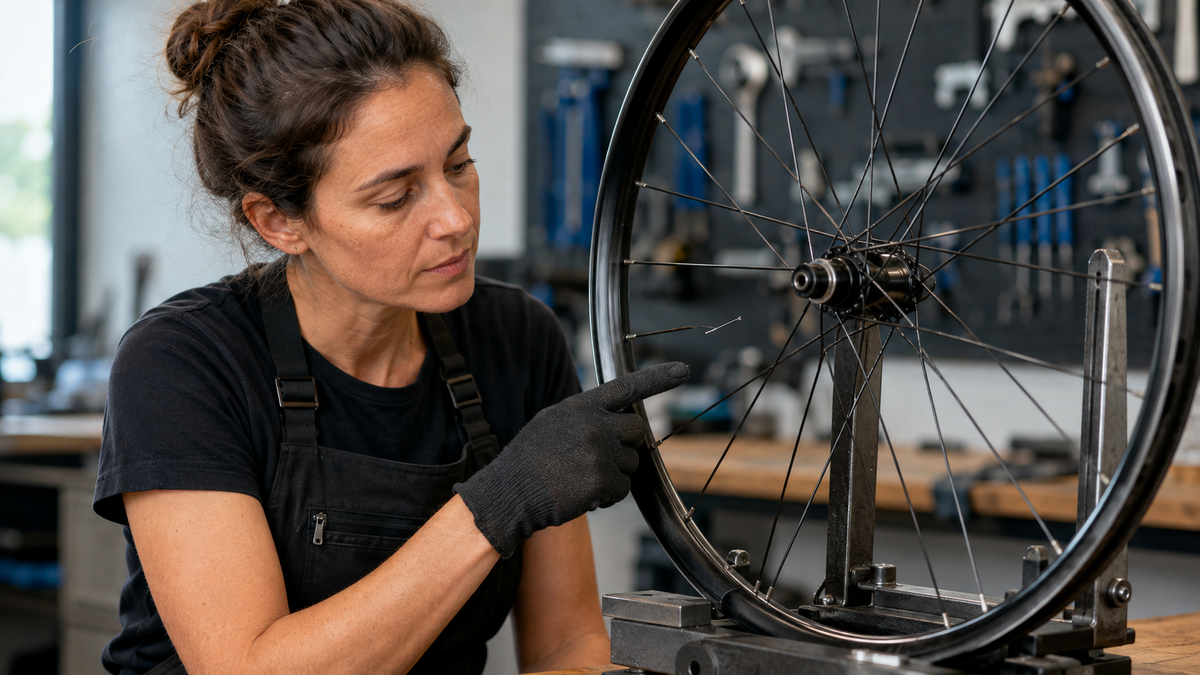
A metallic ping, followed by the wheel rubbing: a broken spoke is not a defect you can simply ignore until the weekend. The remaining spokes have to redistribute the load, and the rim can develop lateral wobble. Stop safely, get off, and inspect the wheel before a single broken spoke turns into more extensive damage or a crash.
First warning sign: slow down immediately
If you hear a sudden noise or feel an imbalance, brake in a controlled manner and stop away from traffic. Avoid sharp steering movements and hard braking if the situation allows. Extra caution is required if the front wheel is wobbling severely, because this directly affects steering. Push the bicycle to a safe place.
Under § 23 para. 2 StVO, if a significant safety-related defect occurs while a vehicle is in use and cannot be remedied immediately, it must be removed from traffic by the shortest route. Bicycles may then be pushed. This is the appropriate basic decision when a spoke has broken.
How to recognize a broken spoke
The spoke may break at the bent head in the hub, at the thread near the nipple, or in the middle of the wire. Sometimes one end hangs loose in the wheel; sometimes it remains under tension and the defect is only detected by touch. Slowly turn the raised wheel by hand, but only if it can move freely and safely. Keep fingers, clothing, and cables away from the spokes and brake disc.
The Shimano wheel user manual lists bent, loose, or damaged spokes, as well as cracks or other rim damage, as items to check before riding. If there is a problem, the wheel should not be used. This conservative manufacturer limit makes sense because a visible broken spoke does not reveal the full extent of the damage.
Why continuing to ride is a bad idea
Each spoke is part of a pre-tensioned system. When one fails, the tension in the neighboring spokes changes. The rim can develop lateral wobble, rub against a rim brake, or cause a brake disc to shift in the caliper. Further load can damage the nipple seat, spoke hole in the rim, or additional spokes.
It is not possible to reliably predict from a distance how quickly this will happen. Wheel construction, spoke count, rider weight, luggage, road surface, and the point of breakage all play a role. A wheel that still looks straight without a load may behave differently under load. Therefore, the safe answer to “Can I ride with a broken spoke?” is: not as a normal trip home.
What you can do at the roadside
- On an e-bike, switch off the drive system and park the bicycle securely.
- Locate the break without reaching into a rotating wheel.
- Visually check the tire, rim, brake, hub, and neighboring spokes only.
- Secure a loose, dangling end only for pushing or transport, ensuring that it cannot enter the brake, tire, or drive system.
- Arrange pickup, transport by train, or a route to the nearest workshop.
Temporarily securing a spoke to a neighboring spoke is not a repair and does not authorize continued riding. Do not repeatedly bend the wire back and forth, and do not cut it near an inflated tire. If the spoke has broken on the cassette side or a part is blocking the wheel, leave the bicycle where it is and transport it.

These areas must also be checked
- Rim: lateral wobble, radial runout, crack, dent, or damaged spoke hole
- Tire and rim tape: cut, abrasion, or damage caused by a spoke or nipple
- Neighboring spokes: unusually loose or noticeably over-tensioned spokes
- Hub and flange: crack, broken-out hole, or play
- Brake: contact with the rim, bent disc, or altered position
- Drive system: contact with the cassette, chain, derailleur, or motor cable
An e-bike also has a higher system weight, but this does not imply a standardized spoke count or tension. Rear hub motors, mid-drive motors, and different rims each require suitable parts and manufacturer specifications. Tell the workshop the bicycle model, wheel size, brake type, intended use, load, and how the break occurred.
Why replacing just one spoke is not always enough
A single spoke can break due to a hard impact or an object becoming caught in the wheel. Repeated breakages are more likely to indicate a problem with the wheel as a whole: uneven tension, material fatigue, corrosion, a damaged spoke hole, or unfavorable spoke routing. These are possible causes, not a remote diagnosis.
The workshop checks whether the spoke type, length, diameter, head, and nipple are suitable. The new spoke is then not merely tensioned; the trueness and tension distribution of the entire wheel are checked. If several spokes have already been damaged or the rim is damaged, rebuilding the wheel or replacing it may make more sense than carrying out a series of individual repairs.
Why “tightening by feel” is risky
Visible lateral wobble can tempt you to turn random nipples. This can worsen the tension distribution, round off a nipple, or permanently deform the rim. The correct adjustment depends on the wheel and the point of breakage. Universal quarter-turn or torque recipes are therefore not reliable.
Professional wheel work uses a truing stand or a controlled reference, suitable spoke wrenches, and, depending on the system, measurements or manufacturer instructions. For some repairs, the discs, cassette, tire, or rim tape must be removed. If you do not have the necessary equipment, using a workshop often saves time and prevents consequential damage.
Distinguishing between the front and rear wheel
Damage to the front wheel directly affects tracking and steering. With disc brakes, the proximity of the spoke to the rotor may also be relevant. At the rear wheel, the cassette, freehub, and possibly the motor are involved; a spoke on the drive side is often inaccessible without the right tools. In both cases, stop riding.
A broken spoke on a cargo bike or heavily loaded touring bike requires additional caution. Remove people and luggage before moving the bicycle. Children or animals must not remain in the seat or box while you push the damaged bicycle. Arrange safe transport instead of improvised load testing.
After the repair
Ask whether only one spoke was replaced or the entire wheel was re-trued. Before your first ride, check that the wheel is seated correctly, the brakes work, and the wheel rotates freely. Begin with a short, slow test ride in an area with little traffic. If you notice rubbing, cracking noises, a soft ride feel, or renewed lateral wobble, stop the ride and return to the workshop.
A follow-up inspection may be advisable depending on the repair and manufacturer, especially if several spokes were replaced or a wheel was rebuilt. The workshop will determine the timing. In future, regularly check whether spokes appear loose and whether the rim shows damage, without changing the tension yourself by turning nipples at random.
Frequently asked questions
Can I ride the last two kilometers?
A safe remaining distance cannot be approved as a general rule. Push the bicycle or arrange transport. Even a short ride under load can increase lateral wobble and consequential damage.
How much does a new spoke cost?
The price depends not only on the wire itself, but also on accessibility, disassembly, truing, and possible damage to the rim or other spokes. Ask for a cost estimate after the inspection.
Is a broken spoke covered by the warranty?
That depends on the cause, age, use, and warranty terms. Document the break and wheel before the repair, keep the invoice and proof of purchase, and clarify the case with the retailer or manufacturer.
May I push the damaged bicycle?
Yes, provided the wheel remains free and no loose spoke endangers people, the tire, brake, or drive system. If the wheel is blocked or the rim is severely damaged, the bicycle must be carried or transported.
Conclusion
A broken spoke is a reason to stop, not to continue riding quickly. Secure loose parts only for pushing or transport and have the entire wheel inspected. The rim, neighboring spokes, hub, brake, and drive system are all important—not just replacing one wire. This helps prevent a minor breakdown from becoming costly wheel damage or a safety risk.
As of: September 6, 2026. The instructions from the wheel or bicycle manufacturer and an inspection by a qualified specialist workshop are authoritative.
Share:
Green arrow for bicycles: Turn right safely and legally at a red light
Bike path in the wrong direction: Avoiding accident risks at intersections