

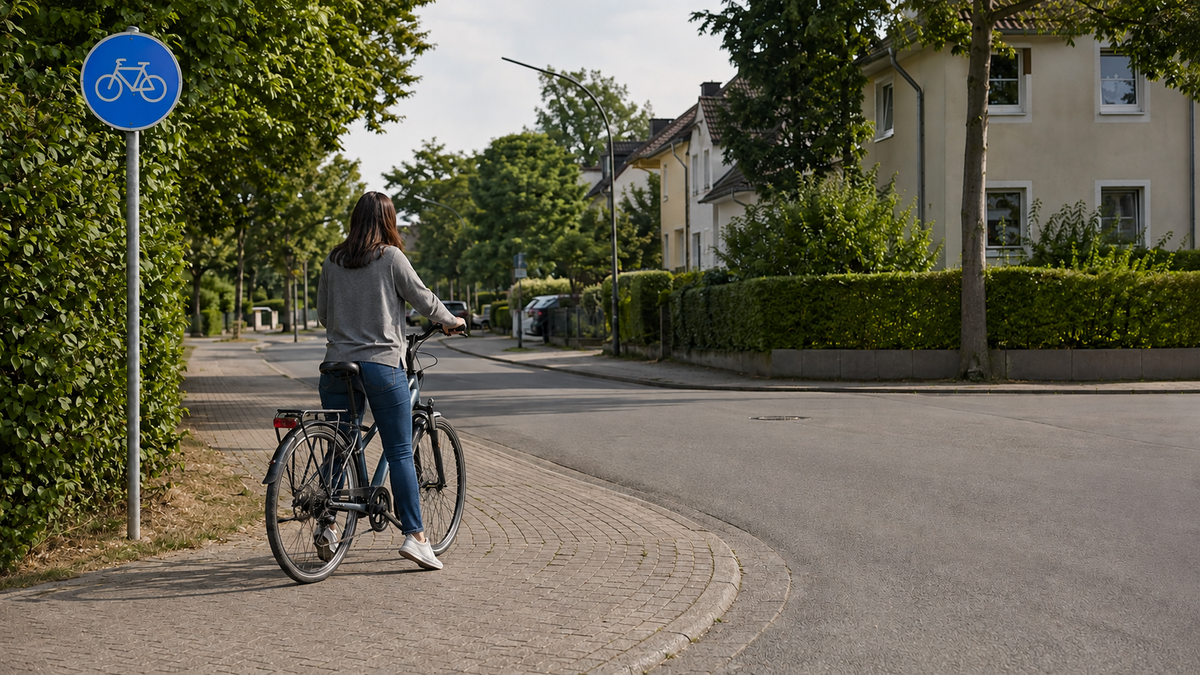
Anyone using a cycle path in the wrong direction appears at junctions where others often do not expect cycle traffic. The problem is not only a possible violation of the rules. Sightlines are shorter, encounters are more confined, and turning situations are harder to assess. This article therefore focuses on avoiding conflicts: How can you recognize a risky wrong-way direction, how should you react to someone riding the wrong way, and what should you do after a collision?
A brief legal check before assessing the risk
Under Section 2(4) of the German Road Traffic Regulations (StVO), using a cycle path is mandatory only in the respective direction of travel when this is ordered by signs 237, 240, or 241. An unmarked cycle path on the right may be used. A cycle path on the left without these signs may be used only with a standalone supplementary sign reading “Cyclists permitted.” A well-developed path on the opposite side is therefore not automatically open to traffic in both directions.
This classification is necessary, but it does not replace checking the specific location. Always read signs from your direction of travel. A sign whose front side is visible only to oncoming traffic does not authorize you to proceed. Roadworks can temporarily change a familiar route. The signage is what matters, not habit or a map app.
Why junctions are particularly critical
Anyone coming from a side street or driveway must watch several areas: the footpath, cycle path, carriageway, and often parked vehicles. If a bicycle approaches from the unexpected direction, there is less time to notice it and react. Hedges, signs, delivery vans, or rubbish containers may further obstruct the view.
Vehicles turning off the main road may also see you late on a cycle path on the left side. A car turning right may first cross cycle traffic coming from one direction and then unexpectedly encounter you. Turning left involves a different sequence of glances. You cannot tell where the person at the wheel has already looked. That is why speed, eye contact, and readiness to brake are more important than assuming you have been seen.
The Insurers’ Accident Research treats riding on the left in violation of the rules as a relevant conflict pattern. This does not allow blanket blame to be assigned for a specific accident. It does, however, show why a short cut at every junction can create new risks.

Five warning signs before a driveway
- Visibility is blocked by a hedge, wall, advertising sign, or parked vehicle.
- A car rolls up to the cycle path because the carriageway cannot be seen until that point.
- Riders are visibly looking only in the usual direction of traffic.
- There is not enough space or room to evade on the cycle path when facing oncoming traffic.
- The crossing is difficult to see because of dirt, faded markings, or temporary construction routing.
At any of these warning signs, slow down early. Do not stop directly in the exit, but at a position where you can be seen without blocking anyone. A bell can attract attention, but it gives you neither priority nor eye contact. If the situation is unclear, wait.
How to approach an intersection defensively
- Before reaching the crossing, check whether vehicles are approaching from a side street, driveway, or turning lane.
- Reduce your speed enough to be able to stop within the visible clear area.
- Seek eye contact, but do not rely on a brief turn of the head as confirmation of safety.
- Keep your distance from the kerb, bollards, and oncoming traffic so that controlled evasive action remains possible.
- Proceed only when the other vehicle’s movement is clear.
The Administrative Regulation on the German Road Traffic Regulations (StVO) sets special requirements for safe crossing points and visibility at left-side cycle-path permissions. In practice, this means that even a legally used two-way cycle path requires more attention at junctions than a straight, clearly directional route.
When someone approaches you from the wrong direction
Stay on your side, reduce your speed, and establish eye contact early. Do not suddenly move onto the pavement or into the carriageway without checking the traffic there. On a narrow section, stopping is usually safer than forcing your way past. Give pedestrians enough space.
Arguing in the middle of the path increases the risk. Do not deliberately block anyone, and do not try to enforce a traffic rule by squeezing past closely. If the location is regularly problematic, document the infrastructure instead and report it to the responsible local authority.
Meeting another cyclist on a legal two-way cycle path
Oncoming traffic does not automatically mean that someone is riding incorrectly. A path on the left may be permitted for both directions. Keep as far right as possible within the path, overtake only when visibility is sufficient, and leave extra room on bends. Groups should ride single file at bottlenecks so that oncoming traffic is not forced to the edge.
In darkness and poor visibility, required lights must be working. Aim a powerful headlight so that it does not dazzle oncoming people. Reflective elements can improve visibility, but they do not replace an appropriate speed.
The Safe Alternative to a Short Wrong-Way Ride
If your destination is on the other side of the road, plan a clear and safe crossing. Use an intersection, a central refuge island, or another suitable location. If crossing while riding is not safe, dismount and walk your bike. A detour of a few minutes is preferable to a series of driveways with severely limited visibility.
If the correct cycle path is blocked, this does not automatically give the other side permission to travel in the opposite direction. Safely position yourself on the permitted roadway or follow the designated detour. Do not cross diagonally over several lanes. Report persistent blockages, including the location, direction, time, and a photo that does not unnecessarily clearly show uninvolved people or license plates.
If a Collision Occurs Anyway
First secure the accident scene without putting yourself at risk. Check whether anyone is injured, provide first aid within your capabilities, and call 112 in the event of injuries or danger. Bicycles and vehicles should only be moved if necessary for safety or rescue. Photograph their final positions beforehand, if this can be done safely.
Exchange names, addresses, and contact details. Note license plates, vehicles involved, visible damage, weather conditions, signage, and directions of travel. Ask witnesses for their contact details. Take overview and close-up photos without obstructing traffic. Do not hastily sign an acknowledgment of fault at the scene of the accident.
In the event of injuries, an unclear situation, a dispute, significant damage, or failure to exchange information, the police are a sensible point of contact; in urgent situations, call 110. Have any health complaints medically assessed, even if they only appear later. Report the damage to your liability or accident insurer promptly in accordance with its terms.
Wrong-Way Travel and Liability
Traveling in the wrong direction can be a factor when assessing an accident. However, it does not automatically mean that all other duties of care no longer apply or that one person is always fully liable. Visibility, speed, right of way, the turning maneuver, detectability, and avoidability are considered on a case-by-case basis.
Keep photos, repair receipts, medical documents, and correspondence. In cases involving personal injury or disputed liability, independent legal advice may be helpful. This article can provide neither an accident reconstruction nor a binding apportionment of fault.
Report a problem location to the municipality
If near misses keep occurring, do not describe it merely as a “dangerous cycle path.” State the exact junction, the direction of travel affected, the obstruction to visibility, the time, and the traffic arrangement. Eye-level photos show better what cyclists and drivers can see. Do not take photos while riding.
The responsible authority assesses possible improvements: trimming vegetation, offset parking spaces, clearer crossing markings, adjusted signage, or a changed route. A private marking or a sign installed by an individual is not a solution. Until a change is made, follow the existing instruction and adapt your behavior to the recognizable danger.
Frequently asked questions
May I ride on the left if only 100 meters are missing?
The short distance does not create an exception. Without an instruction addressed to you or explicit authorization, use the regular route on the right and cross at a suitable location.
Am I always in the right when using an authorized two-way cycle path?
The authorization permits or requires use, but does not waive the duty of care. Speed, visibility, consideration for others, and the specific right-of-way or turning situation remain decisive.
What should I do if navigation sends me to the wrong side?
Traffic signs and the actual route take precedence over the app. Stop safely, check the route, and change sides only at a suitable location.
Is there a fixed fine?
Traveling in the wrong direction may constitute an administrative offense; consequences may increase if there is obstruction, danger, or damage. For a specific case, check the current official schedule of fines rather than relying on outdated tables.
Conclusion
The most dangerous consequence of traveling in the wrong direction on a cycle path occurs at junctions: You approach from a direction that others may check only belatedly. Avoid riding against the flow, reduce your speed early on legally permitted two-way routes, and do not force a passing situation. After an accident, securing the scene, providing assistance, factual documentation, and an individual assessment take priority over any debate about fault.
As of September 6, 2026. The current German Road Traffic Regulations (StVO), the specific signage, and the situation on site are authoritative. This article does not replace legal advice or an accident assessment.

Share:
Green arrow for bicycles: Turn right safely and legally at a red light
E-bike on a bike rack: Check the weight and secure it properly