

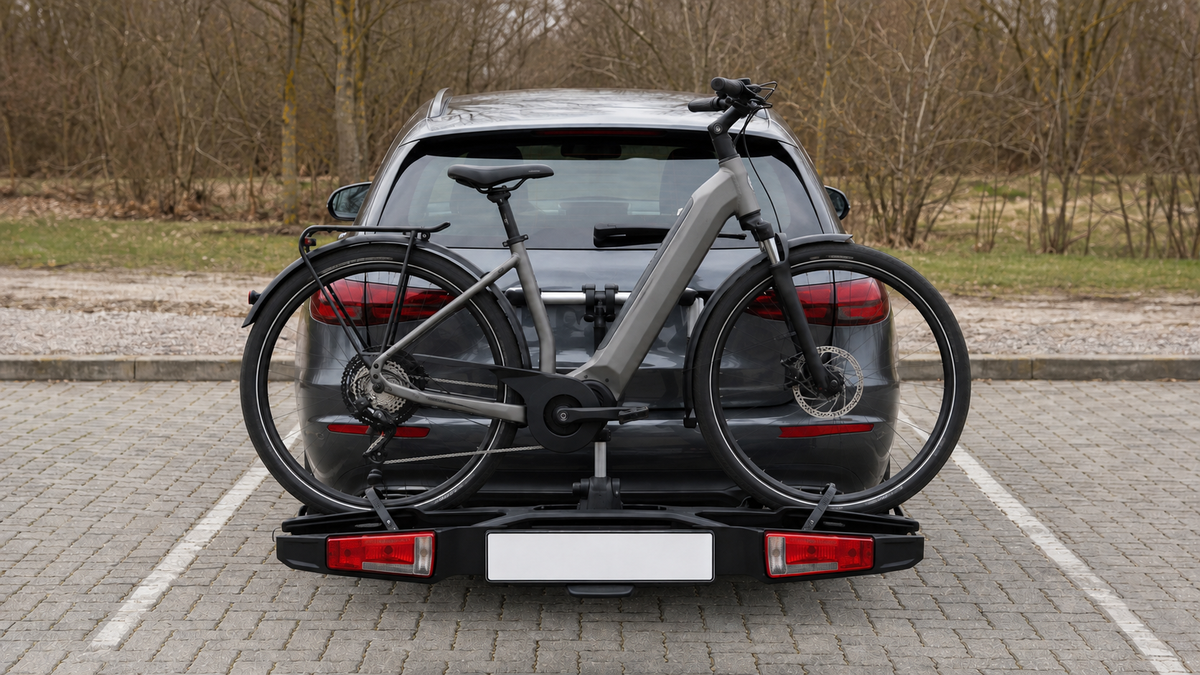
An e-bike does not automatically fit every bike rack. The motor, battery, and sturdy frame often increase the weight, while the rack, tow hitch, and individual rails have fixed limits. Before setting off, you therefore need more than a strong retaining arm: a comprehensible weight calculation, the appropriate approvals, and a complete securing check.
Why e-bikes require special planning
Many racks were originally developed for lighter bicycles. With two e-bikes, the frames, wheels, and accessories alone may use up the permitted load capacity. In addition, the total weight is not the only factor that matters. Manufacturers may set a lower limit per rail, wheel holder, or retaining arm. A total weight that works out mathematically therefore does not automatically permit every distribution.
Weigh the bicycles in their actual transport configuration. Information in a brochure may refer to a different frame size or equipment level. Panniers, locks, bottles, child seats, and removable batteries change the figure. A household scale with a suitable difference measurement provides an indication; if the reserve is small, a reliable scale is advisable.
Calculating the permitted load correctly
With a tow-hitch rack, check at least four values: the vehicle's permitted tongue weight, the tow hitch's permitted tongue weight if applicable, the rack's own weight, and its maximum load capacity. In simple terms, the usable reserve at the hitch is the lowest relevant tongue weight minus the rack weight. The rack's load capacity and the limit of each individual rail also apply.
Example without product approval: If the vehicle permits a tongue weight of 75 kilograms and the rack weighs 20 kilograms, this calculation leaves a maximum of 55 kilograms for bicycles. However, if the rack is approved for only 50 kilograms of load, 50 kilograms is the stricter limit. If a rail permits a maximum of 25 kilograms, no individual bike may be heavier, even if the total works out.
You can often find the tongue weight in field 13 of Part I of the vehicle registration certificate; the documentation for the tow hitch and rack also remains binding. TÜV SÜD recommends precisely this check. Do not calculate using rounded-up values, and plan a reserve instead of loading right up to the last gram.
Rear rack or roof rack?
A tow-hitch rack holds heavy e-bikes closer to the ground. This makes loading easier and reduces the lifting height. It must be explicitly suitable for the weight, frame shape, tire width, and wheelbase. A ramp can help if the rack and manufacturer provide for loading via a ramp. Do not lift a heavy bicycle alone while twisting your body.

On the roof, the roof load, the weight of the base rack, and the bicycle holder's approval apply. Lifting the bike high is demanding, and vehicle height and sensitivity to crosswinds increase. TÜV SÜD advises against roof racks for heavy pedelecs. Regardless of the system, no clamp may crush the battery housing, cable, brake line, or sensitive carbon component.
Should the battery be removed?
A removable battery is often transported separately because this makes the bicycle lighter and can protect the battery from impacts, rain, and loss. However, this is not a blanket requirement or approval. Remove it only in accordance with the bicycle and drive-system manufacturer's instructions. Protect the battery and exposed contacts as specified by the system.
The battery must be secured in the car against sliding, tipping over, and excessive heat. Do not leave it loose in the trunk, next to metal tools, or in direct sunlight. A damaged, swollen, or unusually hot battery must not be transported; clarify the next steps with the manufacturer, a specialist workshop, or a collection point. Displays, bags, and other loose parts should also be removed if the instructions permit it.
Securing bicycles on a rear rack
- Install the empty rack exactly according to the instructions and check the locking indicator.
- Load the rails and arrange the bicycles as specified by the manufacturer; heavy bikes do not automatically belong in any particular position.
- Place both wheels completely in the wheel holders and secure them with the designated straps.
- Attach retaining arms only to approved frame points and ensure that no cables are trapped.
- Prevent handlebars, pedals, or frames from hitting one another; use suitable, non-abrasive spacers.
- Lock the rack and bicycles if the system provides locks. Locks do not replace mechanical securing.
Under Section 22 of the German Road Traffic Regulations (StVO), the load, load securing, and loading equipment must remain secure even during emergency braking or sudden evasive action. Therefore, do not merely pull on one strap; shake each bicycle individually and then the entire rack. No component may move toward the road or vehicle.
Keep the license plate and lights unobstructed
Under Section 23 of the German Road Traffic Regulations (StVO), the driver is responsible, among other things, for road safety, legible license plates, and operationally ready required lighting. If the rear license plate is obscured by the load carrier, Section 12 (10) of the German Vehicle Registration Regulation (FZV) requires a duplicate on the vehicle or load carrier. This duplicate does not require an official validation stamp.
After connecting the rack, check the turn signals, tail lights, brake lights, reflectors, and license plate lighting. A second person can observe the function test. Cables must not drag on the ground or become trapped between the tow hitch and rack. If a warning appears in the vehicle, resolve it before departure.
Rain covers can become a problem
A full cover creates a large surface exposed to the wind. It can place additional strain on the rack and fastenings, obscure lights or the license plate, and come loose. The ADAC warns against such full covers on rear racks. Use only accessories approved by the vehicle and rack manufacturers for this application.
Exposed sensitive contacts can be protected selectively according to the system instructions. After riding in the rain, inspect and dry the bicycle and rack. Do not clean a wet e-bike with a high-pressure jet, and do not reinstall the battery until the connection area and components are dry and undamaged as specified in the instructions.
Driving behavior and checks during breaks
The loaded rack extends the vehicle at the rear and changes its center of gravity and response to crosswinds. Drive defensively, avoid abrupt maneuvers, and take the extra length into account when parking. The lowest speed limit specified in the rack, vehicle, and accessory instructions applies. A general recommendation does not replace this manufacturer's limit.
Stop in a safe place after the first few kilometers and check the tow hitch, locking mechanism, straps, and retaining arms. Repeat the check at reasonable intervals and after very poor road surfaces. If anything loosens, a crack appears, or the rack moves unusually, end the journey until the problem has been fixed.
Checklist before every departure
- Vehicle, tow hitch, rack, and rail approvals checked
- Bicycles weighed in their transport configuration
- Tongue weight minus rack weight and rack load capacity respected
- Batteries and accessories removed according to the manufacturer's instructions and secured in the car
- Wheel straps, retaining arms, locking mechanism, and locks checked
- No contact with cables, rim-brake surfaces, or brake discs
- License plate duplicated, lights connected, and tested
- Total height and rear overhang taken into account for the route and when parking
Conclusion
Safe e-bike transport depends on the lowest permitted limit in the entire system. Calculate weights using the actual bicycle, observe every rail load limit, and secure all parts against emergency braking and evasive maneuvers. A removable battery can reduce the weight, but it should be removed only according to the system instructions and protected in the car. Check the license plate, lighting, and fastenings separately before departure and after the first few kilometers.
As of: September 6, 2026. The current instructions and approvals from the vehicle, tow-hitch, rack, bicycle, and drive-system manufacturers, as well as the applicable traffic regulations, are binding.
Share:
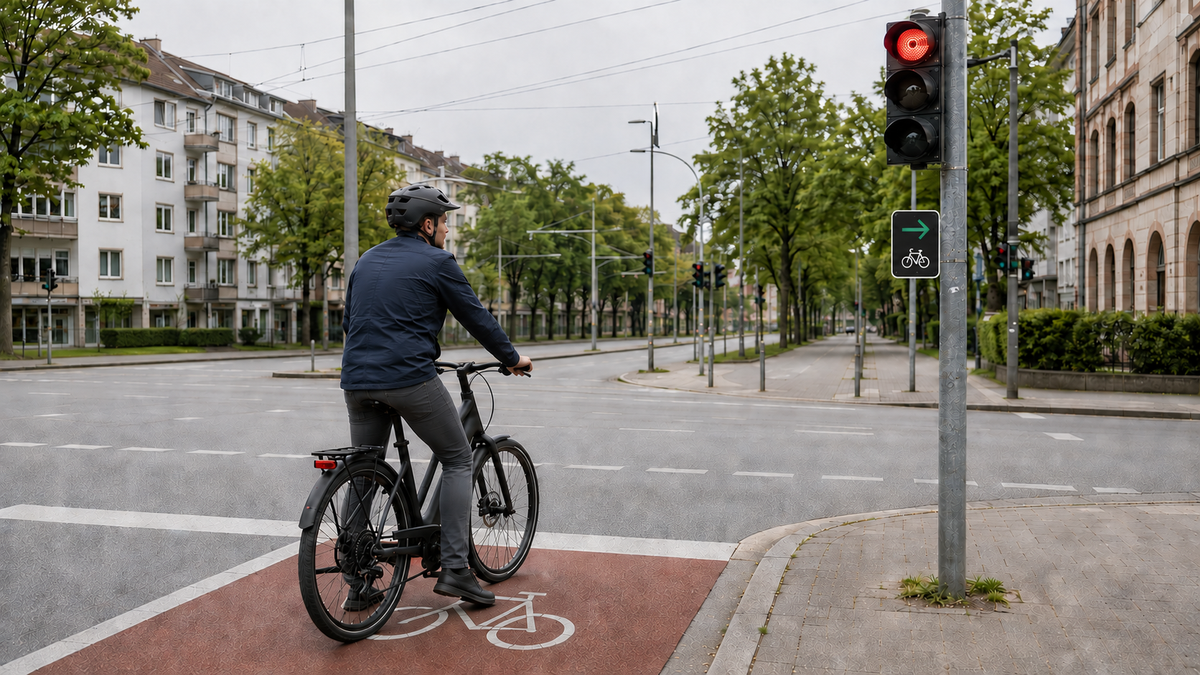
Green arrow for bicycles: Turn right safely and legally at a red light
Bike path in the wrong direction: Avoiding accident risks at intersections