

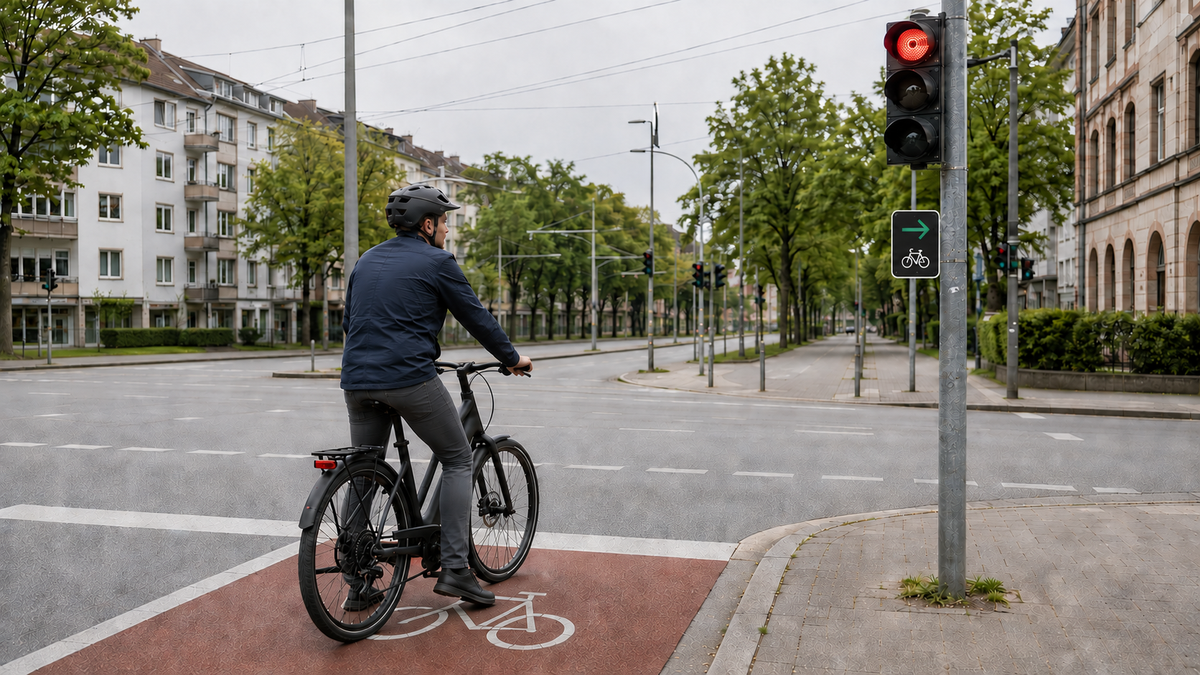
A bicycle green arrow permits turning right under certain conditions even when the traffic light is red. However, it is not a free pass: You must first come to a complete stop, observe the permitted traffic flows, and may proceed only if nobody is obstructed or endangered. If the appropriate sign is missing, the light remains red for right-turning cyclists too.
What does the green arrow mean for cyclists?
Traffic sign 721 limits the green-arrow rule to bicycle traffic. It is installed at a traffic light and applies only to turning right on red. Going straight or turning left remains prohibited. The permission applies only at the specific approach where the sign is installed; a similar sign on the opposite side or at another traffic light does not apply to your route.
Under Section 37 of the German Road Traffic Regulations (StVO), turning is permitted only after stopping. You must then rule out obstructing or endangering others. Particular attention must be paid to people crossing the road, as well as motor vehicles and bicycles traveling in the permitted direction. If in doubt, wait for green. That is permitted and is often the most sensible decision.
Distinguishing sign 721, the standard green arrow, and a green arrow signal
Three green arrows may look similar, but they serve different purposes. Sign 721 is a fixed sign for bicycle traffic. The standard green-arrow sign, sign 720, shows a green arrow on a black background without a bicycle restriction. A lit green arrow, by contrast, is a traffic-light signal: It permits traffic only in the direction of its arrow. A fixed sign does not light up and does not generally override the red light.
In practice, this means you should first check whether you see a permanently installed sign or a lit signal. Then look for the bicycle restriction and determine which traffic light applies to your route. A green arrow at another signal group is not permission to proceed. The official traffic-sign overview explicitly lists sign 721 as the “green-arrow sign restricted to bicycle traffic.”
Which traffic light applies to you?
In principle, cyclists follow the traffic signals for motor traffic. On a designated bicycle route, separate bicycle signals apply instead when provided. This means that at the same intersection, the road, cycle path, and sidewalk may each display different signals. Do not follow the signal that appears physically closest; follow the signal group assigned to your route.
Sign 721 is generally installed on the main signal head. If there is a separate bicycle signal, it should be installed there, provided this does not endanger pedestrian traffic. This requirement from the Administrative Regulations on the StVO helps with orientation but does not replace checking the markings and route layout on site. If the assignment is unclear, stop and wait for the regular green light.
How to turn right on red step by step
- Move into position early: Approach the traffic light on the right-hand route intended for you. Do not suddenly cross the sidewalk, hatched area, or another lane to reach the sign.
- Come to a complete stop: Stop at the stop line. If there is no stop line, stop before the protected intersection area without blocking anyone. Merely rolling slowly is not sufficient.
- Match the signal and sign: Check that the light is red and that sign 721 actually applies to your cycle path, cycle lane, or traffic lane.
- Check crossings: Look first for pedestrians and crossing bicycle traffic. Also expect bicycles coming from a permitted opposing direction.
- Observe motor traffic: Check vehicles coming from the permitted direction, as well as turning vehicles that may cross your path. Seek eye contact, but do not rely on it.
- Turn only when the route is clear: Proceed slowly and closely enough to maintain a controllable line. Do not cut across the pedestrian crossing or cycle path. If you force someone to brake or swerve, the gap was not clear.
Coming to a complete stop gives you time for a second look. In the BASt pilot study on green arrows for bicycle traffic, many cyclists turning right did not comply with the stopping requirement. This does not make a rolling start permissible. Especially when delivery vans, parked vehicles, poles, or waiting people obstruct the view, only stopping creates a reliable basis for deciding.

Who has priority when you use the green arrow?
The green arrow does not give you priority. Permitted crossing and parallel traffic may continue. This includes pedestrians on the crossing, cyclists on crossing cycle paths, and vehicles on the road you are turning into. Even someone who unexpectedly appears in violation of the rules should not become a collision partner. Therefore, ride in a way that allows you to remain ready to brake until the turn is complete.
Pay particular attention to traffic from both sides: A two-way cycle path may bring traffic from an unexpected direction. At the same time, vehicles behind you may start moving or other cyclists may squeeze past on the right. Keep your handlebars straight until the gap is clearly safe, and do not unnecessarily obstruct cyclists waiting to go straight. Do not overtake them via the sidewalk.
When it is better to wait for green
Using the green arrow is an option, not an obligation. Wait when visibility is obstructed, pedestrian traffic is heavy, the signals are unclear, lighting is poor, or the road surface is slippery. A long wheelbase, heavy luggage, a trailer, or a wide cargo bike may also lengthen the turning maneuver. You do not have to go just because someone behind you rings their bell.
At construction sites, yellow markings and temporary signals often change the route. What matters is the current arrangement, not your memory of the intersection. If a signal has failed, a sign has been turned, or visibility is permanently blocked, take a conservative approach and report the defect to the responsible local authority later. Do not improvise your own right-of-way rule.
Common mistakes at a bicycle green arrow
- rolling into the intersection without coming to a complete stop
- confusing sign 721 with a lit green arrow
- going straight on red because a green arrow is displayed somewhere
- applying a sign for the road to a separate cycle path
- looking only for cars and overlooking pedestrians or bicycle traffic
- overtaking waiting cyclists on the right via the sidewalk or crossing
- turning too quickly and swinging too far onto the new route
The current official fine schedule lists violations involving right turns on a green arrow separately. For failing to stop, it specifies a fine of 70 euros; causing an obstruction or endangerment may cost more. More important than the amount is the purpose of the rule: You are entering an area during a red phase that others are currently permitted to use.
Does the rule also apply to a pedelec or cargo bike?
Under Section 1(3) of the German Road Traffic Act (StVG), a standard pedelec with a maximum continuous rated power of 0.25 kW, whose pedal assistance decreases as speed increases and cuts out at 25 km/h at the latest, is subject to the rules for bicycles. Accordingly, sign 721 can generally also apply to this type of pedelec. A cargo bike or a bicycle with a trailer also generally belongs to bicycle traffic unless its legal classification is changed by a different design.
An S-pedelec, by contrast, does not fall under this bicycle definition. Therefore, do not use sign 721 solely because of the informal designation “e-bike.” The vehicle category is decisive. Regardless, the heavier or longer your combination, the more time and space you need. A narrow gap does not become safer through motor assistance.
A short routine for everyday riding
Remember the sequence Stop – Match – Check crossings – Turn. First, stop the bicycle. Then clarify whether the sign and signal apply to your route. Next, check pedestrian, bicycle, and motor traffic in all relevant directions. Only when the route remains clear should you turn right in a controlled manner. This routine also works at unfamiliar intersections and prevents habit from turning into an automatic rolling maneuver.
Conclusion
The bicycle green arrow shortens a red phase only when the specific situation is safe. Sign 721 permits cyclists to turn right only; it does not permit going straight or turning left. Coming to a complete stop, identifying the correct traffic light, and yielding to permitted traffic are non-negotiable. If visibility, space, or the signal is unclear, wait for green.
As of September 6, 2026. This article explains general traffic rules and does not replace an assessment of a specific intersection or vehicle category.

Share:
Broken bicycle spoke: Why the wheel should go to the workshop
Bike path in the wrong direction: Avoiding accident risks at intersections